
Objection Handling

How to Use AI to Write a Better Sales Intro
Most sales call introductions fail because they sound exactly like sales call introductions.
You know the one. “Hi, my name is Lauren and I’m calling from XYZ Company, we’re the leading provider of blah blah blah…” The prospect checked out three seconds in. They’re scanning emails, mentally planning dinner, and looking for the fastest way off the phone.
That’s not a conversation. That’s a pitch disguised as a greeting. And it’s killing your pipeline.
After 20+ years of training Fortune 500 sales teams, I can tell you this: the reps who book the most meetings aren’t the ones with the best pitch. They’re the ones who get the prospect talking before they even realize they’ve taken a sales call.
Here’s how to use AI to craft a sales intro that’ll engage your prospects and get them talking.
First, Let’s Reframe What Selling Actually Is
Nobody wants to feel “salesy.” That word makes people cringe because of the stereotype: pushy, aggressive, slimy. A HubSpot poll found that only 3% of people trust salespeople. (Still just above politicians, so there’s that.)
But here’s what most people forget. Buying is fun. Think about the last thing you bought that made you genuinely happy. If buying feels great, then helping people get there should feel great too.
Selling is connecting one on one with another human to help them accomplish their goals. That’s the real definition. When you reach out to a prospect who’s stuck between “maybe” and “do nothing,” you’re not being pushy. You’re helping them get past the analysis paralysis. You’re making it easier to solve their problem.
Less than 10% of buyers will close themselves without any human help. That’s a lot of money left on the table because nobody picked up the phone.
WATCH: AI Sales Intros That Capture Leads in 30 Seconds
Why Phone Prospecting Still Matters
I know. You’d rather just email or DM people on LinkedIn. It’s more comfortable. It feels less intrusive.
It’s also three times less effective.
The noise in inboxes is deafening. Even with AI-personalized outreach, written messages alone don’t cut it anymore. The most efficient sales prospecting strategy uses all channels: social, email, and phone. But if you want the biggest results, you have to call.
Here’s the math. If you carve out one hour a day to reach out to 20 leads by phone, you’ll talk to one or two of them. Do that five days a week and you’ll touch 100 leads, have 5 to 10 real conversations, and rack up more than 200 first-base conversations in a year.
How many do you have now?
Research from CEB shows that 53% of the time, buyers will choose the seller who was first to add value. Not just first to reach out. First to actually be useful. That’s the key. Being first without adding value doesn’t work. Volume plus value does.
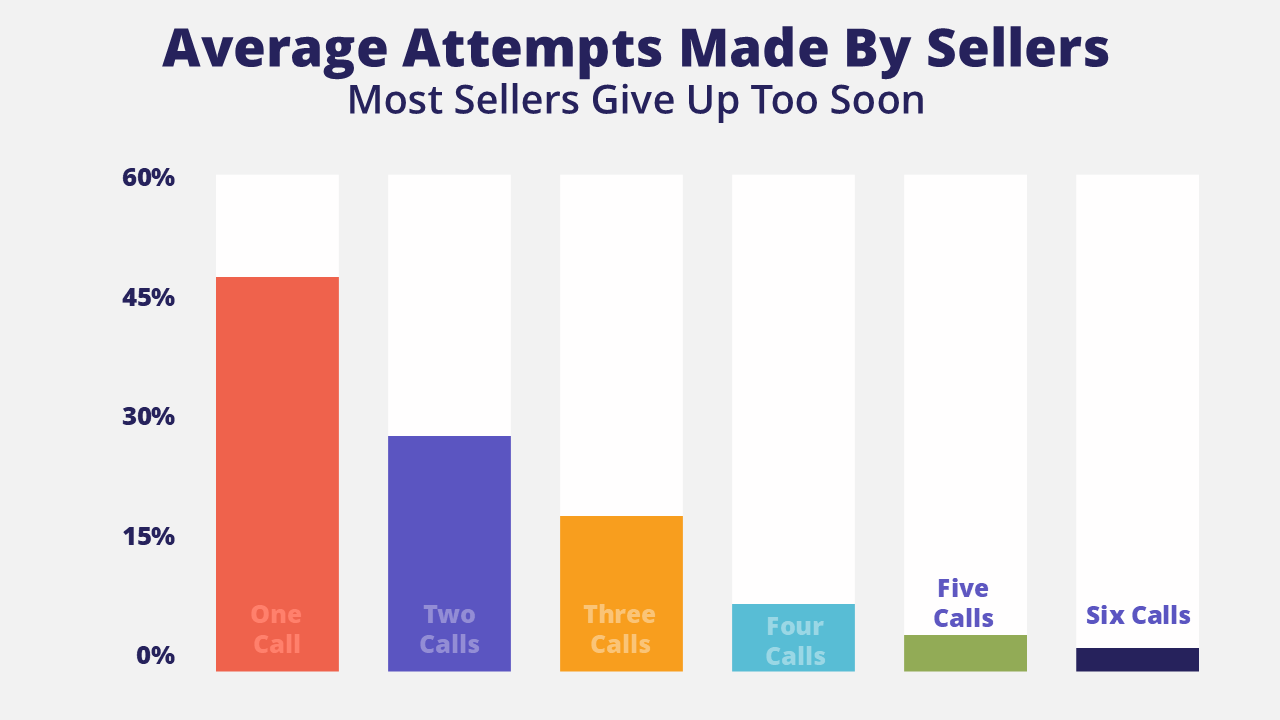
And here’s the thing most reps don’t realize: it takes 8 to 12 attempts to actually reach a decision maker. But nearly 50% of sellers give up after just one call. Less than 2% will make more than six. If you persist, you will be the first one to have a real conversation with that buyer. That’s a massive competitive advantage.
The Biggest Cold Call Introduction Mistakes Reps Make
Before we build a better intro, let’s talk about what’s broken. And let’s be clear: don’t be like every other rep who shows up and throws up. You know the ones.
Pickup and Pitch. “Hey, my name is Lauren and we’re the leading provider of this and that and I can da da da…” They just pitch. It’s pickup and pitch, and it gives sales a bad name. They didn’t pick up the phone to get pitched at. They picked up because they thought it was their kid’s school calling.
“Are you the person in charge of…?” I’ll lie to you to get out of having a sales call. This one screams sales call so loud that your prospect will say anything to end the conversation.
The Value Prop Intro. “Hi, this is Lauren. I’m calling with #GirlsClub, and we’re the premier community for women in revenue to get promoted faster.” Ugh. Shut up. I did not pick up the phone to hear your positioning statement. This is another very popular bad intro.
“Just calling to introduce myself.” Your mom might care. Nobody else does.
“Just calling to touch base.” Drum roll please. This is the most often used intro line in sales, and it’s horrible. Don’t touch my base. Don’t touch anything.
All of these fail for the same reason. They make the call about you. Your company. Your product. Your agenda. The prospect doesn’t care about any of that yet.
DOWNLOAD: 20 Value-Add Reasons to Call Your Customers
What a SWIIFT Sales Call Introduction Actually Is
SWIIFT stands for “So, What’s In It For Them”. It’s a call introduction framework designed to capture attention, get the prospect talking, and start a conversation before they realize they’ve taken a sales call.
A good SWIIFT intro does three things:
- It’s under 10 seconds
- It answers three questions: Who are you? What do you want? Why should I care?
- It ends with questions that get the decision maker talking fast
The goal of your introduction is not to pitch. It’s not to gain credibility. It’s not to check off items on your call sheet. The goal is to get them talking. Because the second they start answering questions, they stop doing email. They stop multitasking. Now you’re in a conversation, and you’re on first base.
Here’s the formula:
- Their name (loud enough to be a pattern interrupt)
- Your name and company (abbreviated, fast, they’ll ask again later)
- One SWIIFT ear perk (a single value that makes them look up)
- 1 to 3 closed SWIIFT questions (easy to answer, gets them talking)
That’s it. No pitch. No product description. No “let me tell you about our award-winning platform.” Just enough to start a conversation.
The 6 Value Levers That Perk Up Attention (Plus One Bonus)
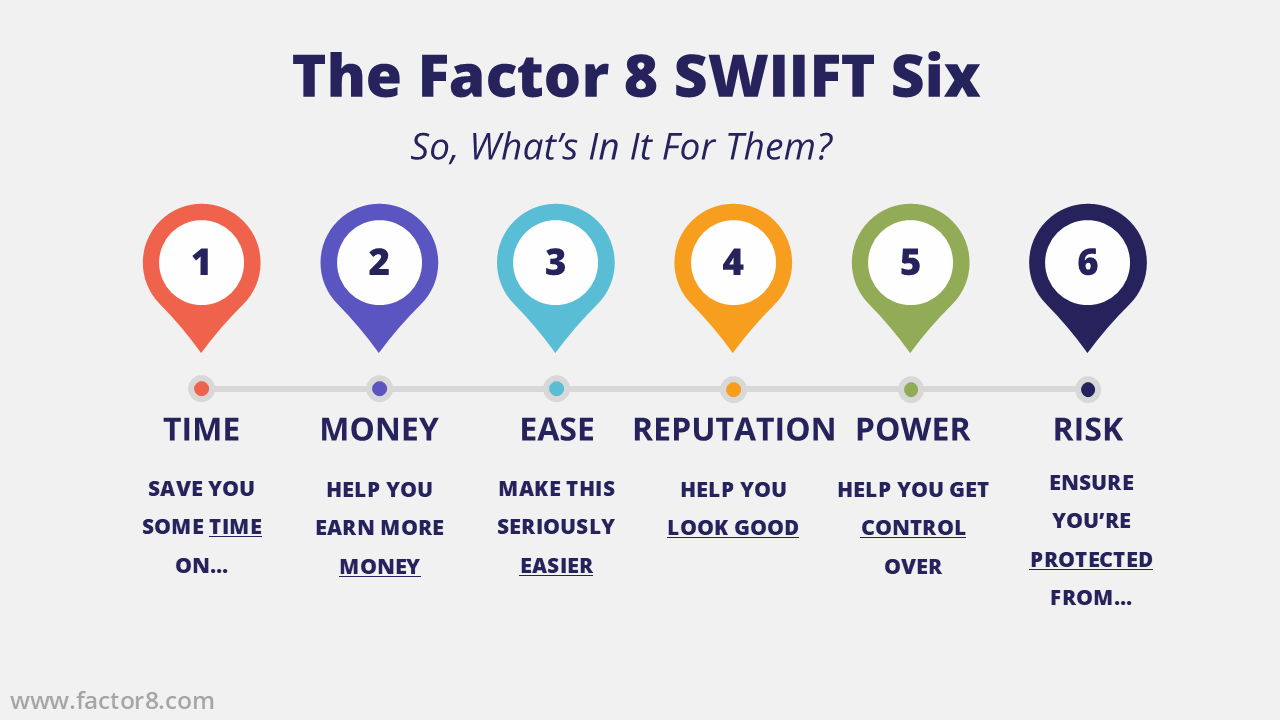
The ear perk is the secret sauce of the SWIIFT intro. It’s one short sentence that hits a value your prospect actually cares about. We call them the SWIIFT Six:
- Time – “I’m calling to save you some time on…” Everyone’s busy. Time savings always land.
- Money – “I’m calling to help you kick up the ROI on…” More revenue, less cost, better margins.
- Ease – “I’m calling to make this a lot easier for you.” This is the hot button for working parents and overwhelmed managers.
- Reputation – “I’m calling to make sure you’re the hero on this.” Looking good, being recognized, being the one who brought in the solution.
- Power – “I’m calling to help you get control over…” Control and influence motivate more people than you’d think.
- Risk – “I’m calling to pull all the risk out of…” Insurance, compliance, protection. If your product reduces exposure, lead with it.
And the bonus lever: a name. When someone hears “Mark in Legal asked me to give you a call,” they instantly give you credibility. Levers like referrals, mutual connections, or internal names are the most powerful ear perks you can use.
Pick one. Just one. Your instinct will be to cram your entire value prop into this sentence. Resist. When I teach this in workshops and ask people what they remember from each other’s intros, they always say the same thing: one word. “Risk.” “Easier.” “ROI.” That’s all they heard. Don’t overcomplicate it.
You can use AI to help pick the right lever. Ask ChatGPT or your AI tool of choice: “Which of these six business values would a VP of Sales care most about?” or “What does a working mom in operations value most?” Then build your ear perk around the answer.
Why Closed Questions Beat Open Questions at the Start of a Cold Call
Here’s where I’m going to go against what every sales training has ever taught you.
Most sales trainers say always ask open-ended questions. And in discovery calls, that’s great. But on a cold call introduction, open questions are a disaster.
Think about it. Your prospect wasn’t expecting your call. They’re busy. They accidentally picked up. And now a stranger is asking, “What’s keeping you up at night when it comes to hiring?” Their brain tries to process it, can’t come up with an answer fast enough, recognizes you’re a salesperson, and decides to get rid of you.
Instead, use closed questions. Yes or no. A number. One or two words.
There’s a scientific phenomenon called instinctive elaboration. When someone asks you a question, your brain stops what it’s doing and hunts for the answer whether you want it to or not. If I ask, “How old are you?” a number popped into your head just now. That means it’s halfway out of your mouth.
Closed questions exploit this. They’re fast, they’re easy, and they get the prospect talking before they’ve had time to put up a wall.
Compare these two:
Option A: “You’ve got over 50 sellers on your team these days, right?”
Option B: “How have you and your team managed to attack virtual onboarding ramp times given that they’re getting longer at most companies I work with now that work is remote?”
You stopped listening in the middle of B. So did your prospect. A is the winner, every time.
How to Tell If Your AI-Written Sales Intro Actually Works
Let’s put it all together. Here are two complete SWIIFT intros side by side. One works. One doesn’t. If you’re using AI to generate intros, this is how you evaluate what it gives you.
Option A: “LB here with Factor 8. I’m calling to see if I can help your team hit quota sooner. Are you primarily B2B there? Do you outbound or inbound? How many sellers under you?”
Option B: “LB here with Factor 8. We’re the leading provider of virtual sales skills for inside sales teams. We work with companies like yours to shorten new hire ramp. Is that interesting to you?”
A is the winner. Hands down.
A leads with one value (hitting quota sooner), then immediately gets the prospect talking with three fast, closed questions. B leads with a company pitch and ends with a question that’s basically asking the prospect to reject you.
“Is that interesting to you?” is an invitation to say no. “How many sellers under you?” is an invitation to have a conversation.
Now here’s what it looks like when you add a lever:
“Mark? LB here with Factor 8. Your VP of Sales asked me to give you a call and I promised him I would. Have you worked with David for a while now? Are you running inside sales or field sales for him? How many reps on your team?”
That’s three easy questions. By the time they answer the second one, you’re in a conversation and they’ve forgotten they accidentally picked up a sales call. That’s first base.
How to Use AI to Draft Sales Intros Without Sounding Like a Bot
AI is a fantastic tool for generating SWIIFT intros. But it’s a starting point, not the finish line.
Here’s how to use it well. Feed your AI tool these inputs:
- Who you’re selling to (title, industry, persona)
- What your product does in one sentence
- Which of the SWIIFT Six values resonates most with your buyer
- Your name and company name (abbreviated)
Then ask it to generate a SWIIFT intro under 10 seconds with one value-based ear perk and two to three closed questions.
DOWNLOAD: The SWIIFT℠ Intro AI Prompt
What you’ll get back will be close. But you’ll need to do two things: cut it shorter (AI loves to be wordy) and make it sound like you. Read it out loud. If it sounds like a brochure, rewrite it. If it sounds like something you’d say to a friend’s colleague at a barbecue, you’re golden.
The best reps use AI to generate five or six variations, pick the best one, and then practice it until it feels natural. That’s the move.
Grade Your Intro Before You Dial
Before you pick up the phone, run your SWIIFT intro through this checklist:
- Is it under 10 seconds?
- Does it answer who you are, what you want, and why they should care?
- Does it use a single value (not three stacked together)?
- Does it end with 1 to 3 closed, easy-to-answer questions?
- Would it perk your ear if you heard it?
- Would you actually answer those questions?
If you can check every box, you’re ready. If not, shorten it, sharpen the value, and simplify the questions.
Get the Conversation, Not the Pitch
You can’t close more deals until you talk to more people. You can’t talk to more people if your intro sounds like every other sales call they’ve gotten this week.
Stop leading with your company name, your product features, or your credentials. Start leading with what’s in it for them. Be SWIIFT. Keep it under 10 seconds. Get them talking. And remember: the goal of the intro isn’t to sell anything. It’s to start a conversation.
Because nobody ever bought anything during a sales call introduction. But plenty of deals started with one.
Subscribe to our email list to receive new content, webinar invites, and training offers.


Best AI Tools, Tips, And Prompts For Sales Prospecting
If your reps are still using AI like it’s 2023 (or not using it at all), they’re already behind. In our Sales Shot, I sat down with four sales pros and AI enthusiasts whose teams are actually using AI for sales prospecting, not just talking about it. We’re talking AI-enhanced targeting and prospect research, coaching bots, live conversation sentiment tracking, even inbound AI voice agents that are outperforming humans (yes, really – so, will AI take over sales jobs? That’s a topic for another blog!)
Here’s what went down, and the best AI tools, tips, and prompts you’ll want to steal.
Smarter Targeting and Prospect Research
We kicked off with a game-changer: using AI to make sure you’re calling the right people. David Kreiger, SalesRoads, shared how his team uses Clay to qualify leads before reps ever pick up the phone. It pulls company data and uses AI to tell you if a prospect actually fits your ICP, saves hours of manual research, and gets your team focused on the right accounts.
John Buckley (from Sell Better’s Daily Sales Show) showed us Agent.ai, a no-code agent that scores a company for outbound fit with a single URL. He’s trained it on his ICP so it gives a quick thumbs-up or “hard pass.” No prompt writing needed.
Jax Gill (from Inspira Financial) took it even further. She trains ChatGPT to review a company’s website and her prospect’s LinkedIn profile, then find common ground to help her build rapport fast. She even gives it a list of her solutions and asks for possible pain points to reference in the convo. It’s like AI-powered pre-call prep, minus the rabbit holes.
Prompt ideas to steal:
- “Here’s my ICP. Here’s this company’s website. Is this a fit or not? Why?”
- “Compare my LinkedIn profile to [prospect’s name]’s. What do we have in common?”
- “Given this company and our services, what pain points can I lead with?”
Better AI Sales Prospecting Emails and Messaging
Let’s talk outbound emails. Doug Gibb’s team at Waste Management uses Conquer with GenAI email, which drafts emails based on past conversations and makes sure they don’t miss a promised follow-up. It pulls call and email history straight into Salesforce, so everything’s in one place.
David dropped this gem: if you write more than three emails a week, build a custom GPT. He’s trained his to match his tone and voice. Upload 50 of your best emails, and now your GPT can write in your style. It’s faster, but more importantly, it’s better.
WATCH: How to Build a Custom ChatGPT (shared by David)
James added Oliv to the mix. This tool sends him a cheat sheet before every call with company background, team bios, and even icebreakers. “Ask Chloe about her transition from radio hosting to content marketing” is way better than “Hope you’re well.”
One big reminder from everyone: AI-generated emails shouldn’t sound AI-generated. If your message is filled with fluff, jargon, or emojis in every line, it’s going straight to trash. Your prospects can smell it. Use AI to help, but still bring your brain.
Prompt ideas to steal:
- “Use my tone. Write a prospecting email for this company using the info from our last call.”
- “Summarize this LinkedIn profile in one sentence I can use as a cold email opener.”
- “Rewrite this message to sound more human, less like it came from a bot.”
Coaching, Confidence, and Call Reviews
AI isn’t just helping reps do the work. It’s helping them get better at it. David recommends using AI to coach yourself after calls. His reps drop their call transcripts into ChatGPT and ask for feedback. What could I have done better? What questions did I miss? It gives them a score and action steps to improve.
Jax uses AI before the call. She practices objections with ChatGPT in persona-mode. “Be a tough IT Director. Push back on cost.” It gives her reps a safe space to screw up and get better.
Doug’s team uses Conquer to transcribe and summarize every call. It flags sentiment dips, highlights next steps, and scores reps on their delivery. That all feeds into Ambition, where managers get a full coaching report before every one-on-one. And yes, even new managers can coach like pros because the system shows them exactly what to focus on.
We also shouted out Grw AI, a tool for roleplay call coaching. Reps can practice calls and get feedback based on real frameworks. It’s like flight simulator training for sellers.
I also shared how much I love using Fathom for call notes. I just click a button and boom, it gives me a clean sales summary with top pain points, current situation, and next steps. It’s fast, easy, and way more useful than generic transcripts. Use it for internal calls too to help you take notes and create to-dos.
Prompt ideas to steal:
- “You’re a skeptical IT Director. Let’s roleplay a cold call. Push back on price and security.”
- “Here’s my call transcript. What could I have done better? Give me a grade.”
- “Give me 3 coaching questions to reflect on after this call.”
Real-Time Insights and In-the-Moment Support
Sales moves fast. Reps don’t have time to dig through notes or scroll LinkedIn for the latest news. That’s where real-time insights come in.
James’s tip: Use LinkedIn Sales Navigator alerts. Ring the bell on your top prospects and accounts. You’ll get notified when they change jobs, get promoted, or post. Instant reason to reach out. That’s prospecting fuel your team is probably ignoring.
Doug’s team uses Ambition’s pre-read feature to prep for coaching. It pulls 90 days of call scores, KPIs, pipeline data, and even sentiment analysis so managers walk into meetings ready. Their AI-based pipeline insights show if deals are stuck, what changed, and where to focus.
David shared Trellus, a power dialer that lets reps pause mid-call to get AI-powered coaching suggestions. It’s like having a manager in your ear without the pressure.
Prompt ideas to steal:
- “Give me coaching advice based on this sales call recording.”
- “Summarize this opportunity pipeline for my one-on-one. What’s stuck and why?”
- “If my rep is below target on discovery, what should I review with them this week?”
AI for Inbound, Enablement, and Emotional Intelligence
You didn’t think AI was just for outbound, did you? David’s team is using Sela for inbound calls, and it’s outperforming human reps in tier-one qualification. The AI calls the lead, asks 2–3 qualifying questions, and routes the hot ones straight to an SDR. It’s efficient, repeatable, and for simple calls, often better than a live person.
James brought up Sybill, which reads facial expressions and body language during video calls. It sends post-call insights like, “Your buyer leaned back and widened their eyes when you said pricing.” That’s gold for follow-up and helps reps refine their messaging and emotional timing.
And of course, Doug’s team uses Microsoft Copilot, a company-approved, closed AI system integrated into their workflows. Their AI governance committee ensures compliance, which matters when your team is 50,000 strong.
Bonus tip from Jax: Use ChatGPT as your personal hype woman. “Give me a pre-call pep talk.” Or ask it to roast you. Either way, you’re showing up more confident.
Prompt ideas to steal:
- “Pretend you’re my mentor. Give me a 30-second pep talk before this big sales call.”
- “Roast me. What could I do better in my outbound pitch?”
- “Act like a buyer. Ask me 3 tough qualifying questions based on this service.”
READ: Confessions from a Late-Adopter: The Truth About AI for Revenue and Enablement Leaders
This session wasn’t fluff. These are real leaders, using real tools, getting real results. If your team is still scared of AI or waiting for some “perfect system,” you’re already behind.
The final takeaway?
“Use the time AI saves you to do the task better. Not faster. Better.”
– David Kreiger
TL;DR – Here are the best AI sales tools and how our panelists are using them:
- Agent.ai – James built an agent that scores companies instantly based on ICP fit, eliminating the need for prompt engineering
- Ambition – Doug uses it to prep managers for coaching with pre-read insights that include sentiment, pipeline data, and call scores
- ChatGPT – Jax shared how her team uses ChatGPT to simulate prospect objections and refine messaging before high-stakes calls; it’s like having a role-play coach on standby
- Clay – David uses Clay to pre-qualify leads and filter out non-ICP accounts, saving reps hours of manual research
- Conquer – Doug’s team uses it to auto-draft follow-ups based on call history and transcribe every conversation for coaching
- Fathom – We use Fathom here at Factor 8 to summarize sales calls and uncover real buyer pain points. Tip: Use it for both internal and external meetings to quickly extract key details, create to-do lists, and skip manual note-taking
- Grw AI – Lauren and Jax called it a flight simulator for sales; perfect for reps to practice and build confidence before high-stakes calls
- Microsoft Copilot – James noted that Copilot helps his team save time by summarizing long email threads and prepping for meetings straight from Outlook and Teams
- Oliv – James loves Oliv for the call prep emails, especially the personalized icebreakers like asking about career transitions
- Sybill – Doug mentioned using Sybill to flag buyer reactions mid-call, helping reps spot hesitation or interest and follow up more strategically
- Sela – David says Sela outperforms humans for tier-1 inbound lead qualification and is being used successfully in production
- Trellus – David mentioned reps can pause a call and get live coaching advice based on the persona or objection they’re handling
Subscribe to our email list to receive new content, webinar invites, and training offers.

How to Overcome Brush-Offs (and Get Prospects Talking)
Let’s face it, every seller has been brushed off (and probably quite often).
“I’m not interested.”
“We’re all set.”
“I don’t have time right now.”
Sound familiar? If you’re making outbound sales calls, cold or warm, you’ve heard these before. But here’s the good news: Brush-offs are not objections. And when you know how to handle them, you can double your talk time, increase your conversion rates, and book more meetings.
I’ve broken down my 6 tips and tactics to help you beat the brush-off and turn dismissals into meaningful conversations. Let’s dive in!
Brush-Offs Are NOT Objections
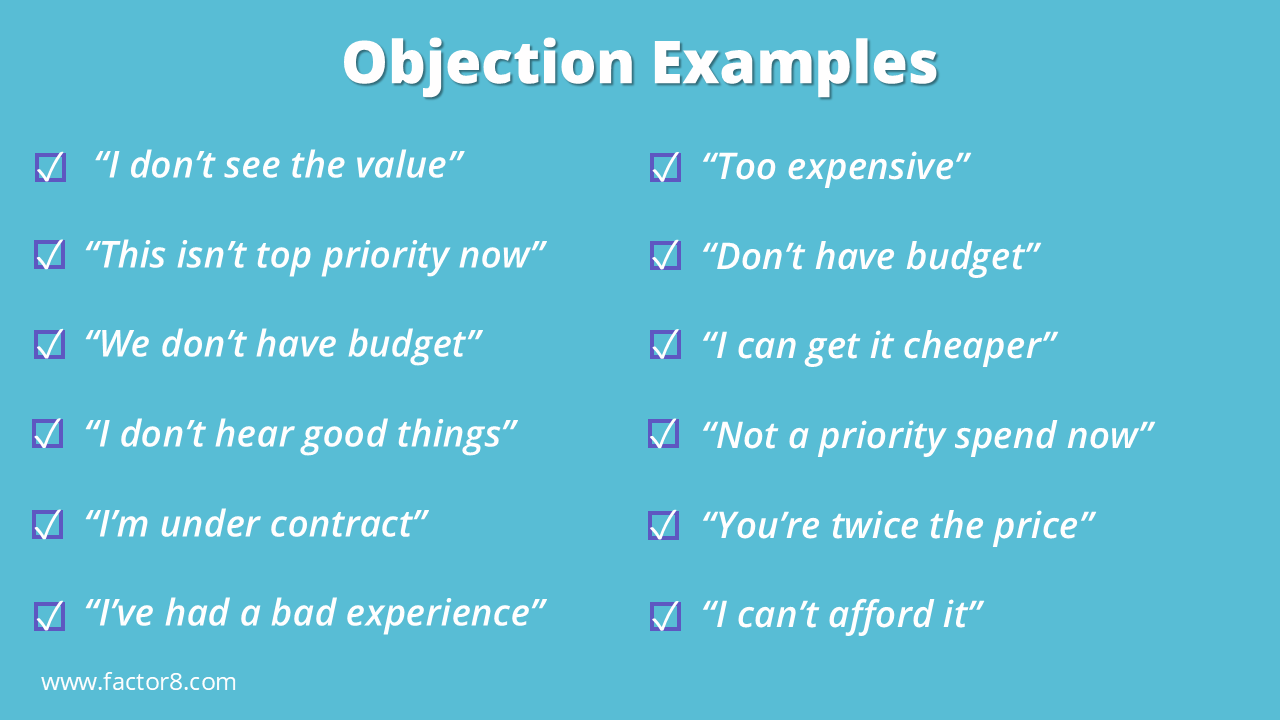
Objections happen late in the sales cycle after you’ve made your pitch and the buyer has concerns, usually about price, timing, or fit. Brush-offs? They happen early, and they’re not objections at all.
Think of a brush-off like an automatic reflex. It’s the prospect’s way of saying, “I don’t have time for a sales pitch right now.” That’s all it is. And it doesn’t mean they aren’t a good fit or won’t buy from you later. It just means they don’t know you… yet.
So, what’s your job? Keep the conversation going, show them you’re different, and provide value ASAP.
READ: How to Keep Prospects on the Phone
Brush-Offs Are Uninformed (That’s Good News!)
Prospects brush you off because they don’t know who you are or what you’re selling. That’s great news! It means they haven’t actually rejected you, they just haven’t heard your value yet.
This is why you should never “kill” a lead based on a brush-off. Too many sellers give up too quickly, assuming the lead is a dead end. In reality, the prospect just isn’t paying attention.
Here’s why you shouldn’t take brush-offs personally:
- They’re often automatic responses, not actual decisions
- The prospect is likely multitasking or distracted
- They don’t remember you yet (if you call back, you get another chance)
Your instinct might be to respond to the brush-off directly (“Oh, but we can save you 20%!”). DON’T DO THAT. That just gets you lumped in with every other pushy salesperson. Instead, sidestep it. Keep the conversation going by staying confident and trying again.
- If it’s a high-value lead, try them at least 10 times before moving on. They won’t even remember they brushed you off the first time.
- Call back quickly. If someone brushes you off today, try them again tomorrow. They probably won’t remember the first attempt, and this time, they may actually listen.
- Don’t answer the brush-off directly. Beat it instead. Instead of reacting to “I’m not interested,” keep control of the conversation and guide it where you want it to go.
By understanding that brush-offs are uninformed and automatic, you can push past them and start real conversations.
The REAL “Objection” Behind the Brush-Off
When someone brushes you off, what are they really saying?
- I’m busy.
- I don’t like sales calls.
- I don’t know who you are yet.
- I assume you’re like every other seller who’s going to pitch me something useless.
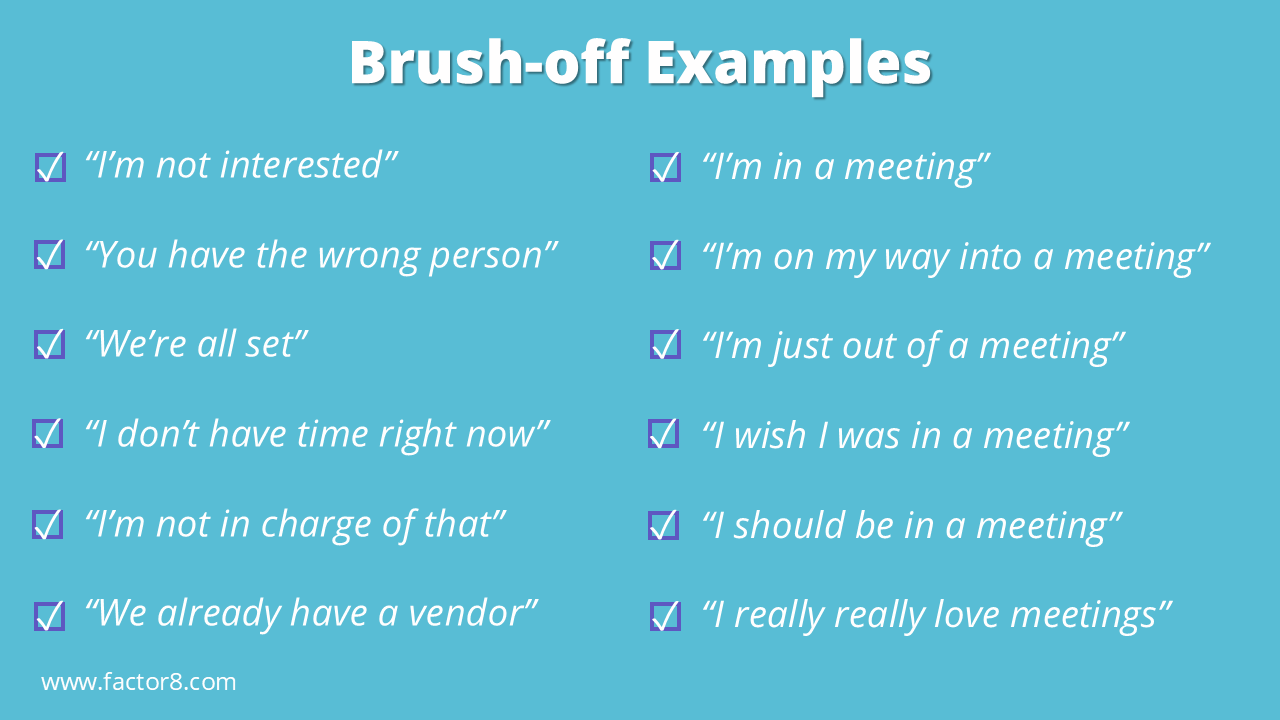
The key to overcoming a brush-off is understanding what’s underneath it. Most brush-offs aren’t real objections, they’re reactions to an interruption. Your prospect isn’t rejecting your solution; they’re rejecting the idea of being sold to in that moment. Your job is to shift their perception of you.
Here’s how to uncover the real meaning behind their response:
- Listen for patterns. Is their response rushed? Dismissive? A sign they don’t trust salespeople? Recognizing their tone helps you respond appropriately.
- Acknowledge and reframe. Instead of pushing back, show you understand: “I hear you. Sounds like you’ve got a lot going on right now.” This lowers their defenses.
- Use curiosity to break through. Ask a question that shifts their attention, like: “Would you say Q4 is your busiest quarter?” or “Out of curiosity, is this something you handle directly, or does someone else manage it?” When they engage, they’re opening the door for a real conversation.
The goal isn’t to argue with their brush-off, it’s to help them rethink it.
WATCH: How To Overcome Brush-Offs On Sales Calls
Get Them Talking (It’s Like Buying a Drink!)
If you’ve ever bought someone a drink at a bar, you know the goal isn’t to “close the deal” in 30 seconds. It’s to start a conversation. The same applies here.
When a prospect gives you a brush-off, they aren’t thinking deeply about your offer, they’re reacting instinctively. Your job is to interrupt that instinctive response and guide them into an actual conversation.
The best way to do that? Use the CCO Framework (Closed, Closed, Open) to break through their initial resistance. Start with simple, closed questions to get them talking, like “Is this a crazy time of year for you?” or “Would you say Q4 is typically your busiest quarter?” Once they’re engaged, move to an open question that invites more thought, like “Is this for a short sales cycle, or do deals take months to close?” By following this structure, you can take control of the conversation and steer it toward a meaningful discussion.
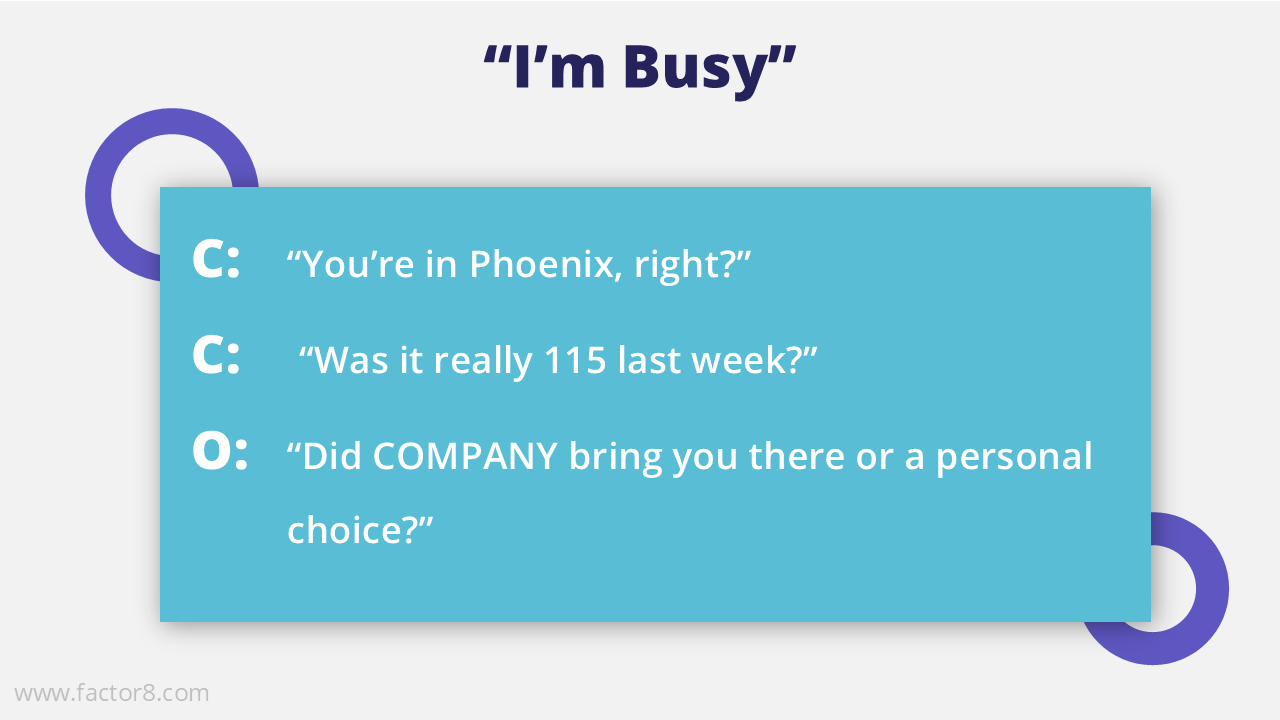
As a reminder, a brush-off is different from an objection. An objection is a real, considered response to your pitch, something they’ve thought about and have a concern over, like pricing, timing, or relevance. A brush-off, on the other hand, is a knee-jerk reaction designed to end the conversation before it even starts. Your job isn’t to overcome an objection here, it’s to keep them talking long enough to break their automatic dismissal.
DOWNLOAD: 4-Step Process to Overcome Objections
Shaking up the conversation with a pattern interrupt gets them to stop and engage. Small talk about something unexpected (like their location, the weather, or a recent event) can lower their defenses and make them more receptive. People also love talking about themselves, so guiding them toward a topic related to their role or priorities can naturally steer the conversation toward business without feeling forced.
Breaking Through Brush-Offs
Once you start recognizing brush-offs for what they really are—automatic, uninformed reactions—you’ll realize they’re not personal and they’re not final. The key to overcoming them is choosing the right approach. You can take the direct path by breaking the ice with the CCO Framework (Closed, Closed, Open), easing your way into the conversation until the prospect naturally engages. Or you can sidestep the brush-off completely by shifting the conversation to something unexpected, like their location, the weather, or a relatable topic, disrupting their auto-response and creating an opening for dialogue.
Either way, the goal is to bypass their defenses and turn a brush-off into a real sales conversation. Try it out, test both methods, and see what works best.
Subscribe to our email list to receive new content, webinar invites, and training offers.
Quick Tips on Overcoming Sales Objections
If you’re a BDR or SDR, you’ve probably heard your fair share of sales objections. And chances are, you’re likely NOT a big fan of them. I’m here to change your mind. Why?
I LOVE objections.
They’re proof a prospect is actually listening, and at some level, they’re even considering buying. I see objections as a challenge to understand prospects better and to showcase the SWIIFT℠ value of my product.
Ready to love objections? Let’s get started.
First, let’s understand the difference between a brush-off and a sales objection. If you’re hearing things like “I can’t talk right now” or “I’m not interested,” what the person on the other end of the phone is really saying is “I’d rather be doing anything than be sold to right now.” In these cases, you are experiencing a brush-off. These are typically heard at the beginning of the call and have almost nothing to do with your product or solution. Brush-offs require their own set of solutions, we’ll get to those in another article.
On the other hand, an objection sounds like “we don’t have a budget for XYZ” or “it’s too expensive” or “this isn’t our top priority.” Prospects with true objections are informed. They know who you are and what you are selling. Their objection is directly related to what you have presented to them (i.e. “We don’t have room in our 2022 budget for XYZ right now”).
Now that we understand the type of push-back that we’re solving for, let’s talk about overcoming objections in sales. Think about sales objections in terms of dating. You’ve poured your heart (your “pitch”) out to this potential customer and they’re quickly trying to show you the door. It’s only natural for us to take it personally. But let’s think about it this way, would you rather hear why a prospect is rejecting you, or be ghosted and left wondering why you weren’t a great fit? If you’re anything like me, you need to know “why?!”
So, let’s go over the 4 easy steps to sales objection handling so you can find both a solution and the answer to that “why?!”
SPOILER ALERT: Most sales reps only follow one step and the majority are unsuccessful! The most important thing to successfully handle an objection is to complete ALL 4 steps!
#1 Acknowledge
When you first hear an objection, you and your prospect are like two people on opposing sides of the table. You need to move to the same side in order to work together. Start by listening closely to what your prospect is saying to help identify the truth behind the objection and to LOWER defensiveness. Be sure to use your active listening skills here, folks. Nodding your head saying “mmhmm” or “I get that” are all useful cues to let them know you hear them. Go a step further by rephrasing their objection to show that you were truly listening to their thoughts.
Skipping this first step will leave you sounding defensive to someone whose guard is already up. That is not a recipe for success. So, let’s listen and acknowledge before moving to step 2.
#2 Ask Questions
The end goal of this step is to truly understand the prospect’s objection. Often, the initial objection is superficial. So, let’s use questions to isolate and clarify before we attempt to handle it. Taking a breath and approaching the questions with a calm tone can really help as well. Below are a few examples of defensive questions vs. calm, open-ended questions.
“What do you mean by that?” vs. “Sure, I get it, tell me more?”
“How could you say we’re too expensive?” vs. “I totally understand. Can you explain more about the cost?”
“You honestly think you don’t need this?” vs. “I hear you. So, what’s your solution to this problem?”
The most important part about this step is asking questions until you fully understand what the roadblock is.
#3 Overcome!
This is the step that most salespeople jump to. Reminder: If you skip steps 1 and 2, you are very likely not getting to the root of their objection and are coming off as defensive. This will lead to an aggravated prospect who will likely hang up on you.
Now let’s talk about addressing the true objection and providing a solution. After years of handling objections, we have found three tactics that show proven results!
- Value:
- Find the SWIIFT℠ value that the client’s objection embodies and use it to explain how your solution will overcome the objection at hand. (New here? Don’t know about the SWIIFT℠ values, yet? Check out the details HERE)
- Money Example: “You know, if we implement this right now, our solution will help save about five times this investment! And that’s just in the first year. Our projections estimate at least $50k in savings right off the bat! I know it’s scary, but the savings are worth it!”
- Find the SWIIFT℠ value that the client’s objection embodies and use it to explain how your solution will overcome the objection at hand. (New here? Don’t know about the SWIIFT℠ values, yet? Check out the details HERE)
- Felt/Found:
- This tactic explains the cause and effect of your solution in the context of a previous client or clients.
- Example: “I get it. Honestly? At least half of my current customers have FELT this way. It’s scary to invest upfront. But, what each of them has FOUND is that the cost savings more than make up for it – and does so quickly!”
- This tactic explains the cause and effect of your solution in the context of a previous client or clients.
- Story:
- This is similar to the Felt/Found tactic but goes into more detail. It’s important to remember that this can be a true story that happened to you or one of your co-workers, it could be a story pulled from a research report (with the names and details adjusted to your specific company), or it could be a story based in truth, with a few exaggerations.
- Example: “I get it. It’s a totally normal reaction. You know from the beginning, you’ve reminded me of Bob from Spokane. He was shopping for the same solution – although he picked the XYZ model. He hesitated to pull the trigger too, and he has already recouped 75% of his original investment. That was literally just last month!”
- When you’re sharing a story with a prospect, remember that good stories have these components:
- Time
- Place
- Main Character
- Challenge
- Goal
- Series of Events (aka Plot)
- Outcome
- Details (1-2 fun embellishments or random details)
- This is similar to the Felt/Found tactic but goes into more detail. It’s important to remember that this can be a true story that happened to you or one of your co-workers, it could be a story pulled from a research report (with the names and details adjusted to your specific company), or it could be a story based in truth, with a few exaggerations.
- Insider Tip: facts are 20 TIMES more likely to be remembered when they are part of a story! Stories release dopamine to the brain. Which, in turn, causes a deeper sense of emotional engagement with what is said. The brain automatically goes into curiosity and receptive mode (instead of defensive mode). Cool, right!? So, get your clients to drop their guard a bit with a good story!
DOWNLOAD: 4-Step Process To Overcome Objections
#4 Check-In & Close
In this step, you’ve got to confirm that you’ve answered your prospect’s questions and concerns. After confirming, we push the deal forward to either the next steps or to a close. Only about 10% of customers will close themselves. This means 90% of deals will stall out if you skip this step! Check out the image below to see 5 different types of closes. Which one feels the most comfortable for you?
BONUS! Here are a few additional tips to use after you’ve mastered the 4 steps above:
- Always run through the proposal live with your client. If you are only emailing a quote you will lose a larger percentage of business.
- If you are getting pricing objections from a lot of clients, you are probably selling on features only. You’ve got to include those SWIIFT℠ values!
- If you don’t know which questions to ask, then remove the objection. Example: “Suppose you didn’t have ______? How would the situation be different?”
- If you don’t know what to ask, then ask “why”? Example: “I’m sorry to hear you feel that way. I would like to understand your concern. May I ask why you say that?”
If you master the 4 steps above, you’ll find those sales objections turning into deals in no time!
Subscribe to our email list to receive new content, webinar invites, and training offers.
How to Overcome Brush-offs on Sales Calls [Webinar Recording]
How to Overcome Brush-offs on Sales Calls
[Video Recording]
How to Show Value FASTER with SWIIFT℠ [Webinar Recording]
How to Show Value FASTER with SWIIFT℠
[“Sales Shot” Workshop]
Mastering the Transition from Field to Virtual Selling [“Sales Shot” Workshop]
Mastering the Transition from Field to Virtual Selling
[“Sales Shot” Workshop]
Win Sooner. Earn Faster. Stay Longer. [Live Event Recording]
Win Sooner. Earn Faster. Stay Longer.
[Live Event Recording]