Time Management
How Sales & Enablement Leaders Are (and are NOT) Using AI to Work Smarter, Not Harder [Webinar]
How Sales & Enablement Leaders Are (and are NOT) Using AI to Work Smarter, Not Harder
[Video Recording]
Meet the Speakers
Lauren Bailey
Founder
Factor 8 & #GirlsClub
Lauren Bailey, known to many as “LB”, is a sales leader, enablement leader, and entrepreneur and founder of 3 successful brands: Factor 8, providing front-line job training for inside sellers and managers, The Sales Bar, a subscription-based virtual sales training platform, and #GirlsClub, a community and development program helping more women earn leadership positions in sales.
Rose Paik leads Global Sales Development Enablement at Docusign, where she’s transforming how teams learn and perform through innovative AI solutions. Rose focused on AI-enabled adaptive learning while earning her Master of Science at Johns Hopkins School of Education. She’s passionate about using AI to unlock human potential and make enablement more impactful, not just more efficient. When she’s not building the future of sales enablement, you’ll find her experimenting with new AI tools and sharing practical insights with the enablement community.
Helen Fanucci
Sales Performance Expert,
Speaker, Author
Helen Fanucci is an accomplished sales performance expert, team builder, business leader, venture investor, and trusted advisor to technology growth companies, with a track record of leading high-performing sales teams at IBM, Apple, Sun Microsystems, and Microsoft. Helen currently leads a private sales performance practice focused on empowering sales leaders and their teams to deliver predictable growth. Helen is the author of the best-selling book, Love Your Team, A Survival Guide for Sales Managers in a Hybrid World.
Helen serves on the Board of Directors of Legacy Executive Club, a membership organization focused on uplifting careers and enriching lives, as well serving on the Board of Directors at the 5th Avenue Theatre, Seattle’s leading musical theater.
Dr. Richard Conde
Assistant Professor
University of Houston-Downtown
Richard Conde is an Assistant Professor at the University of Houston-Downtown, responsible for teaching sales MBA seminars, as well as digital and international marketing courses. As the lone full-time academic inside sales researcher, Richard is recognized as an expert in inside sales performance, leadership, and operations. His research has been published in the European Journal of Marketing, the Journal of Business and Industrial Marketing, the Journal of Marketing Theory and Practice, the Journal of Marketing Intelligence & Planning, and the International Journal of Higher Education.
Before transitioning to academia and consulting, Richard led mid- to large-scale inside sales operations, managing up to 400 inside sales agents and leaders. During his tenure as a sales executive, Richard was recognized for managing a $400 million book of business and increasing sales revenue from approximately $65 million to over $100 million in three years, while employing fewer inside sales agents. He also improved employee satisfaction from 3.6 to 4.6, based on the Gallup Survey.
Casey Calkins
Founder, Executive Coach
C2it Partners
Casey Calkins is the founder of C2it Partners, an executive and sales leadership coaching firm that helps new and emerging sales leaders build high-performing teams — without burning anyone out in the process.
A SaaS sales leader with 15+ years of experience at companies like Salesforce, Casey led high-performing teams through mergers, acquisitions, and leadership transitions, while also serving as a culture builder for a rapidly growing new office location. She launched ERGs, developed enablement frameworks based on emerging team trends, and turned top-performing teams into talent pipelines — with an average of 40% of her reps promoted annually into senior AE and leadership roles.
Today, as a Professional Certified Coach (PCC, ICF) and Certified Executive Coach (CEC), Casey helps leaders apply practical frameworks, emotional intelligence, and systems thinking to drive results, motivate teams, and lead with confidence. She is passionate about making AI accessible for busy leaders, showing them how to use it as a tool to work smarter — not harder — in coaching, planning, and communication.
4 Sales Manager Types Explained: Strengths, Skill Gaps, and Growth Tips
Most sales managers never got formal training. They were great reps, promoted for crushing quota, and then… handed a team.
Sound familiar?
Managing people requires a whole new set of skills. And when you’re juggling forecasts, pipeline reviews, and never-ending fire drills all before lunch, it’s easy to default to what you think good management looks like.
That’s why I created the Sales Manager Quiz. It’ll help you identify your natural leadership style and see what’s working and where you can level up.
In this deep dive, we’re breaking down the four manager types (Powerhouse, Cheerleader, Quarterback, and BFF) and…
- What each type nails
- Where they struggle
- And exactly how to level up
This isn’t a personality quiz just for fun (though it is fun). It’s a growth tool to help you lead more effectively, feel more in control, and build the kind of team that actually hits their number.

The Powerhouse Manager
You’re the engine of the team. Powerhouses get stuff done, no excuses, no delays, no loose ends. Your standards are sky-high, your work ethic is unmatched, and your team probably describes you as intense, but fair. You’re the person people trust when they need results fast.
But here’s the tradeoff: That pressure you thrive under? It can overwhelm your team. When everything is urgent and nothing falls through the cracks, reps can struggle to keep up or feel like they’re always letting you down. You may find yourself stepping in to fix things, juggling too much, or skipping coaching because it feels slower than just doing it yourself. Sound familiar?
If you’re a Powerhouse, your next level of leadership isn’t about doing more, it’s about doing less and leading smarter.
Traits:
High achiever, results driver, flawless executer, pressure lover, chronic improver, priority juggler
Strengths:
- Creates a high-performance culture
- Work gets done on time (and done right)
- Team focuses on the right things
- Solves problems quickly
- Leads by example
- Pushes team to deliver results
Areas for Growth:
- Risks burnout — both for self and team
- Micromanages instead of developing independence
- Prioritizes task reviews over real coaching
- May miss signs of team fatigue or lack of collaboration
How to Level Up:
- Block time for dedicated skill coaching
- Use a standard coaching form: 3 wins + 1 area to improve
- Set one clear priority at a time
- Assign ownership to reps (even if you’d do it faster)
- Add team-led training sessions to build collaboration
Resources:
- Download: The Eisenhower Matrix – Use this worksheet to prioritize what actually moves the needle and stop wasting time on low-impact tasks that drain your day.
- Course to Take: Own Your Day – The go-to course for managing priorities, time, and team expectations without burning out.
The Cheerleader Manager
You’re the hype squad, heart, and hope of your team. Cheerleaders are natural motivators who lead with positivity, praise, and a deep belief in their people. Your reps feel seen, supported, and genuinely like coming to work. You’re the one reminding them they’ve got this, because they usually do.
But high morale doesn’t always equal high performance. If you’re not careful, you might avoid giving hard feedback, hesitate to push underperformers, or focus so much on celebrating strengths that you miss the growing skill gaps.
Being a Cheerleader means balancing the pep with a plan. Confidence is the fuel, but your reps still need a clear destination and a map to get there.
Traits:
Confidence builder, esteem booster, strength finder, encourager, positivity spreader, inspirer of self-directed improvement
Strengths:
- Builds confident, high-performing teams
- Creates a safe, engaging team culture
- Reinforces wins to accelerate growth
- Boosts rep loyalty and retention
Areas for Growth:
- Hesitant to give tough feedback
- May avoid holding reps accountable
- Over-focuses on strengths, under-focuses on gaps
- Team may not be improving skills or results
- Lacks systems to track progress
- Risks getting blindsided on forecasts
How to Level Up:
- Set clear, measurable skill and results goals
- Use a balanced meeting framework (coaching + accountability)
- Start peer mentoring to scale support
- Schedule recurring team trainings to improve skills (not just confidence)
Resources:
- Download: The COACHN Model – Use this framework to run more effective 1:1s, coaching sessions, and performance conversations that actually drive action.
- Course to Take: Having Difficult Conversations – helps managers deliver honest feedback with empathy and clarity.
The Quarterback Manager
You’ve been in the trenches. You’ve carried the bag. You know exactly what it takes to win a deal, because you’ve done it a hundred times. As a Quarterback, your team relies on you for play-by-play guidance, deal-saving advice, and that one perfect story that closes the deal. You’re sharp, strategic, and always ready to jump in and move things forward.
But here’s the catch: if you’re always calling the plays, your reps never learn to run them. That creates a team of highs and lows, some stars, some stragglers, and a lot of dependence. You may find yourself rescuing deals instead of coaching skills, or relying more on stories than questions.
To level up, it’s time to trade the helmet for the headset. Coach the rep, not the deal.
Traits:
Leader of deals, experienced pro, knows how to win, storyteller, answer man, saver of deals
Strengths:
- Deep sales expertise and sharp instincts
- Knows how to map the path to success
- Offers tactical, deal-specific advice
- Leads confidently from experience
- Earns quick trust from the team
Areas for Growth:
- Inconsistent team performance (highs and lows)
- Focuses too much on deals, not enough on rep development
- Struggles to let reps fail and learn
- Doesn’t block enough time for skill coaching
- Leans on telling stories instead of asking questions
- May unintentionally build a team of “mini-me” clones
How to Level Up:
- Run win-loss sessions (game tape style) to break down deals
- Take a manager coaching course to shift focus to skill-building
- Share personal failures to normalize mistakes
- Establish a regular cadence of 1:1s, team meetings, and reviews
- Appoint peer experts to foster independence and collaboration
Resources:
- Download: Tasks to Start vs. Stop Doing – Use this guide to shift out of “super rep” mode by focusing on high-impact leadership tasks and leaving the old rep responsibilities behind.
- Course to Take: The COACHN℠ Model – helps you coach reps more consistently and shift from fixer to developer.
The BFF Manager
You’re the safe space. The one your reps vent to. You know their pets’ names, their partner’s promotion status, and who’s on the verge of burnout (because they told you, not their therapist). As a BFF manager, your superpower is trust. Your team feels supported, understood, and motivated—and in today’s world, that’s no small thing.
But emotional intelligence isn’t a substitute for leadership. When you’re too close to your team, it gets harder to hold the line. Performance conversations get postponed. Boundaries blur. And the reps you care most about? They may end up stuck, because no one’s pushing them to grow.
Being a great manager isn’t about being liked. It’s about being respected and effective. You already have the heart. Now it’s time to build the structure.
Traits:
Empathetic, emotionally attuned, deeply connected, personal motivator, team nurturer
Strengths:
- Builds strong morale through personal connection
- Creates psychological safety and trust
- Reads emotional cues and team dynamics well
- Motivates with recognition and empathy
- Fosters collaboration and peer support
Areas for Growth:
- Too patient with underperformance
- Avoids hard conversations to preserve relationships
- Lacks clear performance metrics and expectations
- Risks playing favorites
- Inconsistent accountability
- Needs a more structured roadmap for team development
How to Level Up:
- Implement a standard meeting framework with clear expectations
- Get comfortable setting (and sticking to) deadlines
- Schedule recurring performance reviews with every team member
- Set (and keep) professional boundaries (save the lunch dates for Fridays)
Resources:
- Download: Coaching Frequency Guide – Use this to categorize your reps by skill vs. will, so you know who needs your time, who’s coasting, and where to focus your coaching energy.
- Course to Take: Driving Performance With Goals – gives you tools to set clear expectations and build accountability without sacrificing team trust.
Knowing your type is step one. The real magic happens when you use that insight to grow.
The best sales managers aren’t stuck in one style, they flex. They coach intentionally, delegate purposefully, and lead with both heart and structure. Whether you’re a Powerhouse learning to let go, a Cheerleader learning to lean in, a Quarterback trading the playbook for coaching time, or a BFF building boundaries, there’s always a next level.
Better managers build better teams. Let’s get to work! Take the quiz here.
Subscribe to our email list to receive new content, webinar invites, and training offers.
What Type of Sales Manager Are You? (& How to Make It Your Superpower) [Webinar Recording]
What Type of Sales Manager Are You? (& How to Make It Your Superpower)
[Video Recording]
Your Sales Manager Survival Kit [Cheat Sheets]
Your Sales Manager Survival Kit
[Free Resources & Cheat Sheets]
Build Your Sales Manager Cadence (& Save Time and Stress)
Sales Management is the busiest, most overwhelming job in the world (right?!) And that was before most of us went remote.
It’s no wonder so many new managers hit a wall and ask themselves, “Did I make a mistake getting into management?” Trust me, you’re not alone.
But it doesn’t have to be this hard. One of the biggest game-changers for managers is building a cadence, or a system, for how and when you engage your team. Like sellers need a sales process, managers need a management process. This is how you take back control of your day, stop fighting fires, and get back to why you took this job in the first place: to develop and lead people.
Here are 5 things to help you take back control of your day (and learn to love being in management!) Let’s dig in.

No More Whack-A-Mole
If your day feels like playing whack-a-mole with Slack pings, rep questions, and customer escalations, you’re not alone. These are what I call “jello days”, days that feel messy, unstructured, and impossible to control.
Picture trying to nail jello to a wall. That’s how sales managers often describe their days. No matter how hard you try to stick to your plan, something always slips, shifts, or melts away. It’s reactive chaos. You’re busy all day, but not moving anything forward. You’re putting out fires, answering questions, jumping into calls, but not doing the proactive work that actually drives results.
It’s exhausting. And it’s not why you got into leadership.
Most of us became managers because we love seeing others win. But when you’re stuck in jello days, that purpose gets buried under a pile of “got a sec?” interruptions and endless meetings.
So what’s the fix? A structured cadence. Organizing your week around proactive touchpoints like coaching, huddles, and strategy sessions helps you take back your time and lead with intention.
Here’s the difference between reactive and proactive tasks:
Reactive:
- Reading your email
- Tending to the line at your desk
- Helping reps with questions and issues
- Creating reports for the boss
Proactive:
- Calling a morning huddle
- Planning the team meeting
- Pulling a rep into a strategy meeting
- Coaching!
Want your life back? Prioritize the proactive.
READ: How to Run Successful Sales Rep 1:1 Meetings
Plan Ahead
I literally pull out a Post-it each day and write down the one thing I must do. I don’t leave until that’s done. It’s simple but powerful.
The magic formula:
- Identify your top priorities
- Build them into your calendar
- Do your one thing first before opening your inbox
This discipline is what separates high-performing managers from the rest. The best don’t just exceed team goals. They get more of their team to quota, reduce attrition, and consistently coach. That doesn’t happen by accident.
READ: The Best Sales Coaching Questions Ever
Create a Cadence
Let’s break the myth. You don’t need to cover everything in one meeting. It doesn’t work. Instead, you need a sales manager cadence, a system of regular, focused meetings that make everything more efficient and effective.
Here’s the cadence I teach:
- 1:1 Meetings (Monthly) – Focus on performance. What happened last month? What’s the plan this month? How are we tracking? Then shift gears. This is also your chance to connect and coach.
- Call Coaching (2x/month) – Small groups (no more than 3). This is real coaching. Feedback on call execution, not just listening together.
- Sales Huddles (2x/week) – Stand-ups with energy. Talk goals, wins, contests, and questions. Keep it short.
- Pipeline Meetings (2x/month) – Stop doing these 1:1. Make them group sessions. It builds accountability and saves you hours.
- Sales Strategy Sessions (Ad hoc) – When someone’s behind, this is your chance to step in and help with deal, territory, or lead strategy.
- Team Meetings (1x/month) – Focus on culture, recognition, and updates. Make them worth showing up for.
- Quarterly Career Reviews (1x/quarter) – Go deep on development. Celebrate progress, talk about career goals, and lay the foundation for retention.

Calendar It or Forget It
Now, make it real. Start with a blank calendar and schedule your cadence:
- Block quarterly reviews
- Add monthly 1:1s and team meetings
- Layer in weekly huddles and coaching
- Leave half your day open for the inevitable reactive stuff
Don’t over-schedule. Try to keep your total meetings under four hours a day. The other half of your day will get eaten by the unexpected, so plan for it.
Once it’s on your calendar, protect it. This is your new system. If you move meetings around, your team will too. When your reps know when they’ll get your attention, the “drive-bys” stop, and they’ll start saving their questions for the right time.
Send out the invites. Include prep expectations and agendas so everyone shows up ready. And if they don’t? Don’t let it slide. Your calendar only works if your team respects it — and they’ll follow your lead.
DOWNLOAD: Successful Sales Manager Meetings
They Aren’t All Fires
You don’t have to answer every rep question in the moment. In fact, doing that all day is exactly what’s keeping you in firefighting mode. Start redirecting those interruptions into your existing cadence.
Try phrases like:
“I did hear your call. Nice job. Let’s break it down during coaching.”
“Can we talk about that in tomorrow’s huddle?”
“I’d love to help, but I only have three minutes right now. Can you bring this to our 1:1?”
Reps will always take the path of least resistance. If you make yourself available 24/7, they’ll keep coming. But if you push conversations into the right meetings, they’ll start to respect your time—and even come more prepared.
Lauren calls this “guarding your time.” The requests won’t stop, so you have to stop them.
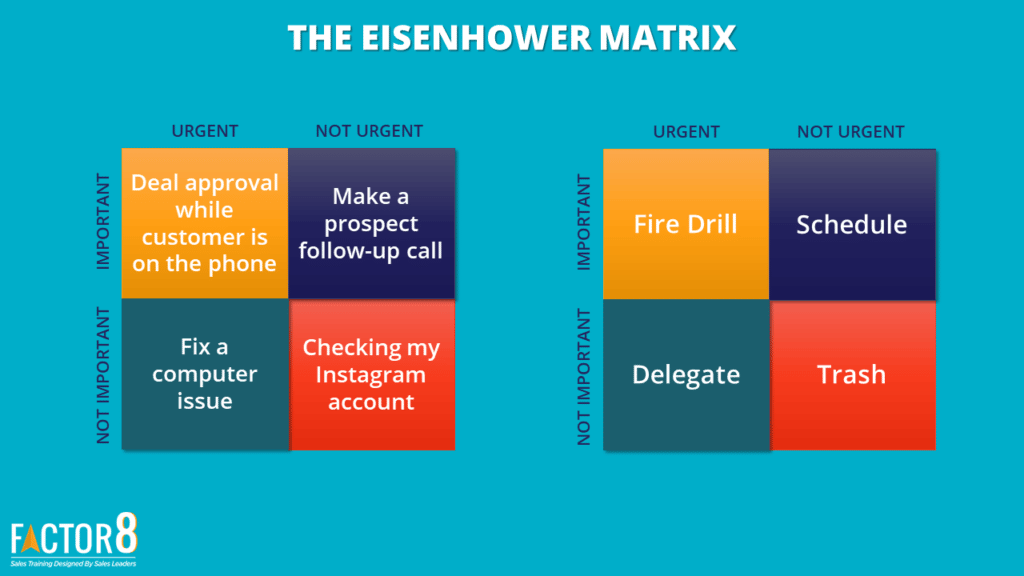
This is where the Eisenhower Matrix comes in. It helps you quickly sort out what’s:
- Urgent and important (you handle it)
- Important but not urgent (you schedule it)
- Urgent but not important (you delegate it)
- Neither (you trash it)
Urgent usually means there’s a time-sensitive deadline. Important means it impacts results or revenue. Just because something feels urgent to someone else doesn’t mean it is.
Building the muscle to decide what gets your time is one of the most critical skills a manager can learn.
Building your sales manager cadence will give you back your day and maybe even your life. It creates structure, accountability, and clarity for your team. And it lets you do the thing you wanted to do when you took this job: lead.
Try the cadence. Try it for one month. I’ve gotten hugs around the world for this structure, and I hope it helps you too.
And if you’re not sure where to start? We’ve got cheat sheets, templates, and a full class in The Sales Bar to help you Own Your Day and run every meeting like a pro.
Subscribe to our email list to receive new content, webinar invites, and training offers.
How To Build A Sales Manager Cadence (And Save Your Own Life) [Webinar Recording]
How To Build A Sales Manager Cadence (And Save Your Own Life)
[Video Recording]
Sales Manager Fears, Fails, and Fixes: Fast Actions to Prevent Burnout & Failure! [Webinar Recording]
Sales Manager Fears, Fails, and Fixes: Fast Actions to Prevent Burnout & Failure!
[Video Recording]
4 Time-Saving Tips for Sales Managers
I’m writing this blog at 9 am tucked into bed with the flu. I started to write it at 7:15 am, but decided on OJ and an episode of American Housewife instead.
In the 45 minutes I procrastinated, I received 74 emails. WHAT?!
Please be clear that I counted the new emails, scanned briefly, and then shut Outlook. Why? Because if I didn’t this article wouldn’t get written this morning – probably not even by end of day. And because if someone really needed me there are at least 3 faster ways they can get a hold of me.
Email is the new snail mail. It’s where un-urgent requests, FYIs, and sales pitches belong, and if you aren’t treating it that way you and your organization could be wasting precious time. Yes, you get enough emails to keep you busy 4-6 hours/day, and if you ignore them all the time they will pile up (you make good points my dear sweet email lover). Alternatively, answering other people’s requests is probably not the most important part of your job, is it?
Our completely normal instinct to deal with something simple that’s in our line of sight is prioritizing other people’s to-do lists over our own.

Here are a few best practices and time-saving tips to take back your day:
- Get rid of email alerts. Immediately. If we can agree that email is NOT where urgent items live (read: it has an imminent deadline), then quit interrupting your current screen with them. Every time the pop-up happens, a part of your brain goes down the rabbit hole until it finally just can’t resist a quick alt-tab to email to take care of it. It only takes a minute, right? Sure! Until you see the next one and the next one…it’s like trying to eat just one handful of popcorn at the movies. Impossible. If we could resist we wouldn’t be in our inbox right now. Kill the alerts. Be present in your current task instead.
- Designate a time for email. There, that may feel better to my GMail addicted friends. 🙂 I do email once a day at the end of the day. True, my assistant cleans it out for me in the morning, so I’m cheating just a little bit. Carve out two hours/day, put it on your calendar, and be strong. It only hurts for a couple of days. You’re not ignoring. You’re prioritizing. You were hired to coach, strategize, lead…not to type.
- Set communication expectations with your team. Have a conversation about what you consider urgent and important tasks and requests. Agree on what task/topic requires an instant message, text, phone, call, drop by, or email. Help team members know when you want to be CC’ed and when you don’t (there’s 50 less per day for you) and help them understand that if they email, they can expect a reply in 2-3 business days. If you choose to reprimand them for “bumping their email to the top” and sending you emails about their emails, that one is up to you. It may also be a great time to let them know when you’ll be doing meetings, coaching, and other activities that may not be interrupted with a minor customer issue or system question.
- Assess in a week. Getting more done? Finding times where you wonder what you should be doing? Getting more rep coaching done? These are good signs. If you find you’ve chewed off your nails and you’re staying at work late to do all the email, your addiction is more serious and I’m sorry for recommending this cold turkey. Try some of these gentler adjustments instead:
- Start the day by cleaning out emails – just book your first meeting within an hour so it doesn’t go long
- Try an email cleaner like Unroll.me that will aggregate your junk mail
- Consider delegating – if you’re on email alerts, groups, etc. for leads or training, perhaps someone on your team could monitor these and bring hot topics to a team meeting
- Eat lunch at your desk once or twice a week and take the extra hour to respond during that time
- Find one email/day your can unsubscribe or junk

I cordially invite you to try several of these time-saving tips and join me in the sweet, sweet freedom of being released from email jail. Looking for more ways to get sales management tasks done in less time? This was one of over twenty hacks in our top-rated sales manager course “Own Your Day”, which is now available on-demand at The Sales Bar.
Subscribe to our email list to receive new content, webinar invites, and training offers.
#1 Best Time Management Tip for Sales Managers
I’ve got a quick time management tip for all of you super-busy frontline sales managers.
At 23, in my first sales management job, I was buried by everything my team needed and all the things I didn’t know how to help with. Sound familiar?
Here’s the best time management tip that you can learn that we teach in our quick and easy time management course for sales managers (it’s called Own Your Day)
It’s all about getting out of the reactive mode and into the proactive mode.
READ: 4 Time-Saving Tips for Sales Managers
And here is the most fun and hardest part of what we’re teaching.
You’ve got to learn to say NO. Why?
Because that team of 8 to 15, new, experienced reps that you’re there to lead, serve, motivate, and nurture, will suck you dry.
I’m telling you, it will happen.

Because we’re all in the business of making money and doing it as fast and as easy as possible.
That makes you the go-to for all their questions.
And my goodness, they’re going to keep asking until you teach them to fish, which takes longer.
So it is a vicious, vicious cycle.
READ: Top 8 Sales Management Productivity Hacks
One of the most important skills that we teach new managers (who literally hug me afterward) is what to focus on first, second, third, and fourth, what to get rid of, what to delegate, what to do immediately, what to schedule for later, etc.
But here’s the crux of the skill: it’s saying NO to the rep request that’s coming at you right now.
You know the ones—people telling you about the call they just had, the deal they closed, or asking a product question. And all of that hits you before 9 am.

But here’s how to say no without being a jerk:
Scheduled meetings. When you build a sales management cadence, you’re not saying no, you’re saying, “This is so important, let’s talk about it in our scheduled call coaching,” or, “Bring that story to the huddle.” That way, you’re acknowledging their need but pushing it into the cadence.
This is probably the #1 best time management skill you’ll learn to take back your day and stop working before it’s dark (winter excluded 😉). You’re welcome.
Don’t have a cadence yet? Or a way to manage the requests? We’ve got you covered. Join our Sales Management Certification.