
Closing


Top Sales Closing Techniques
So you put in the hard work, you hooked your prospect, you got to the decision-maker, and you’re at the finish line – it’s now time to close the sale.
Time to celebrate? Not quite yet…
A shocking 64% of reps don’t actually end up closing the deal. (and unsurprisingly enough, only 10% of customers will close themselves).
So, why aren’t most reps closing? Hint: there are 5 main reasons.
Keep reading to learn our top sales closing techniques. Buckle in, folks!
You Feel Too Pushy & Lack Confidence
I get it – you don’t want to come off as the “used car” sales rep and hound someone to get your deal finalized. Or maybe you’re just nervous and don’t have the full confidence to take that last step.
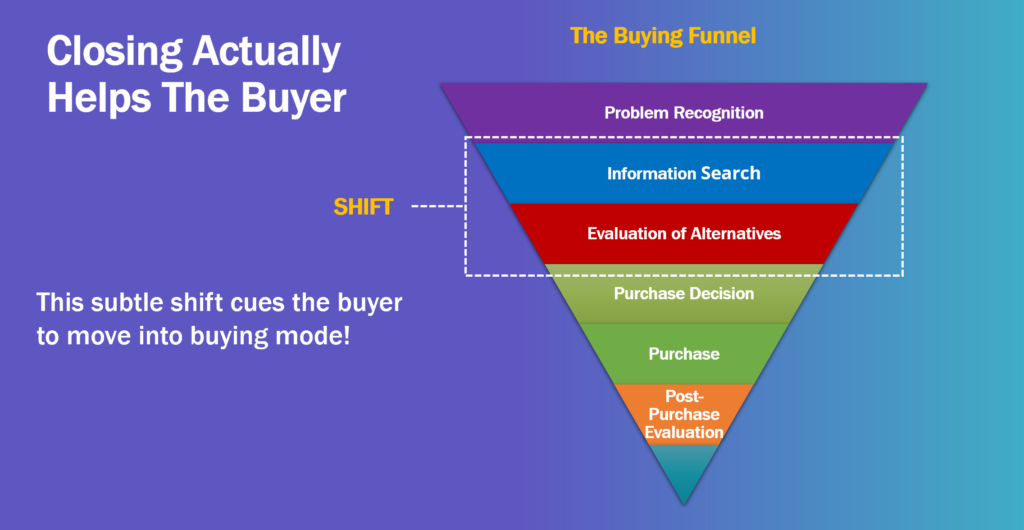
Let me help you out here – take a look at the graphic below of the buying funnel. Most prospects are stuck up in the top half – they’re in research mode!
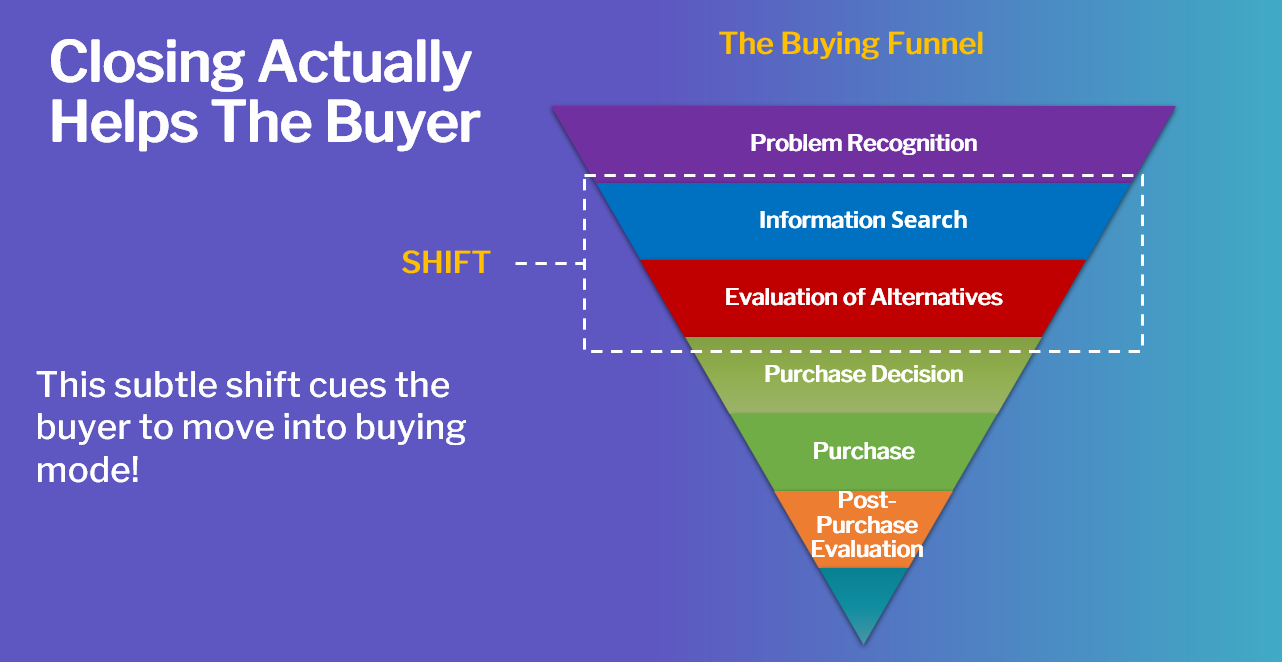
When you lack the confidence to ask for the close, you’re letting them stay in an endless loop of research and evaluation without clear next steps. The reality is you should be offering clear steps on the VERY FIRST CALL to lead them into the evaluation phase.
Think about it like this: when you go to buy coffee in the morning or stop to pick up lunch, do you walk up and order? Or do you wait for someone to ask you what you want? You probably stared at the menu figuring out what to get and then someone asked if they could take your order, right? They prompted you out of your research and evaluation mode into the bottom half of the funnel!
Helping lead them into those next phases is the core of being a sales rep! It’s not pushy, and not doing it shows a lack of confidence. This is where you decide if you are a true salesperson or not.
Remember: Closing. Helps. The Buyer.
You Don’t Know How To Ask
If you’re worried it sounds too good to be true – it’s not! You can literally just ASK them questions to inch closer to the close. Okay, so the reality is that a lot of those go-to closes rely on cheesy or crappy tactics. Here are a couple good questions and statements for closing sales to steal:
- Ask a Question: Did we solve the problem? Did we meet your needs? Ready to move onto the next step?
- Make an Assumption: We’ll get this nailed down and start next week. When do you want to take delivery? (You’re acting like you’re already involved in the next step!)
- Which pitch: Which solution is a better fit right now? Which option is a better match for budget? Do you like option A or option B?
- Timeline: You mentioned wanting XYZ in place by next month – working backward we’ll need to ink the contract by next week.
- Add-On: If we can get this wrapped up by the end of the month, we can throw in an extra license and a live training.
DOWNLOAD: How to Transition to Close
You Need More Customer Info
Don’t make the super embarrassing mistake of lacking customer insight and information by the time you get all the way to closing!
CSO Insights estimates that 26% of deals are actually LOST because sellers weren’t fully aligned to a buyer’s needs before closing. Save yourself the time and hassle by making sure you know these before you get to close:
- What is the agreed customer goal or pain?
- What is the “why” behind the buy/value to them?
- What’s their budget & timeline?
- What does their buying process look like?
- What is their current state vs. desired state?
- Are there other options/competition?
- Any personal motivation here?
(Hint, if you need help coming up with a pitch that aligns with their value – check out SWIIFT℠!)
READ: SWIIFT℠ Selling Methodology
You’re Out of the Closing Habit
Closing is a muscle just like anything else – if you aren’t exercising it, you’re not going to know what to do with it when the time comes to use it!
You can close every single call you have with something we like to call closing for commitment.
Think about football for a second. You’ve got your first downs to lock it in – and instead of having to go all the way back, you get to start on THAT yard line. Now when you apply to this sales – even if it’s something small you’re getting a customer to make a commitment to you. That means next time you’re starting from THAT point! You’re taking up mindshare with them.
Here’s an example:
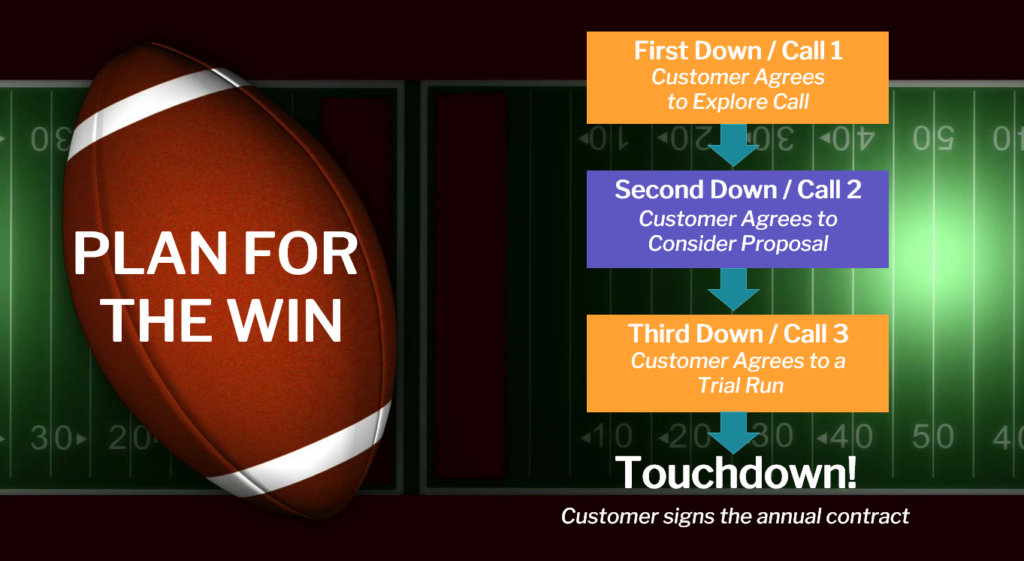
You’ll never have to ask yourself if it’s closed because you will know and you will OWN exactly what you need to do.
Always plan for the win!
READ: Increase Close Rates Fast With This Technique
You Don’t Know When to Close
Can you guess the most critical stage when it comes to closing?
Gong did a study on this, and believe it or not – the qualification stage is MOST important. Close rates decline by 71% when the next steps are not covered on that first call. Plus – deals that closed the fastest spent 1.53 times MORE talking about those next steps compared to other deals.
If you have a well-defined sales process, you’re 33% more likely to close your deals (TAS Group). And if you don’t know how to gauge when that is or how it plays out – do a trial close! Try something different!
Sometimes you have to abandon your sales script, and that’s okay.
Read: Quickly Transition to Close on Sales Calls
The more confident you get with closing, I promise the easier this gets. So don’t be afraid to get out there, practice, and remember that there’s a closing strategy for each and every one of those fears you might have. You got this – now go get those deals!
Subscribe to our email list to receive new content, webinar invites, and training offers.
4 Easy Tips (& Scripts to Steal) to Close More Deals [Webinar Recording]
4 Easy Tips (& Scripts to Steal) to Close More Deals
[Video Recording]
How to Stop Prospect Ghosting and Move Stalled Deals
In today’s world, it’s (unfortunately) become the norm for deals to stall out—even when everything felt great on the call.
You’re not imagining it, prospect ghosting has increased and sales cycles are longer (it’s brutal). But that doesn’t mean you’re helpless. By making some tweaks and improvements to your approach and outreach, you can get deals moving again.
READ: Top Sales Closing Techniques
Whether it’s ensuring you’ve locked in next steps, gotten a commitment from your prospect, or revived stalled conversations, these tactics will help you avoid deals slipping through your fingers.
1. Close Every Call
If you’re not securing the next step before you hang up, you’re missing out. Deals don’t move themselves, you have to drive them forward. That’s why it’s crucial to close every call. The best way to do this is by using the 4 Cs of closing:
- Check-in: Ask your prospect, “Did we hit all your top questions today?” This ensures they feel heard and reassures them that you’re paying attention.
- Commitment: Make sure everyone knows what’s expected before the next call. Are you sending them more info? Are they bringing pricing from a competitor? Clarify all deliverables to ensure everyone’s prepared. It sounds like, “Will you send over the pricing you received from the competition next week after your meeting?”
- Call bridge: Here’s where the magic happens. Lock in the next step on the spot. Don’t settle for a vague promise of a follow-up. Instead, say, “How does Tuesday at 10 AM look for us to review the proposal?” Pull up your calendars and nail it down before you hang up. No next meeting means no progress. Important: Don’t wait to do this 2 minutes before the call ends! Give yourself time to schedule the next call (so they’re not eagerly rushing to their next meeting).
- Close: Finish strong with a positive sign-off. “Thanks, I’m looking forward to our next call!” Leave the prospect feeling good about keeping the deal in motion.
TIP: Master the 4 Cs of closing by taking our course, “Closing Confidently”
Now, to ensure no prospect ghosting ensues, you need to lock in your next meeting with these three key steps:
- Calendar Invite: Don’t leave the meeting up to chance! Get them to pull up their calendar and schedule it right then. If it’s not on their calendar, it doesn’t exist.
- Reminder: As soon as you hang up, send a meeting invite with a clear agenda. This helps keep both of you accountable and sets expectations for the next conversation.
- Cell Phone: Always, always get their cell number. This is your backup plan in case they go dark. Having a direct line makes all the difference when it comes to securing that next call.
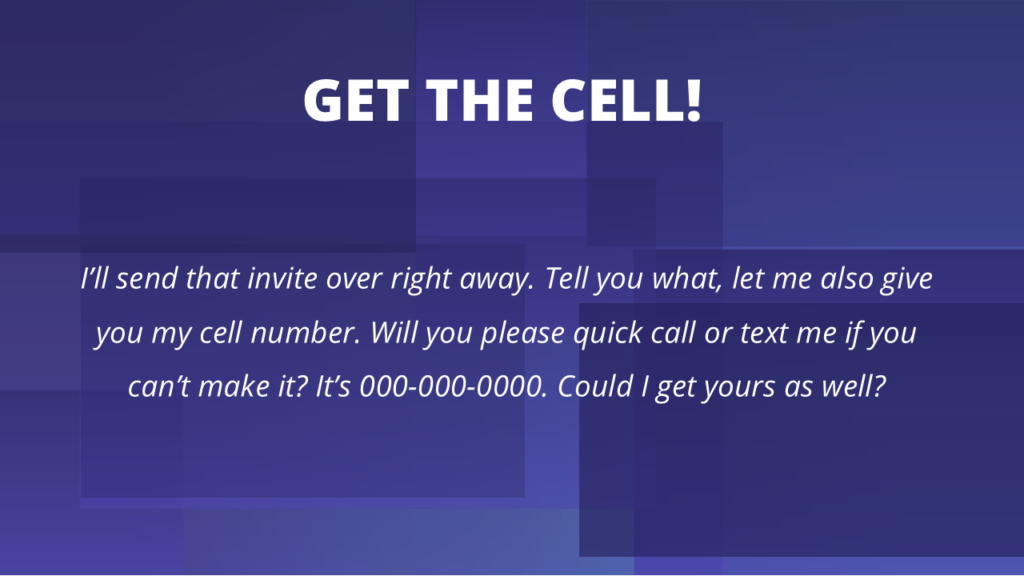
Combine the 4 Cs with these three steps, and you’ll ensure that every call ends with a solid plan and keeps your deals moving forward. No more ghosting, no more stalled deals!
2. Get a Customer Commitment
Don’t let the conversation end without getting a customer commitment. It’s simple: give them a little “homework” before the next call. When you ask a prospect to bring something to the table for your next meeting—like competitive pricing or feedback from their team—you secure mindshare.
Why does this work? People are less likely to ghost you if they’ve agreed to do something for the next step. It turns your prospect into an active participant, making them more invested in the process and, ultimately, the deal. This tactic keeps things moving forward while solidifying your partnership.
Here’s another way to think about it: Imagine your friend invites you to a party and asks you to bring the beer. You agree, but when the day comes, all you want to do is stay home in your sweats and binge Netflix. Then you remember, you promised to bring the beer, and your friend is counting on you. So, you get up, get dressed, and head to the party, knowing they’d be upset if you bailed after committing. That’s how mindshare works. By giving you a responsibility, your friend increased the chances you’d follow through.
Securing even a small commitment can be the difference between a deal that fizzles out and one that’s locked in with purpose and momentum.
TIP: Take our 15-minute online course “Getting Deals Moving” to get more customer commitments
3. Re-engage Prospects
When a deal stalls or a prospect ghosts, it’s easy to assume all is lost. But a stalled deal doesn’t mean a dead deal! To re-engage those quiet prospects, you need to get creative and tune into buying signs and signals. What’s going on under the surface? Are they asking about functionality or delivery times? Are they showing glimmers of interest but not committing? Recognizing these signals helps you approach the next touchpoint strategically.
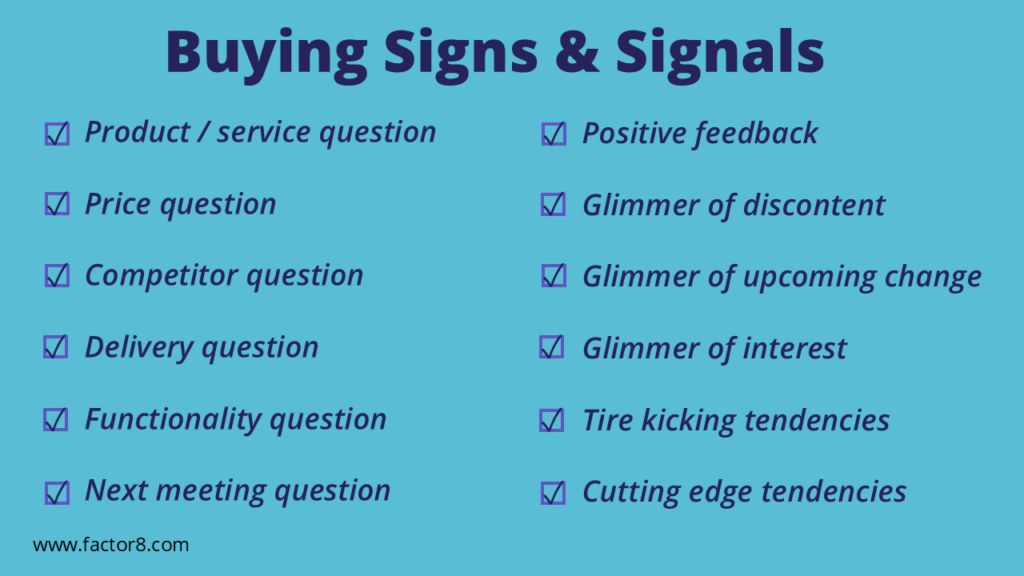
Mix up your communication channels and don’t just stick with email. Reach out through LinkedIn, send a personalized video, or even text (that is, if you’re text buddies). Keep your messaging light but direct. Something like, “Hey, are you buried in work? Let’s reconnect when you’re ready,” shows empathy. Or, if you want to go a bit bolder, say, “Did I drop the ball somewhere?” to draw out what’s really happening.
Urgency also plays a role here. Is there a deadline approaching or a new feature/product that could catch their attention? Mention that to reignite their interest and get them back in the conversation. And when you do get them back on the phone, don’t book them two weeks out. Leave room for urgent follow-ups so you can capitalize on those buying signals.
READ: How to Quickly Transition to Close on Sales Calls
In this tough sales environment, deals won’t close themselves (in fact, only 10% of customers close themselves). You need to be proactive in securing next steps, getting commitments, and re-engaging prospects when things slow down. Whether it’s using the 4 Cs to bridge every call, locking in a prospect’s commitment with small tasks, or mixing up your re-engagement tactics, these strategies will get your deals moving and keep them on track for a win.
The insight in this article was shared in our webinar, “3 Tips to Get Deals Moving NOW (So You Hit Quota!)”
Watch it here: https://factor8.com/get-deals-moving-workshop/
Subscribe to our email list to receive new content, webinar invites, and training offers.
3 Tips to Get Deals Moving NOW (So You Hit Quota!) [Webinar Recording]
3 Tips to Get Deals Moving NOW (So You Hit Quota!)
[Video Recording]

How to Close More Deals
Don’t like closing? You’re not alone. If you feel like you’re being too pushy when you close, here’s a whole new way to think about it. In fact, two. Listen, most of us hate being closed, and most of us avoid closing as sellers. It’s a highly-requested sales skill training at Factor 8 and an often-lamented gap we hear from sales leaders. They’re not wrong.
The Sales Board reported recently that 64% of sellers don’t close. Surprised? I’m not. Closing feels pushy. As much as the general public distrusts salespeople, an equal amount of salespeople hate being perceived as annoying or pushy. Closing is the precise skill we don’t want to be known for.
Yet only 10% of customers will close themselves if not asked (Impact Business Partners). Wow, right? So it’s a critical skill. It’s an avoided skill. Enter a closing mindset shift.
Closing is helping.
Think of your last personal purchase. Were you excited? Happy you splurged? I bought myself a candle that smells like rain in the Arizona desert (yeah, I live in the Arizona desert, but it doesn’t always rain). It’s my favorite smell. I was so happy unpacking it from the Etsy box. I’ve wanted this candle for about 10 years. Just. Bought. It. Had I been closed in a store, I’d have been happier for 10 years. I never really got into information search mode in the buyer’s journey. Take a look:
Most buyers are looking to buy.
That bears repeating (go ahead and re-read, I can’t be bothered to type it twice). Seriously! 🙂 When we ask if they want to buy today, we’re helping them switch mental gears from stage one or two of the buyer’s journey into stage three. SHIFT. When they need something or really want something or could be better off for having something.
Shifting the customer’s position is a service.
Explained another way, it cues the buyer into the situation and the opportunity to purchase. The cloudy-headed buyer is thinking of the issue, of lots of alternatives, of doing nothing, what they did last time, and what’s for dinner all at once. Now they’re being asked if they want to buy this, and, Snap! Turns out that question forces his brain into decision mode. YES. I’m ready. No, maybe not. Maybe, I’m not sure, but I am going to think more seriously about it now…
This feels a lot like a restaurant, right? I’m reading lots and lots of yummy things. I’m talking to my family. I’m nagging my boys to stop teasing each other and sit on their butts.
Waiter: “Are you ready to order?”
Me: “No.” OK, I’ll get serious now.
(Five minutes later he’s back.)
Waiter: “Do you need more time?”
Me: “No. Almost there, let me just ask you this one question now that you’re here and I’ll make up my mind now…”
Am I annoyed by him? No! I’m grateful he’s asking me because I can’t remember the last time I ate.

Ordering at Starbucks… Do you go up to the counter and immediately give your order or do you wait to be asked?
You’re getting it. Closing is giving the customer the opportunity to purchase. Lucky them.
Mindset shift two: Closing wouldn’t be so darn scary if we did it all the time. We call it “Getting Deals Moving” at Factor 8 and it’s a Sales Bar favorite. It’s all about getting a customer to say “yes” before the call is over. This increases mindshare and keeps your deals moving faster than when we let them fade away, go dark, and we start over trying to connect again.
Gong did some really cool research recently (as usual) and shared that deals that close the fastest spend 1.53x more time talking about the next steps on the first call than other deals did. In fact, close rates decline 71% when the next steps are not covered on the first call.
So closing the first call is more important than closing on the last. Assuming the next steps as a closing technique is super smart! And yup, closing is a process, not an event.
If we would get in the habit of asking more trial closes, tie-downs, and commitment-gaining questions on each call, more deals would close and close faster. We’d also build muscle memory so it wouldn’t be so darn scary asking for the final order. Know where your prospect is all during the cycle so you’re not surprised at the end you have a tire-kicker, folks.
CSO Insights supports this with a stat of 26% of deals not closing because we’re not aligned with the buyer’s needs before we try to close. That’s a pretty big loss reason. Whoops.
Closing throughout means asking more questions and aligning. In fact, you’re doing customers a disservice if you’re moving too fast or too slow. Back to the restaurant… Ever been annoyed by the chatty waitress who you wish would just put in your order?!
Figure out what you can close each call and start immediately.
Not sure about your go-to close? What kinds of commitments to close for? Join our award-winning online training platform, The Sales Bar! We cover lots of the data above + some great go-to closes in our course, “Closing Confidently”. “Proposing with Value” shows how we present solutions, align with our customer value, and then close. It’s probably time for a brush-up. We’ll serve it up with a mindset shift, some live collaboration, and lots of fun at The Sales Bar. See you there!
Subscribe to our email list to receive new content, webinar invites, and training offers.
How to Show Value FASTER with SWIIFT℠ [Webinar Recording]
How to Show Value FASTER with SWIIFT℠
[“Sales Shot” Workshop]
Tips to Close More Deals [Webinar Recording]
Quick Tips to Close More Sales
[“Sales Shot” Workshop]