

Empathetic Selling

Selling to Gen Z and Millennials
Gen Z and Millennials have grown up in an interconnected world with most information available at their fingertips.
Based on current trends, they value two aspects more than anything when judging a brand – speed and authenticity.
Both generations are accustomed to instant gratification thanks to the internet and evolved communication tools. They also value brands that take a strong stance against injustice.
As a more optimistic and ethically minded group, Gen Z and Millennials make calculated decisions when buying something (especially if it’s outside the tech industry!)
For that reason, selling to Gen Z and Millennials requires a certain level of knowledge, understanding, and sales intelligence.
Here are our top tips on how to tailor your selling approaches to both Gen Z and Millennials.
Understanding Gen Z and Millennials
Understanding Gen Z and Millennials significantly helps how you approach selling to them. Here’s some key factors highlighting their similarities and differences:
- Technology Use: While both generations are tech-savvy, Gen Z has grown up with smartphones and social media, making them more comfortable with technology than Millennials. As a result, Gen Z tends to rely more heavily on online reviews and social media when making purchasing decisions.
- Brand Loyalty: Millennials are often associated with being loyal to specific brands, but Gen Z tends to be more open to trying new products and experimenting with different brands. They prioritize value and authenticity over brand loyalty, and are more likely to switch to a different brand if they feel it better aligns with their values.
- Social and Environmental Consciousness: Both generations prioritize social and environmental issues, but Gen Z is more likely to take action on these issues. They seek out brands that share their values and are more likely to the ones that positively impact the world.
- Communication Style: Gen Z tends to prefer shorter, more direct communication through text messages and emojis, while Millennials are more likely to use longer-form communication like email and phone calls. You can even notice the difference in the resume examples of each generation. While Millennials focus on achievements and uniformity, Gen Z is more likely to experiment with custom design resumes and unique one-liners within their content.
- Social Media Influence: Both generations are heavily influenced by social media, but Gen Z is more likely to engage with influencers and user-generated content. They trust peer reviews and user-generated content more than traditional advertising.
- Shopping Habits: Millennials are often associated with being bargain shoppers, while Gen Z prioritizes convenience and speed. Gen Z is more likely to make purchases through their mobile devices and value free shipping and easy returns.
- Financial Outlook: Millennials came of age during the Great Recession, so they are generally more financially cautious. Gen Z is more optimistic about their financial future and tends to be more willing to spend money on experiences and products that align with their values.
READ: Sales Pitch Tips to Engage Prospects
Tips on Selling to Gen Z and Millennials
First up, let’s reiterate that Millennials and Gen Z prefer authenticity and the ability to be quick and efficient. Keeping that in mind, here are five tips on how to sell to Gen Z and Millennials.
1. Differentiate Between Self-Service and Customer Support
Seems contradictory, right? Both generations actually WANT self-service options while equally expecting excellent customer service.
Gen Z and Millennials want to become an active part of the buying process because they need as much information as possible. They also want the decisions to be final on their terms.
They actively gather as much information as possible on their (and try out free trials) before contacting a brand. Both generations would rather learn more about a product themselves or through organic customer reviews than hear about it from the brand or its sales reps, especially when a new product is involved.
For example, selling a healthcare CRM to a Gen Z or millennial customer should not be done through cold calling or emailing. Instead, adopting a more personal approach is better. Introduce them to the product and allow them to take it for a test run!
At the same time, both generations also expect complete customer support from brands. This can be done through customer service reps, social media, or other easily accessible ways for them to directly communicate and seek assistance.
2. Adherence to Personalization
Gen Z and Millennials have been constantly bombarded with information their entire lives. Over time, this leads to information saturation, especially when today there are tons of competitors in every business space.
So the bottom line is that true differentiation is only noticed by these groups when there’s personalization involved.
Traditional advertisements involve targeting a massive audience with the same ad and message (like typical TV ads). It worked because people didn’t have enough information available, and they couldn’t use their phones to research a product and check out its reviews quickly.
But that’s the FIRST thing Gen Zers and Millennials do today!
Capturing their attention alone requires a little more effort – you want to make them feel like they’ve been specifically targeted. This is also a great way for brands to show that they care about their customers.
DOWNLOAD: Human-Centered Communication
3. Fast Media Is Key
It’s no secret that videos have become one of the most consumed forms of media. While it started with Vine’s six-second videos, we now have TikTok, Instagram Reels, and stories on multiple social media platforms.
This form of fast media is what most Gen Z and Millennials consume on a daily basis. This is where they trust information on current events, find entertainment, and buy products.
Gen Z typically uses social media like TikTok as a search engine rather than Google. Think about that for a second – that means a huge part of selling to Gen Z and Millennials involves effectively marketing on these social platforms.
General social media ads do not cut it. You need to provide quick, consumable content that’s engaging and enlightening. What value are you bringing to them? That’s how you build a following and a loyal community today.
READ: Value-Adding with the SWIIFT℠ Selling Methodology
4. Use Their Language
In order to communicate with Gen Z and Millennials effectively, you need to speak their language. Don’t toss in phrases or words they use nowadays (especially if you don’t know the meaning or social connotation) while keeping the rest of your business tone professional.
Authenticity trumps all. One of the easiest ways to do it? Get that form of insight directly from the source by hiring a millennial or Gen Z employee.
Speaking their language involves using their specific vocabulary, using their jokes and memes, and any relevant acronyms.
Remember these are often very trendy and constantly evolving. Make sure you’ve got someone with their finger on the pulse to continually update your brand’s language along with what’s being used by your customers.
5. Values and Activism Matters
When it comes to Gen Z and Millennials, they have very strong beliefs regarding common societal issues. They also expect their brands to adhere to those beliefs and opinions.
You can’t expect to seem authentic if you suddenly start performative allyship or activism. Gen Z and Millennials can easily call this out or feel when it isn’t sincere. And once that happens, you’ve lost their trust – and it’s unlikely you’ll win it back anytime soon.
Start establishing a strong base of values and causes your brand supports. Moreover, be open and transparent about what you’re doing for the causes you support! For example, if your brand believes in sustainability, what is it actively doing to make the business more sustainable?
You also want to make sure all aspects of the company are on the same page – from revenue, to delivery, and other teams within the organization.
READ: Improving Sales-Marketing Alignment
Final Thoughts
Selling to Gen Z and Millennials isn’t challenging if you’re actively adapting to the changing marketing landscape.
Adopting strong marketing strategies will always help your brand in the long run and allow you to build brand affinity.
One key takeaway? Have fun with it! Continue experimenting with new ways to connect with the latest generations and remember that authenticity and speed are always your number one priority.
Subscribe to our email list to receive new content, webinar invites, and training offers.

How to Improve Buyer Engagement in Video Sales Meetings
There’s no denying that “something’s missing” when we move from in-person meetings to video. It’s true of team meetings, training, and especially sales calls. If video is part of your every day, how do you stand out from the crowd?
The baseline of video acumen has risen since the early days of remote work. You’ve got to go beyond the basics and use video as a tool in your arsenal. Thanks to technology, we can actually measure the effectiveness of our video meetings with AI tools.
How would you rate on a scale of 1 to 10 if we asked your prospects how engaging your sales call is?
What is Engagement vs. Sentiment?
When measuring the effectiveness of your sales calls, you’ve got to watch two things: engagement and sentiment.
For quick reference, here’s how we break down the two:
- Engagement = buyer’s attention or presence on the sales call
- Sentiment = buyer’s attitude or emotion towards the seller
According to Q for Sales, Uniphore’s AI-powered Sales Assistant, an engaged customer has an 83% higher propensity to buy than a non-engaged customer. When both engagement and sentiment are high, you’ve got an 89% greater chance of closing the sale.
DOWNLOAD: THE IMPACT OF BUYER ENGAGEMENT AND SENTIMENT ON DEAL OUTCOMES
TL;DR – Get them leaning in quickly, make sure they like you, and you’ve got nearly double the chances of closing the deal.
(Take a peek at Uniphore’s AI tool, Q for Sales, below to see how it tracks sentiment on video meetings.)
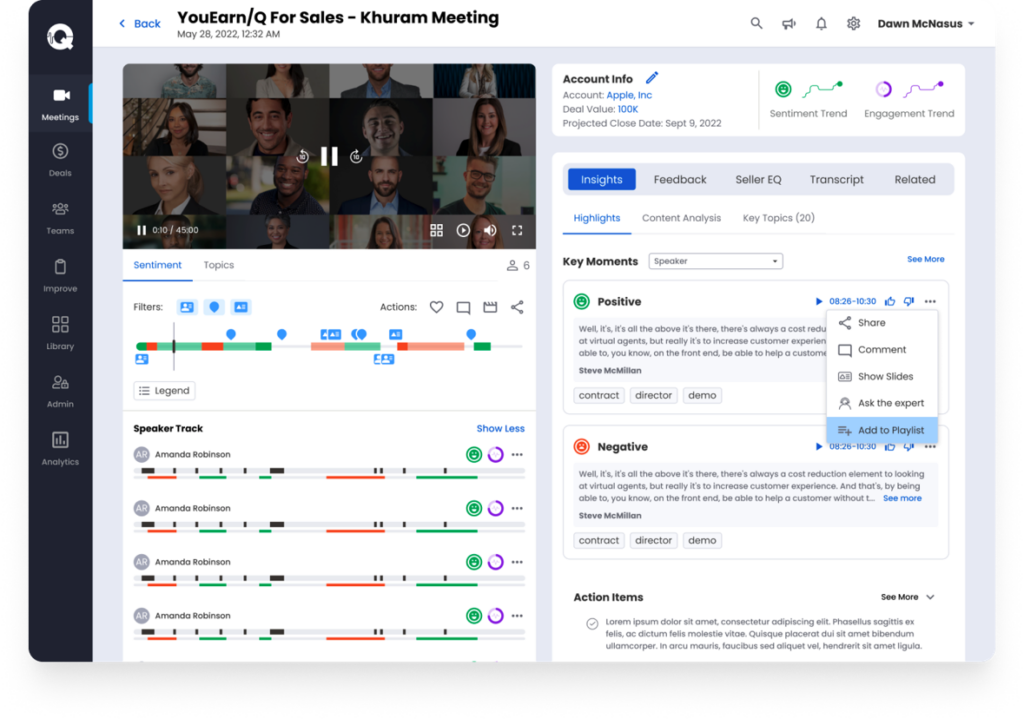
How Do You Engage Buyers (Faster)?
Nearly 29% of buyers admit to multitasking during video calls. That means that roughly one-third of buyers aren’t paying attention to you. It’s a lot harder to re-engage someone after they’ve already tuned out, so starting the call with a high level of engagement is key.
Follow these 8 steps to ensure engagement is high from the beginning of your call:
- Stop sharing your screen. Engagement goes down when sellers share their screens. Why? Because sellers ask fewer questions when they’re screen-sharing. We tend to go into a monologue and talk AT the buyer, vs. carry a conversation and ask questions. It’s not about the screen, but rather our behavior while the screen is up.
- Share personal information. Create a quick bond with a buyer by sharing something personal about yourself. It helps you find commonality and build quick rapport with the buyer.
- Review goals and the agenda. Start the call by outlining the goals and topics of discussion before diving in. Make sure you check in to see if the buyer wants to cover any other topics or has any other questions. This is especially important when selling to the C-suite. Give them the opportunity to drive the conversation by gauging what they want to cover on the call.
- Ask questions. As a general rule, the seller’s goal of the call should be to uncover as much important information as possible from the buyer. You do this by talking less and asking more questions.
- Ask them to recap their challenges. Even if they’ve told you what their challenges are before, you don’t want to put words in their mouth – it’s a surefire way to disengage them. Ask them to share their current situation and challenges.
- Match their energy. Imagine showing up to a sales call on a Monday morning after your 5th cup of coffee. The buyer shows up yawning and barely even awake. You want to lower your energy level to match theirs. If they’re pumped up and high-energy, match it. If they’re relaxed and calm, match it. It’s a form of empathy when you’re able to connect with buyer by matching their energy level to build trust and rapport.
- Say it with a smile. Positivity is contagious. Smiling automatically has a positive effect on your buyer’s sentiment. If you want to be easier to connect to, watch your facial expressions. Do you find yourself scowling without realizing it (read: RBF!)? Then practice smiling on all calls.
- Give them eye contact. It’s tough when you’ve got multiple screens with Slack, email, a presentation, and Zoom all open at the same time, but you’ve got to make sure you’re looking AT the camera and giving buyers eye contact. Tip: Put your notes underneath your camera so you can read from them while making eye contact.
How Do You Encourage A Buyer To Turn On Their Camera?
You ask them to turn it on. Easy, right? Yet 83% of sellers don’t do it. And, it’s so much harder to connect with someone when you can’t see them.
Need more of an incentive to ask? Let’s break it down with stats…
- Less than 10% of the message in a conversation is verbal
- Between 30-35% is in the tone, speed, or pitch
- But a whopping 50% of the conversation is visual (hello, body language)
So if you don’t ask them to turn on their camera, you’re missing more than half of the conversation.
If you need a little help asking them, try any of these out on your next sales call:
“Hey, if it’s not too forward, are you OK sharing your camera so we can talk face-to-face?”
“OK, camera bullying time! No hiding! Unless you’re literally naked, please pop it on. Thank you so so much. It’s hard talking to myself.”
“I promise I didn’t get dressed up for this meeting and there’s zero judgment! Would you mind terribly going on video so we can have some eye contact?”
How Can You Tell If A Buyer Is Engaged?
They’re showing signs of active listening and attentiveness by:
- Smiling
- Leaning forward
- Nodding
- Looking at their screen
- Showing their hands
- Chatting, clapping, sharing emojis, etc.
How Can You Tell When A Buyer Is Disengaged?
They’re actively not paying attention and are distracted by something else. If someone is disengaged, they might be:
- Looking away
- Leaning back
- Showing a negative facial expression
- Visibly reading their emails
- Playing on their phone
- Off camera
How Do You Quickly Reengage A Buyer?
- Notice or mention something that could be common ground – “I see that gorgeous picture in your background.”
- Share something first – “I am an avid sunrise photographer. Although, I don’t see them enough lately!”
- Ask a closed & follow-up question – “Did you take that yourself? It’s so beautiful! Where is it?”
- Ask an open question – “Tell me about it?”
TIP: TAKE OUR CLASS “AUTHENTIC (AND QUICK!) RAPPORT BUILDING”
You’ve got to master the art of active listening in order to effectively engage (or reengage) buyers.
Here’s how to be a great listener:
- Listen actively – No interrupting, look at the camera, nod your head
- Acknowledge – “Yes”, “Okay, got it”, “Mm-hmm”
- Restate (with empathy) – “OK, what I heard was that you’ve tried this many times already and it may be a little frustrating now.”
- Check-in – “Did I get that right?”
TIP: TAKE OUR CLASS “EXPERT AND EMPATHETIC LISTENING”
What Do You Do When A Buyer Disengages?
The first thing is to stop screen sharing. That way you can talk and pivot the conversation. Try some of these scripts to get your call back on track:
“I’ve been talking like 5 straight minutes, and I think I lost ya’ll. My bad. NAME, what’s the next most important thing we can cover for you?”
“Hey, I think I went off track. My bad. Let’s go back to the agenda. Is this still what you want to accomplish? Quick show of hands if you’d like to move on to XYZ item?”
“Let’s take a beat here to check-in. Could you please give me a thumbs up if you’re tracking with me 100% or a hand raise if you have a question? If I lost you completely, sit very still…”
TIP: TAKE OUR CLASS “DEMOS THAT DON’T SUCK”
How Do You Build Trust With Buyers?
Let’s talk about trust. According to Hubspot, only 3% of people trust salespeople.
“Trust is not something you can ask for, you need to earn trust. It takes hours, weeks, and years to build it, but seconds to lose it.” Sylvain Tremblay, CRO, Uniphore
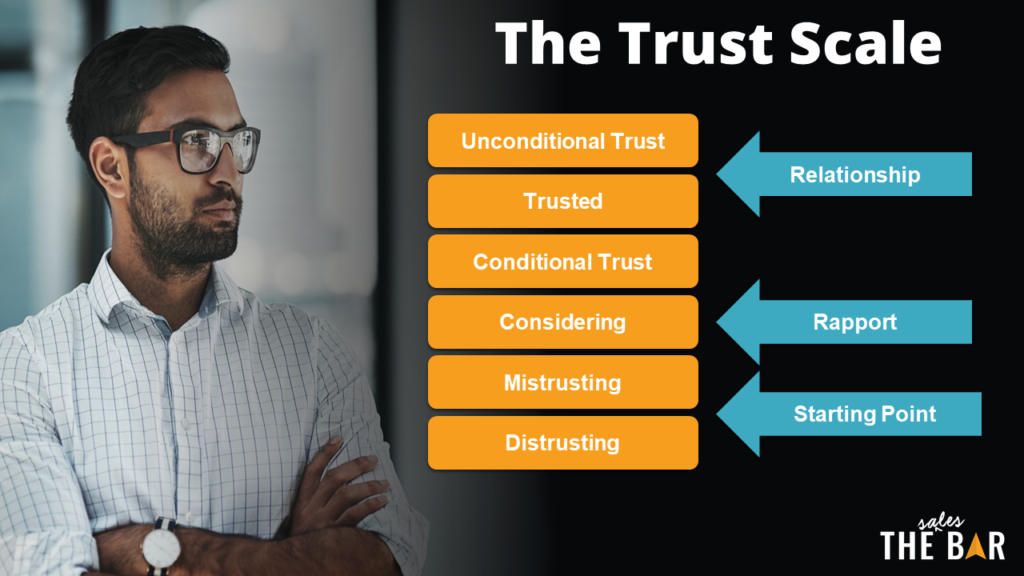
Since trust is earned, that means we all start at the bottom of the trust scale, at mistrust. Luckily, we don’t start at distrust, that’s when someone knows us and has actively lost trust in us.
Mistrust means that they aren’t sure of our character based on the fact that we’re a salesperson and their fear that we’re going to try to force them to purchase their product.
Our job as salespeople, through empathy, engagement, and rapport building, is to move up the trust scale as fast as possible. Folks, you’ll never make it to the top of the trust scale in a call or two. It takes time to build trust. The goal is to simply move up the scale faster.
How Do You Build Rapport Quickly?
We’ve all heard that people buy from people they like, but the truth is that people buy from people that are LIKE them. We’re hard-wired to connect to people that are like us. That’s why small talk was invented; to help us find common ground with others.
The key to building authentic rapport (and quickly), is to let people get to know you faster.
Here are a few tips on what you can share with buyers to build rapport:
- Introduce yourself at the beginning of the call
- Get your resume off LinkedIn & share something about your experience
- Connect on LinkedIn with a personal message
- Send a personalized video
- Share some (personal) background
- Add something funny
- Make fun of yourself (pratfall effect)
If you want to connect to your buyer, you’ve got to give to get. Give information about yourself and you’ll get an authentic connection to your buyer.
Want more tips? Watch our 30-minute Sales Shot to learn how to improve buyer engagement in video sales meetings.
Subscribe to our email list to receive new content, webinar invites, and training offers.
5 Tips for Reps to Keep Selling During a Recession
When the economy gets shaky and buyers get nervous, we see meetings fall off calendars, and deals go dark. It can feel scary for sure – especially when we see our new hire classmates cut from the team.
Here are some tips to keep on keeping on selling during a recession.
Confirm and reconfirm all your meetings.
That includes getting cell phone numbers. Start with everything currently booked. Call and email them today to confirm and leave your cell number. Ask them to text and leave theirs. It’s OK to be honest. Try something like:
“Hey Ted, LB here. Looking forward to Tuesday and just want to confirm we’re still on. I’ve had a few folks literally disappear in the past month with this uncertain economy. VERY glad that’s not you. Listen, I’m going to leave my cell. Will you please be kind enough to return my call or pop over a text to confirm Tuesday at 11 Central? Thanks! It’s xxx-xxx-xxxx. One more time: xxx-xxx-xxxx. Talk soon.”
This move helps you keep the connects you have, shows concern, and gets you cell numbers. Winner! Do it for meetings you are setting up this week as well.
“OK, I’ll hit you back on Tuesday at 11. I’ll be ready to cover A, B, and especially C. Will you bring XYZ? I’m sending over a calendar invite to hold our place. It has a bridge, but I want you to have my mobile as well. My number is xxx-xxx-xxxx, can I grab yours?”
You won’t get it every time, but I’ll estimate 9 out of 10. Boom. No more going dark.
Reswizzle your value prop – in your messages, your posts, your pitches.
I stole this great tip from Doug Landis in our recent webinar, How To Build Pipeline And Keep Selling During A Recession. Nobody buys vitamins during a recession, they buy Advil. Truth is, my service of sales and leadership skills is definitely vitamins – the stuff that’s good for you we are supposed to take and tell our doctors we do…but isn’t usually prioritized. Yes, even though taking your vitamins helps you AVOID taking the hard stuff down the line, human nature is human nature. So if you’re normally plugging things like employee morale and retention, it’s time to restate.
Advil helps us avoid pain. Pain we’re already in. What does your product solve that fixes a pain? Uncertain times lead to fear buying (one word ya’ll: hand sanitizer. Wait, here’s another: toilet paper.) These memories are fresh. People stop buying anything that isn’t essential, doesn’t pull them out of pain, or won’t protect them from horrible recession-related risks. Find the Advil in your solution and lead with that.
(Watch LB’s tips on changing your value prop during a recession below)
Sort & call intelligently.
What industries aren’t suffering right now? Automotive is strong (have you SEEN prices!?), healthcare and insurance are always winners, banks are flush, who else? Buy a new list or pull the bottom of yours out and go long.
Remove risk however you can.
Can you highlight a cancellation clause? Payment terms? Low-cost trial? Nobody wants to be the guy who spent too much and trapped the company in a big spend if this whole situation gets worse. Help them see this purchase will deliver them from pain and not get them in trouble.
Talk longer.
Now is the time to build deeper relationships. When someone says they can’t buy now, don’t hang up the phone! Get to know them, their company, their situation, their partner! Sometimes the best you can do is build pipeline, so build the strongest damn pipe your manager has ever seen. That means rock-solid projections of how many, how much, when they can buy, and every step it will take in the purchasing process. Get it one step short of a signature and be best friends with everyone along the way so they can’t wait to sign.
We’re talking about asking more questions, building more rapport, showing more empathy, finding more contacts, going wide in the account. You should know every past competitor considered and why they failed, exactly how your solution will be used, the three purchases in line in front of you, the one guy who’s most doubtful. Getting the picture? About triple the info you normally have when you call it.
Remember…A recession or economic downturn is inevitable and also temporary. Do your future self a favor by staying positive and keeping momentum going so you’re ready to hit the ground running when things get back to “normal”!
Subscribe to our email list to receive new content, webinar invites, and training offers.
The Empathetic Selling Quiz [Cheat Sheet]
The Empathetic Selling Quiz
[Cheat Sheet]
Tips for Sales Managers to Coach Their Reps in Empathetic Selling [Cheat Sheet]
Tips for Sales Managers to Coach Their Reps in Empathetic Selling
[Cheat Sheet]

How the Hell Do I Prospect Right Now? Part 2
In part 1, we talked about call planning. I hope you’ll check it out here as your outreach depends on getting to the right people with the right questions.
Outreach
So let’s talk about the outreach call, email, or social media message?
Written
My advice: keep it short, zero sales, and very human. Lead with humanity, the desire to help, and an eagerness to learn and talk. Not pitch. I dare you to craft a message that has nothing at all to do with you and everything to do with them. I’ve replied to messages who even say that it’s a strange time to reach out, even those who vaguely apologize for doing so. I haven’t replied to a single three-paragraph value prop.
Voicemail
Ask yourself what calls you’ve returned in the past few weeks. Company I’ve been dodging for months to sell online credentials – hard pass. In fact, I’ve eye-rolled at the message as he and I both know damn well I should have been segmented to the bottom (read about segmenting and more planning in part 1 here)
FedEx account rep who was sorry to bother but thought she could save me some money – yes. Even called her during “I’m on kids” time and talked for fifteen minutes.
We have four simple strategies that work better than any other I’ve seen for getting a call back (watch more here) but the key is to customize these even further with empathy. During these times I recommend you downplay the “mystery and urgency” approach and lean more on the “value or lever” approaches. Let your message show that you know who they are and you get their situation. A few lines I like to get you started:
“I’ve been thinking about you and wondering how you and your team are doing”
“What a crazy time to call…or maybe crazier NOT to call…but I do hope you’ll call me back…”
“You may not be taking sales calls, but if you’ll give me five minutes, I might be able to save you some money right now / make things easier right now. Anyway, I’d really appreciate it…”
“I understand you won’t be going to XYZ conference anymore this summer with person A and person B, could we talk about that…”
Call
Same with our opening call. How are you doing? How is your business doing? How are your people doing? These are your go-to questions right now, and people want to answer them (a year ago I told folks to ditch the “how are you?”).
Keep the rapport building and empathy section of your call long and strong. A quick pivot into exploring for sales opportunities starts to smell. Want to build the fastest rapport? Get real and share your side as well. Skip the pat, “Hanging in there…it’s the new normal.” If you want to connect, share something real. What are you struggling with? For me it’s managing homeschooling and not drinking every day. It’s a little personal and a lot real and it builds fast connections with virtual strangers.
Now is the time to be 100% human.
Not an employee. Not a rep. Not a brand. Be you. And enjoy it. Connecting with people is probably a big reason you got into sales in the first place. If you achieve nothing else but a fifteen-minute rapport-building session at a personal level, you’ve achieved a lot. Be willing to leave it there. In the wise words of my friend Colleen Stanley, author of Emotional Intelligence for Sales Leadership: Ask yourself if your prospecting effort demonstrates that you get their world right now. It’s the perfect litmus test.
Disco Anyone?
If you’re lucky enough to go further and you’re in a discovery call, lead with learning. Understanding how your customers and prospects are approaching their business and lives gives you great stories to share with the rest of your prospects. I want to know:
1. How are sales?
2. How are they serving their customers?
3. What are the biggest challenges?
4. Any hiring or layoffs?
5. Any new markets or approaches?
6. Any changes to the tools they are using?
7. How has their leadership approached this?
8. Have they had to change or cancel plans?
9. Are budgets frozen?
10. What are the top priorities right now?
And that’s just getting started. These answers will not only help you connect but even change your approach as needed.
Tell Stories
Even better, if you’re leading with learning in discovery, you’re collecting stories to tell others that can help other prospects and even yourself (XYZ company is actually hiring right now because….spending right now because….buying software because…) Storytelling is key right now – right up there with empathy.
You are providing a service by doing some cross-pollination. What is the flowerbed over there doing? How about our competition? What are you hearing that’s real and not either fake news or LinkedIn fluff?
And the Pitch!
Finally, if you’re in a position to pitch something, very carefully lead with value – and customized value to the situation (you planned this above!). You’re not just convincing people why to do business with you, it’s why to do business with you RIGHT NOW.
May I also be so bold as to recommend a backup. If you pitch the sale, be prepared with an offer. I’m offering discounts, payment plans, and delayed payments. I’m trial closing for next month or quarter when this doesn’t work. Help people who want to say yes to do it or to sell it internally right now.
I hope you grabbed some nuggets in the above. Take “lead with empathy” to a new level with your planning, your outreach, your discovery, and your pitch. Note what’s working, cross-pollinate stories, and set yourself up to love your sales day rather than feeling (and smelling) like failure. Harsh…but fair.
It’s time you guys. Let’s get after this together.
Subscribe to our email list to receive new content, webinar invites, and training offers.

How the Hell Do I Prospect Right Now? Part 1
I can smell fear. You can too. And if we’re being pressured to produce pre-pandemic numbers I can smell the source. But if it’s leading to mass cold outreach and a tireless blast of pitch pitch pitch, these days it smells not just like sales C-list, it smells like sales Death.
So let’s get intentional about how we sell during the pandemic and let’s pray these best practices stick to all of us afterward (and that I never have to type that phrase again).
A few best practices from our team at Factor 8:
Planning
Take five to ensure that when you do get someone you’re prepared. They may actually be the most important part.
Ruthlessly Segment
Start by segmenting your list into companies or people who might need your services even more right now. Then the folks who still could need your services. Hard-hit industries and companies go to the bottom. Be selective and force yourself to put your list into these three categories as evenly as possible. Resist the urge to say, “Everyone needs XYZ right now…” that’s as fool hearty as, “I have no competition.” Be a critic and be ruthless with yourself.
Value Prop
Now reframe your value proposition. Why do these companies need you more or still need you now? Carve your typical features and benefits to only benefits and those influenced by our current times. It’s always best practice to tie your product to an industry trend, and boy do we have a biggy right now. Start by asking how this global trend would affect your prospect and develop 1-3 key benefits for them right now (not features, benefits).
For example, prior to COVID, I could say any company with an inside sales team needs phone skills training for reps and management skills for new leaders to improve call quality, sales results and employee engagement. Now the very top of our prospect list are companies who traditionally sell face to face and who have no idea how to engage digitally. Companies with years of inside sales experience and enablement departments with robust virtual offerings are bottom of my list. I don’t lead with the amazing results we get in live workshops, I talk about our virtual offering, executive forums, referral programs, and dedicated manager coaching. (In other words, leave some of your tricks in the bag.) The benefits we emphasize are improved call quality vs. quantity, protecting them from lost opportunities, making it easier on their leaders, keeping morale high, and the long-term payoff of a team ready to crush it when things are back to normal.
Image
I’d be remiss in not also advising y’all to get intentional about your background. Video calls are king, and I’ve seen open closets, unmade beds, and piles of laundry in backgrounds. On the same note, use your prospect’s visual clues to build rapport. Family pictures? Golf trophies? The weather out a window? If you show it, you want to talk about it – both directions.
Reframe Goals
Finally, I urge you to create some baby call goals. If your usual goal is to get a meeting, send a quote, or close a sale; your new goals could be to get their interest, develop a relationship, or qualify the account. We need small wins here and although budgets may be frozen, now is an amazing time to set up your future self for some fast sales. Right now people are:
- Taking more calls
- Attending more scheduled meetings
- Attending more webinars
- Getting real
(Thanks to my friend Chris Beall at ConnectAndSell for feeding me that data based on thousands of calls, connects, and shows).
So what if we went into calls with the goal of having a good conversation, learning about their situation, identifying future needs, and connecting with people at a human level? That’s a sales call I’m more willing to make and one I’m more willing to take. It also helps me start my day with an achievable (dare-say benevolent?) goal rather than a waft of desperation. If we open up a few opportunities during this, awesome. If we pave the way for future success, let’s take it.
Tune in to part 2 to learn more tips on the email, social, and phone call outreach.