There’s no ifs, ands, or buts about it – virtual selling is here to stay, folks. That’s why the transition from field to inside sales is becoming more prevalent.
If you’ve spent years perfecting the art of in-person selling and are struggling (or resisting) the shift to virtual, it’s time to get on track and embrace it.
I get it – virtual selling is a whole different ball game where reaching contacts is harder, your sales cycle is longer, talk tracks are shorter, and a whole slew of other things you’re not used to.
That’s why I took 30 minutes on our recent Sales Shot to break down key virtual and hybrid work practices that will help you feel like a superstar again.
Whether you’ve been at it for a while or recently transitioned, these are tips you can start implementing RIGHT NOW to help you fill those holes in your pipeline.
Do you like baseball? (Even if you don’t, stick with me for a minute.)
Home base is closing the deal and having a happy client – but you can’t get to home base if you aren’t even on first! First base is getting someone on the phone.
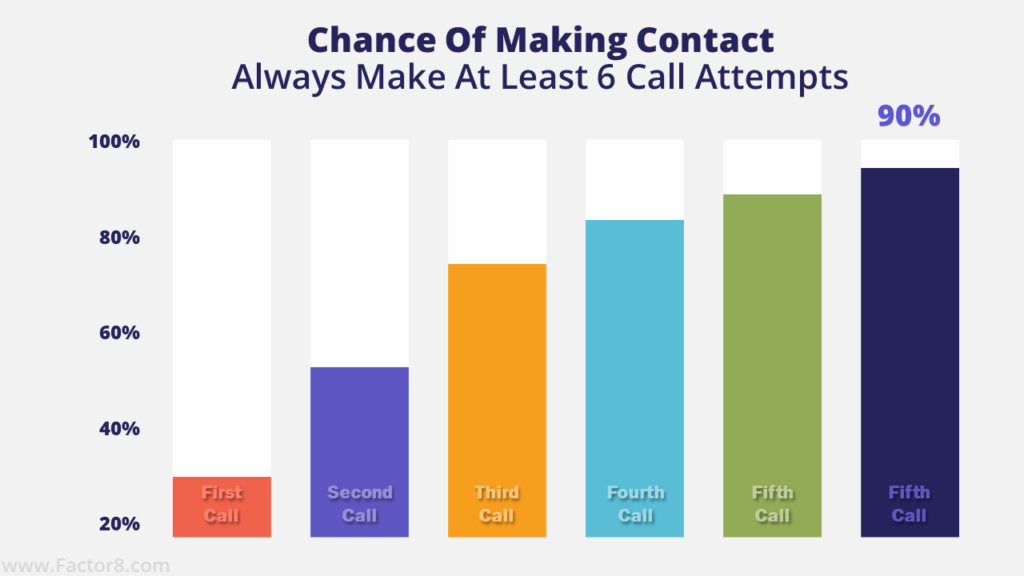
Chances are, they’re not going to pick up on the first try. In fact, less than 20% will connect on that initial call. Even if it takes 12 attempts to connect – you keep calling!
Research shows that 30% of leads are never even contacted at all. That’s a ton of missed opportunity. Especially when you consider that 82% of buyers admit they bought something after a series of cold calls.
So, moral of the story: Pick. Up. The. Phone.
Always Leave a Voicemail
If you’re making all these calls, you’d absolutely better be leaving a voicemail – a GREAT voicemail. In fact, make voicemails your new BFF!
Voicemails have a few different goals. The most obvious one is getting a callback. Realistically, most of them are probably never going to get returned. But here’s what you CAN do: create a positive impression of yourself and your company, and guilt them into either picking up the phone or eventually calling back. So, get creative and make it fun!
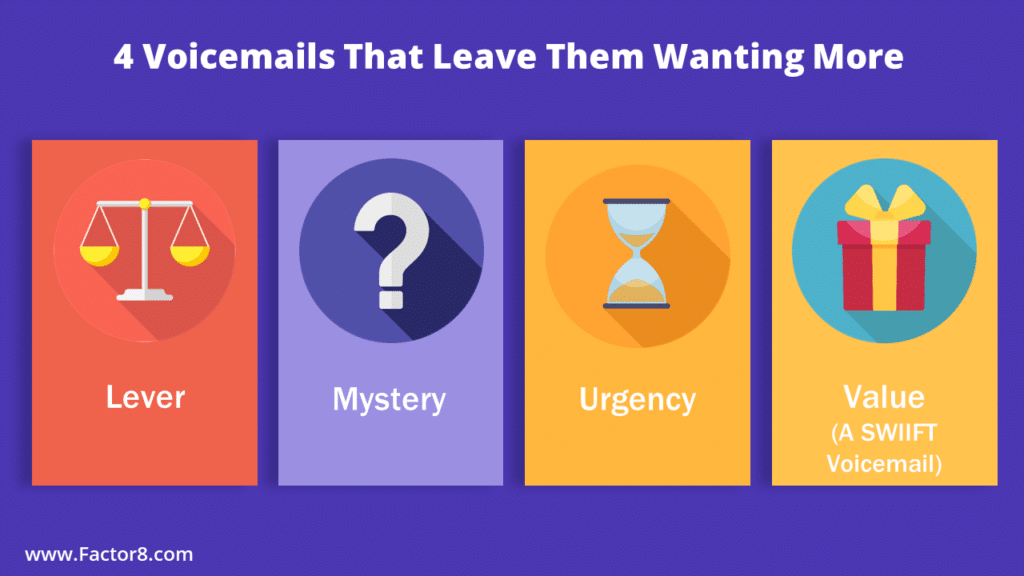
The 4 most effective types of voicemails are:
Lever – Drop their first name, reference one of their coworkers, mention a previous rep they worked with – something that’s going to get their attention! Whatever you do, make it about them!
Mystery – Keeping the message short and vague can pique their interest.
Urgency – Are you running a limited promo on a product or service? Are they losing money by the minute if they aren’t using your product? Give them a reason to JUMP!
Value – There are 6 of them we teach (remember SWIIFT℠, everyone?), but remember that during economic challenges people tend to care most about saving money and mitigating risk.
Whatever you do, ALWAYS leave a voicemail. No voicemail = no touch. It’s like buying a billboard and leaving it blank. Yikes!
Quick Tip: Send an email right after you leave a voicemail. Your likelihood of getting a response is MUCH higher when you mix voicemail + email.
Embrace Smaller Goals
A year ago, your quota probably looked a whole lot different than today. So, take your goals and break them up into smaller, more achievable pieces!
The average successful call is now just 3.5 minutes!
Structure your calls around these 3 key questions:
What do I need to learn?
What do I want them to know?
What commitment do I want to close?
Qualify Your Leads
Do NOT go through an alphabetical list of prospects and pick away at it until you get to Z.
Take the time to actually qualify your leads and call based on that score! You’ll have A,B, C, and D leads (and you can probably skip the D leads). Start with your A leads and work your way down the list until you finish the C leads.
As a general rule, here’s how often to call each lead:
A leads = 10-12 dials
B leads = 8 dials
C leads = 6 dials
Build A Bridge to Call #2
If you got someone talking on the phone after a cold call, the hardest part is over. So make sure you’re taking advantage of it by ALWAYS scheduling the next step WHILE you’re on the call.
Can you schedule the follow-up call now? How about sending a calendar invite with the next meeting’s info? Have you given your cell number to get theirs?
Give yourself permission to call back by urging them to look at their calendar and confirming when you’ll be connecting again.
Keep in mind, the more you try out these tips, the easier it gets and the more success you’ll see. So get on the virtual train with the rest of us and start building that pipeline. You got this!
Subscribe to our email list to receive new content, webinar invites, and training offers.
Prospecting might be uncomfortable, time-consuming, and frustrating, yet it’s still the single biggest driver of pipeline.
No prospecting means no conversations. No conversations means no meetings. No meetings mean no deals. And no deals means a very awkward forecast meeting.
What makes this even more painful is that most sellers are putting in the time. They’re just spending it in the wrong places.
Our data shows reps spend the majority of their prospecting effort on email, social (hello LinkedIn), and texting because it feels safer and easier. Less rejection. Fewer awkward moments. More boxes checked.
But when you look at the meetings that actually get booked and the deals that actually close, the story flips.
In other words, prospecting isn’t broken. The way most sellers are taught to do it is.
Prospecting isn’t about grinding longer hours, blasting more messages, or hoping something sticks. It’s about prepping smarter, planning your day, and knowing exactly what to say and why before you ever pick up the phone.
Why Prospecting Feels So Hard Right Now (And Why You Still Can’t Skip It)
Selling today is loud.
Buyer inboxes are flooded. Spam filters are smarter. LinkedIn DMs are packed with copy-and-paste messages. AI has made it easier than ever to send more outreach, which means buyers are spending more time ignoring it.
At the same time, buyers are busy. Internal meetings. Budget reviews. Tool fatigue. Decision fatigue. Even when interest exists, attention is scarce.
Sellers feel this every day. In our research, reps are not asking for more pressure or more meetings. They want tools that make their job easier and training that helps them say the right thing. Managers feel the strain too. Burnout is real.
So yes, prospecting feels harder than it used to.
But here’s the part that hasn’t changed. You still can’t skip it.
Prospecting is how pipeline starts. It is how conversations begin. It is how deals enter the funnel instead of magically appearing halfway through it. What has changed is that the old spray-and-pray approach does not survive in this environment.
More emails will not fix it. More automation will not fix it. And “just try harder” definitely will not fix it.
Modern prospecting requires intention. Knowing who you are calling, why you are calling them, and what you are trying to accomplish in that moment. Not jumping straight to a pitch. Not forcing a meeting ask before you have earned it.
The answer is not more activity. It is better preparation.
The Real Goal of Prospecting (And Why Most Sellers Get It Wrong)
Most sellers go into prospecting with one goal in mind. Book the meeting.
On the surface, that makes sense. Meetings lead to opportunities. Opportunities lead to deals. Deals make quota feel slightly less awful.
But this mindset is where prospecting starts to break down.
When sellers treat every call, email, or voicemail like it has to end in a meeting, messages get heavy fast. Value props show up too early. Case studies sneak into voicemails. Discovery questions get asked before a buyer has even agreed to talk. Outreach starts sounding like a pitch instead of an invitation.
It also makes rejection feel personal. When the goal is “get the meeting,” anything short of a yes feels like failure. That wears people down quickly, especially when most prospecting attempts will not convert on the first touch.
Here’s the shift.
The goal of prospecting is not to book the meeting. The goal is tostart the conversation.
You cannot get home if you cannot get on first.
Prospecting works when you break it into smaller, more realistic goals.
Get their attention
Get a response
Get them talking
Once someone replies, calls you back, or engages, you have earned the right to sell. Not before.
This is why shorter messages work better than longer ones. Why curiosity beats credibility early. And why sellers who focus on engagement instead of pitching consistently build more pipeline with less effort.
Prospecting is not about forcing an outcome. It is about opening the door.
Prospecting Emails, Voicemails, and Call Intros Are Not the Time to Sell
This is where a lot of sellers lose momentum before they ever get started.
Early outreach is not the place to pitch. It is not the place for your value prop, your customer logos, your case studies, or your discovery questions. When sellers try to sell too early, buyers do exactly what you would do. They scan, decide “no,” and move on.
The purpose of early outreach is simple.
Get noticed. Get a response. Start a conversation.
That is it.
When sellers treat prospecting like a mini sales presentation, messages get long, tone gets salesy, and response rates drop fast. Shorter, lighter, more human outreach consistently works better because it respects the buyer’s time and attention.
Think engagement first. Selling comes later.
Speed Wins. Shorter Messages Work Better.
One of the biggest prospecting myths is that more preparation always equals better results. In reality, over-preparing often slows sellers down and keeps them stuck in research mode instead of having real conversations.
Speed matters in prospecting.
Shorter messages are easier to listen to, read, and respond to. Buyers are far more likely to engage with something that feels quick and low effort than something that feels like homework.
This applies across every channel:
Short call intros beat long explanations
Short voicemails beat detailed messages
Short emails beat value prop dumps
Your job is not to explain everything. Your job is to earn the next step.
Phone Still Works. You Just Need Support from Other Channels.
Despite how uncomfortable it feels, the phone continues to outperform every other channel when it comes to booking meetings and closing deals.
That does not mean email, LinkedIn, or text are useless. They matter. They support the phone. They reinforce familiarity. They help warm things up.
But they work best when they are part of a plan, not the plan.
The strongest prospecting strategies use multiple channels together, with the phone leading the way and digital channels supporting it.
How to Prep Before You Ever Start Prospecting
Good prospecting starts before the first dial. The goal is not to research everything. It is to prepare just enough so you can move quickly and stay consistent.
When Should You Call
Timing matters more than most sellers think. You don’t need to guess or test endlessly. Patterns are pretty consistent.
Best days to call: Tuesday, Wednesday, and Thursday
Best times to call: 8–9am and 4–6pm (local time)
Reaching executives: Before 8:30am and after 5pm
Sneaky underrated window: Friday late afternoon
Calling at the right time doesn’t guarantee a conversation, but calling at the wrong time almost guarantees you won’t get one.
What You Need Ready Before You Call
A clear call goal
A short, practiced call intro
One rapport builder
A simple value hook
A voicemail plan if they do not answer
That is it.
You do not need pricing. You do not need a case study. You do not need their full job history.
Selling happens after the response, not before it.
Prospecting Is a Skill, Not a Personality Trait
Prospecting feels hard because most sellers were never taught how to do it well. They were taught to grind, push through rejection, and figure it out on their own.
There is a better way.
Prospecting works when sellers prep smarter, plan their day, and focus on conversations instead of outcomes. When done right, it takes less time, creates better engagement, and builds healthier pipeline.
Prospecting is not broken. It just needs to be done differently.
And when it is, everything downstream gets easier.
Subscribe to our email list to receive new content, webinar invites, and training offers.
Gen Z and Millennials have grown up in an interconnected world with most information available at their fingertips.
Based on current trends, they value two aspects more than anything when judging a brand – speed and authenticity.
Both generations are accustomed to instant gratification thanks to the internet and evolved communication tools. They also value brands that take a strong stance against injustice.
As a more optimistic and ethically minded group, Gen Z and Millennials make calculated decisions when buying something (especially if it’s outside the tech industry!)
For that reason, selling to Gen Z and Millennials requires a certain level of knowledge, understanding, and sales intelligence.
Here are our top tips on how to tailor your selling approaches to both Gen Z and Millennials.
Understanding Gen Z and Millennials
Understanding Gen Z and Millennials significantly helps how you approach selling to them. Here’s some key factors highlighting their similarities and differences:
Technology Use: While both generations are tech-savvy, Gen Z has grown up with smartphones and social media, making them more comfortable with technology than Millennials. As a result, Gen Z tends to rely more heavily on online reviews and social media when making purchasing decisions.
Brand Loyalty: Millennials are often associated with being loyal to specific brands, but Gen Z tends to be more open to trying new products and experimenting with different brands. They prioritize value and authenticity over brand loyalty, and are more likely to switch to a different brand if they feel it better aligns with their values.
Social and Environmental Consciousness: Both generations prioritize social and environmental issues, but Gen Z is more likely to take action on these issues. They seek out brands that share their values and are more likely to the ones that positively impact the world.
Communication Style: Gen Z tends to prefer shorter, more direct communication through text messages and emojis, while Millennials are more likely to use longer-form communication like email and phone calls. You can even notice the difference in the resume examples of each generation. While Millennials focus on achievements and uniformity, Gen Z is more likely to experiment with custom design resumes and unique one-liners within their content.
Social Media Influence: Both generations are heavily influenced by social media, but Gen Z is more likely to engage with influencers and user-generated content. They trust peer reviews and user-generated content more than traditional advertising.
Shopping Habits: Millennials are often associated with being bargain shoppers, while Gen Z prioritizes convenience and speed. Gen Z is more likely to make purchases through their mobile devices and value free shipping and easy returns.
Financial Outlook: Millennials came of age during the Great Recession, so they are generally more financially cautious. Gen Z is more optimistic about their financial future and tends to be more willing to spend money on experiences and products that align with their values.
First up, let’s reiterate that Millennials and Gen Z prefer authenticity and the ability to be quick and efficient. Keeping that in mind, here are five tips on how to sell to Gen Z and Millennials.
1. Differentiate Between Self-Service and Customer Support
Seems contradictory, right? Both generations actually WANT self-service options while equally expecting excellent customer service.
Gen Z and Millennials want to become an active part of the buying process because they need as much information as possible. They also want the decisions to be final on their terms.
They actively gather as much information as possible on their (and try out free trials) before contacting a brand. Both generations would rather learn more about a product themselves or through organic customer reviews than hear about it from the brand or its sales reps, especially when a new product is involved.
For example, selling a healthcare CRM to a Gen Z or millennial customer should not be done through cold calling or emailing. Instead, adopting a more personal approach is better. Introduce them to the product and allow them to take it for a test run!
At the same time, both generations also expect complete customer support from brands. This can be done through customer service reps, social media, or other easily accessible ways for them to directly communicate and seek assistance.
2. Adherence to Personalization
Gen Z and Millennials have been constantly bombarded with information their entire lives. Over time, this leads to information saturation, especially when today there are tons of competitors in every business space.
So the bottom line is that true differentiation is only noticed by these groups when there’s personalization involved.
Traditional advertisements involve targeting a massive audience with the same ad and message (like typical TV ads). It worked because people didn’t have enough information available, and they couldn’t use their phones to research a product and check out its reviews quickly.
But that’s the FIRST thing Gen Zers and Millennials do today!
Capturing their attention alone requires a little more effort – you want to make them feel like they’ve been specifically targeted. This is also a great way for brands to show that they care about their customers.
It’s no secret that videos have become one of the most consumed forms of media. While it started with Vine’s six-second videos, we now have TikTok, Instagram Reels, and stories on multiple social media platforms.
This form of fast media is what most Gen Z and Millennials consume on a daily basis. This is where they trust information on current events, find entertainment, and buy products.
Gen Z typically uses social media like TikTok as a search engine rather than Google. Think about that for a second – that means a huge part of selling to Gen Z and Millennials involves effectively marketing on these social platforms.
General social media ads do not cut it. You need to provide quick, consumable content that’s engaging and enlightening. What value are you bringing to them? That’s how you build a following and a loyal community today.
In order to communicate with Gen Z and Millennials effectively, you need to speak their language. Don’t toss in phrases or words they use nowadays (especially if you don’t know the meaning or social connotation) while keeping the rest of your business tone professional.
Authenticity trumps all. One of the easiest ways to do it? Get that form of insight directly from the source by hiring a millennial or Gen Z employee.
Speaking their language involves using their specific vocabulary, using their jokes and memes, and any relevant acronyms.
Remember these are often very trendy and constantly evolving. Make sure you’ve got someone with their finger on the pulse to continually update your brand’s language along with what’s being used by your customers.
5. Values and Activism Matters
When it comes to Gen Z and Millennials, they have very strong beliefs regarding common societal issues. They also expect their brands to adhere to those beliefs and opinions.
You can’t expect to seem authentic if you suddenly start performative allyship or activism. Gen Z and Millennials can easily call this out or feel when it isn’t sincere. And once that happens, you’ve lost their trust – and it’s unlikely you’ll win it back anytime soon.
Start establishing a strong base of values and causes your brand supports. Moreover, be open and transparent about what you’re doing for the causes you support! For example, if your brand believes in sustainability, what is it actively doing to make the business more sustainable?
You also want to make sure all aspects of the company are on the same page – from revenue, to delivery, and other teams within the organization.
Selling to Gen Z and Millennials isn’t challenging if you’re actively adapting to the changing marketing landscape.
Adopting strong marketing strategies will always help your brand in the long run and allow you to build brand affinity.
One key takeaway? Have fun with it! Continue experimenting with new ways to connect with the latest generations and remember that authenticity and speed are always your number one priority.
Subscribe to our email list to receive new content, webinar invites, and training offers.
Freight and logistics sales has undergone a massive change in the past few years. As companies embrace digital transformation, in-person sales meetings are falling in frequency. So you’re probably spending a lot more time on the phone than before.
This can be…how should I put it…intimidating? 😱 Or at the very least, uncomfortable?
So here are six logistics sales tips to help you crush cold calls and reach those tough-to-crack prospects.
(Psst! Interested in logistics sales training? We can help! Contact us today.)
1. Don’t stop calling
For sales calls, the third time isn’t the charm. You have to call someone at least six times before you get a response. Not just for cold leads, but warm leads too.
People are shocked when I say this. But think about it: when was the last time you called someone once and immediately got a response? (I’m gonna guess it doesn’t happen that often.)
Over 36% of purchased leads receive no sales contact. And it’s not because reps are lazy. It’s because we’d rather go after the low-hanging fruit for immediate results. But there just isn’t enough low-hanging fruit to go around. If you want consistent results, you’ve got to climb a little higher. That’s why I recommend 10 touches for A leads, 8 for B leads, and 6 for C leads…as a bare minimum.
Yes, you read that right. Every time. It’s easy to ignore a missed call. It’s harder to ignore several missed calls, multiple voicemails, emails—you get the picture. If you’re going to invest the time in making several hundred calls a week, make it hard for them to forget it.
Think of the voicemail as a resume. It’s there to show who you are, what differentiates you, and what value you offer. If you put it in front of them enough times, the prospect is more likely to pick up. Once that happens, then you can start selling.
In a virtual environment, sales cycles can be longer than traditional, F2F approaches. So when you make 100 calls in a day and don’t hear anything, don’t worry! Eventually, you’ll call someone enough times and they’ll pick up (even if it’s because they feel guilty 😉). At that point, you can make them feel like they’re the one doing you a favor by taking the call.
Salespeople often talk about “engaging prospects.” But what does “engage” actually mean? It’s simple: An engaged prospect is a talking prospect. And what’s the best way to get someone talking? Ask them a question.
So instead of going through your usual dog-and-pony show, use the SWIIFT℠ methodology (So, What’s in it for Them?) to flip the conversation around. SWIIFT℠ gets the prospect to answer 2-5 short, closed questions to get the conversation going. This helps you build the necessary rapport and understand the prospect enough to demonstrate your value.
Be real: how many times have you jumped at the chance to “check in” with a sales rep? Yeah, me neither.
If you’re going to ask for your prospect’s time, you better give them a good reason to get on the line with you. So start brainstorming how you can add value to them:
Address a specific issue they raised last time you talked
Update them on new and improved features
Talk about something in the news and how you can respond to that
Share something you learned from another client—a kind of cross-pollination
Don’t just call to sell something. Call to add value…real value.
In virtual sales, the average first call is three-and-a-half minutes. If you last that long, you’re doing great.
You may wonder: what could I possibly get done in such a short amount of time? In reality, you only have to do three things:
Differentiate yourself
Get a commitment for the next step
Book the next call
Commitments change depending on where the buyer is in the journey: set up a demo, loop in other stakeholders and decision-makers, read over a contract, or even sign and onboard. But every call you make needs to involve getting some kind of commitment. Then, you use that commitment to bridge to the next call.
Can you guess what percent of sellers HATE prospecting?
(Hint: it’s not 100% – that was my first guess) But it is the majority of sellers…
64%!
Yet 100% of managers DO say that sellers need to prospect more (and be better at it – if you’re one of those managers, contact us. We can help 😉)
So what can you do?
It all starts with planning.
In order to get better results without feeling like you’re wasting hours, you’ve got to put some work in ahead of time. But have no fear, there is a way for you to plan for prospecting without being part of that 64% hating it along the way (and if you already are, maybe this article will change your mind!)
Check out these top 4 sales prospecting strategies to help speed things up.
Yep, read it again. Think about it this way: what’s your main goal when you pick up the phone? The obvious answer is to entice them to set up meeting 1. But that’s probably a pretty unlikely accomplishment with just one phone call.
What’s the most likely case? You’re going to get their voicemail!
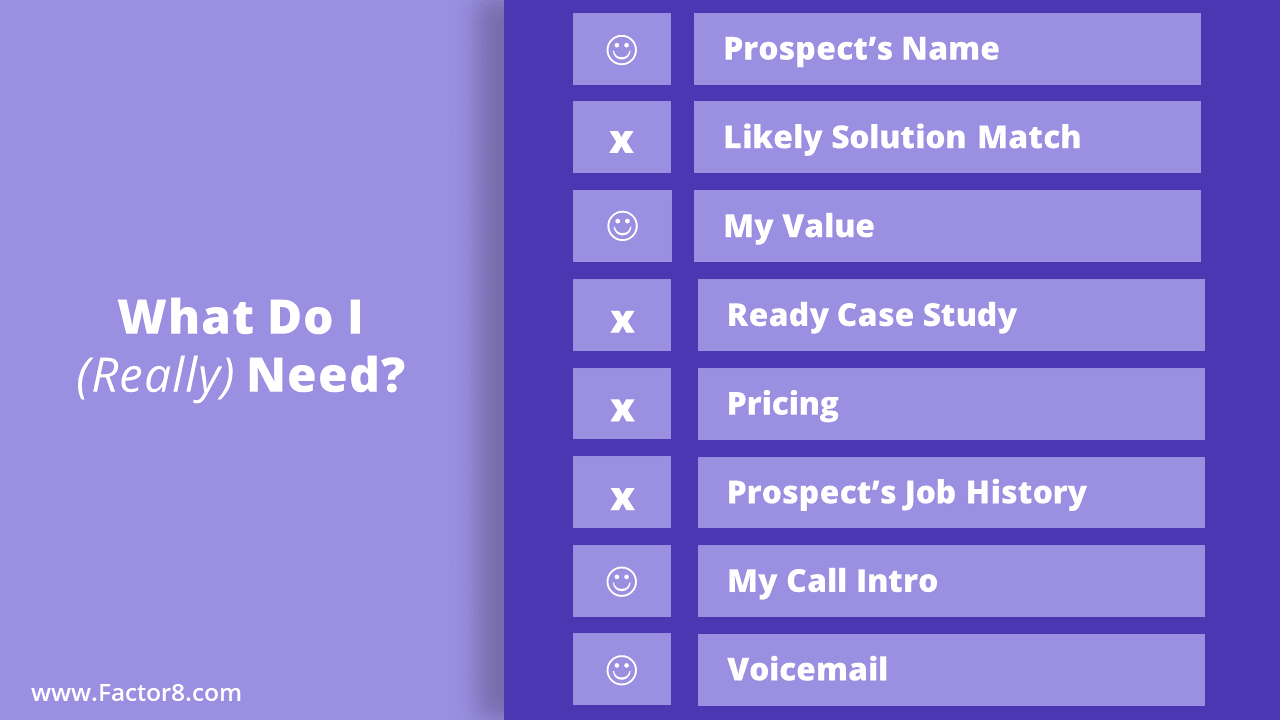
With speed in mind, think about the key elements you need to craft and leave your voicemail during your prospecting. Here’s a list of the usual suspects with a breakdown of why you do or don’t need them.
Name – This one is pretty obvious. Know their name when you call! (But guess what? Sometimes you don’t even need this when they’ll repeat it in their voicemail!)
Solution Match – If they aren’t even on the phone, you’ve got nothing to diagnose for them, so you don’t need it yet.
Value Prop – YES! (SWIIFT℠ everyone!) What value are you bringing them? An absolute must. A whopping 74% of buyers will choose to work with sellers who are the FIRST to add value according to Corporate Visions.
Case Study – Sure, a ready case study is helpful, but do you really want to bog down your call OR voicemail by spitting out stats? They don’t care yet! Skip it.
Pricing – Again, hard to know what they need yet, and that doesn’t lend itself well to providing pricing.
Job History -Spoiler: it’s not needed! Focus instead on one quick rapport builder.
Call Intro – Make sure you have this down pat.
Voicemail – ALWAYS leave a voicemail! Otherwise, the effort you put into making this call goes right down the drain. You’re not buying a billboard to leave it blank, are you? (Shameless plug: your voicemail is 3x more likely to get returned when you take our class, Messages That Get Returned, which we offer in our eLearning platform, The Sales Bar)
So to summarize – when you pick up that phone, know their name, have your value prop handy, your call intro, and a voicemail if all else fails. Save the image below to help you remember.
Group Your Leads
Make it easier on yourself by grouping your leads together. Here are some quick categories to organize them by:
CRM History
Trigger Event (did they all attend a conference? Fill out an inbound lead form?)
Profile/Demographics
Offer (do you have an incentive to offer when you reach out to them?)
Location (do you have a rep going to that location soon? Perfect time to reach out!)
Social Connection (mutual friend, past acquaintance, school history, etc.!)
When you do your research, your first instinct might make you feel like you HAVE to give individual attention to every single person and potential lead. Guess what? You don’t!
Easily group call goals, qualify & explore questions, voicemail scripts, and your SWIIFT intros.
What should you individualize? The rapport builder – it’ll be unique for each person.
Boom, you just saved yourself a whole lot of time!
Never Prepare Twice
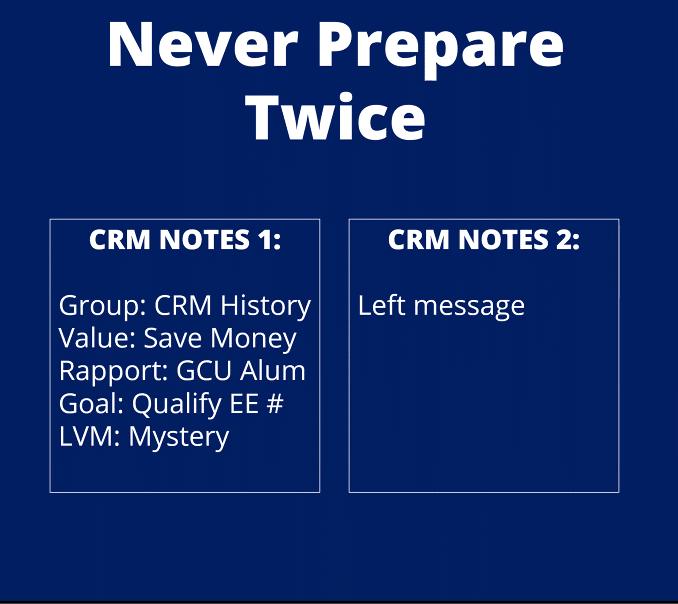
Be nice to future you! By taking better notes and including specific details about the voicemail you’ve previously left, you’ll never be left scratching your head wondering what you’ve already done and having to double back.
Here’s what to include:
What group is your lead in
What value prop did you use
What was your rapport builder
What was your call goal
What type of voicemail did you leave
BONUS: Always Add Value
Seems like a no-brainer, right? You always want to call to add value to your prospects. Try the following:
Interact with them on social media – comment and share their posts
Recognize something – give a compliment!
Customize your request
Be brief
Always GIVE something first
Ask short and closed questions to get them talking
Bottom Line
Prospecting is always going to be a numbers game. Remember: it takes 6-9 times to get to 90% of the people on your list! Put in the work – but don’t worry about putting in extra.
Subscribe to our email list to receive new content, webinar invites, and training offers.
If you aren’t getting any response to your sales prospecting outreach, you might be guilty of making these common mistakes.
Mistake #1: Pitching in your sales outreach
It’s tempting to explain why you’re sending a prospect an email, direct message, or leaving a voicemail, but don’t! This lets your prospect scan, decide “no”, then put you on auto-ignore. It also automatically makes your message too long and your tone too salesy.
The purpose of the outreach message is to gain attention and engage – to get the opportunity to pitch, not to pitch itself. That means your goal is to make them smile, notice who you are, type a quick reply – NOT take themselves all the way down your sales funnel and be ready to purchase (it takes time, folks).
Try sending 3-4 lines of a personal connection and a short closed-question (NOT related to your quota) instead.
Of course you want to explain who you are, what you do, and why they care, but if you’re trying, you’ve already typed too much! Like above, the outreach is to engage, and using a marketing-approved value prop probably sounds a little pitchy.
One sure way to get more attention instead is to make the message about THEM, not about you. Try some flattery or ask a short question instead.
Nope, don’t try to shortcut this with some social proof or other customer names, that’s cheating! Message one should NOT be about selling them, it’s about engaging them instead. You got it!
A few years ago I won an award for being a top coach in sales. Since then I’ve received over 1000 sales pitches promising to help me improve my coaching business. I have a training business that uses coaching to get results, not a coaching business.
Don’t make the same mistake by using phrases like, “I work with businesses like yours,” or “I help ____ like you.” You may be right, you may be wrong, but it irks me to think a stranger thinks they know what I need more than I do.
To correct this, you could try showing your understanding and making a hypothesis instead. Turn, “I help training companies fix their SEO problems” into, “You train B2B sales right? Would I be anywhere close by guessing you get inbound leads?”
This message showed a bit more humility and didn’t automatically assume my business NOR make me wrong. Nobody wants to feel like an idiot – especially not by a young seller.
Remember, the goal of initial outreach isn’t to close a sale right off the bat but to spark a connection and get the prospect talking. By focusing on creating a genuine rapport, asking questions that matter, and demonstrating an honest curiosity about their needs, you set the stage for a dialogue that can lead to more than just a transaction—it can lead to a partnership. So, let’s ditch the pitch, tune into the specifics of our prospects, and start our conversations on a note of authentic interest. After all, in the realm of sales, a thoughtful approach is not just appreciated, it’s rewarded.
Outbound prospecting is tough. Want to get a leg up? Take our online course, SWIIFT℠ Introductions That Work, to learn how our SWIIFT℠methodology will help reframe your messaging to capture a prospect’s attention immediately and get them talking to you.
Subscribe to our email list to receive new content, webinar invites, and training offers.
You may have heard us talk about our SWIIFT℠ Intro before, and if you haven’t, it’s an acronym we use for our sales scripts that means — So, What’s In It For Them? The idea behind the SWIIFT℠Intro is to focus on the buyer and add value to your sales script so your prospects will stop typing their emails and start listening to you.
Once you grab their attention, you can hit them with one of the most powerful parts of the SWIIFT℠ Intro — and that’s a lever. A lever is a piece of information you have on the company, contact, industry, or history that says,
“Hey, this isn’t a cold call. I’m important and you practically already know me. Tune in!”
So, where do you start when creating the ultimate phone sales script? First things first, write an outline for what you plan to say.
Start With A Sales Script Outline
Planning out what you’re going to say is just as important as actually saying it. You’ll want to make sure you hit all the right points with your sales pitch. Keep in mind your goal is to grab their attention and plan a follow-up interaction.
When creating the outline, think about who you’re calling and how you can get them interested in what you have to say. Planning out the people you’re going to reach out to along with the times will also allow you to be as productive as possible when you finally make the sales pitch.
Personalize every outline you make depending on the person or their role and change it up a bit according to what works.
Next, Figure Out The Best Levers For Your Sales Script
As we mentioned before, levers are the most effective way to grab their attention, and you’re going to want to use them to your advantage once you make your sales call.
There are plenty of different options to use for levers — such as buying history, shared experience, shared external contact, or even events.
Here are some sales script examples that use levers:
(external name) Looks like we both know John pretty well
(company history) We’ve been providing your security licenses for the past few years
(internal name) I work closely with Kathleen in marketing
(experience) I see we both attended the AA-ISP conference this year
The best lever, however, is a name — preferably one in their company (e.g. their boss or an executive):
Bob! Lauren with Factor 8.
I talked to Larry Reeves yesterday. He asked me to give you a call and I promised him that I would.
Tell me something, are you guys expanding your sales force this year?
What’s different about this lever statement is that the “why” is completely up to the contact’s imagination. It immediately generates Bob to pay attention and ask himself something like, “What’s going on?!”
It’s also important to notice that we didn’t launch into a background story when we used the name-drop technique. This is something you should avoid:
I talked to Larry and he said that he isn’t the right contact and that I should call you.
This just screams sales pitch! But, it’s what we hear most often. Don’t get into a long explanation of why he wasn’t the right contact because more than likely — the prospect doesn’t care. Instead, just call the person like you promised you would!
Use Your Script & Make The Sales Call
Once you’ve figured out which lever to use, you’re one step closer to having an effective sales script that will ultimately grab your buyer’s attention. Your final step is to make the call! With this guide and the right levers, you’ll be sure to reach your goal.
And remember — don’t leave out the SWIIFT℠ question at the end of your intro. This is what will get prospects to stop thinking about how to get you off the phone and start thinking of the quick and easy answer to your question. That’s what will get them talking!
Subscribe to our email list to receive new content, webinar invites, and training offers.
Every 2 years there’s a new airport sales book, am I right? The longer I’ve been around, the more I’ve watched them cycle through. Ask questions! No, share insights! Add value! Wait, actually challenge instead. I don’t think I’ve read one I find incorrect, but I’ve also never aspired to be an airport author.
To me, the methodology is always secondary to the process. Also, the sales methodology only addresses the decision-maker conversation, and in virtual selling, the conversation is less than half the battle.
I take pride that Factor 8 content helps sellers find the right people, capture new contacts, figure out who to call, how to get (and keep) their attention, and get a call back – and all of that is before conversation one! (and yes, you can buy a tool to help with nearly all of that, but trouble ensues when tools replace strategy – that’s a different blog).
All that said, we don’t have a sales call where we aren’t asked about our methodology, and this is fair. You don’t want us teaching your people something counter to your culture, your process, or your existing methodology.
So for the first time in 15 years, I’m finally defining Factor 8’s methodology. It’s called:
SWIIFT℠ Selling
No, it isn’t a typo. SWIIFT℠ stands for, “So, What’s In It For Them?” and it’s the opposite of WIIFM (“What’s In It For Me”, in case you needed help with that one 😉 ). And although nobody purposely teaches reps to use the WIIFM methodology, it’s what happens in sales calls when we don’t teach them not to.
If you’re unsure what I mean, check your inbox. 99.9% of sales messages are about the rep, the company, the product, and what they want.
“I wanted to check in with you to see if you were getting enough leads because my company is helping others get leads and we’re the leading provider of leads and we’re doing an event about leads…”
Enough!
This is what happens when we onboard reps with company and product information only. They go out and parrot that information. Instead, SWIIFT℠ Selling teaches sellers to always first ask, “So, what’s in this call for them?” And to re-focus a message, a call, a value prop, or a call intro into one that leads with value for the customer.
If you’re thinking, “wait, I thought value-based selling is dead,” just try letting your 24-year-old rep lead with a challenge. Ouch! Also, SWIIFT℠ Selling doesn’t mean it’s ONLY about value, it means we use value and customer centricity to get and keep attention for our discovery call and our product demo, and our closing call.
Of course, SWIIFT℠ Selling also implies speed. Bingo! This is absolutely critical in virtual selling.
If my email is too long OR all about me, we’re dead in the water.
If my intro is too long or all about me, we’re dead in the water.
If my discovery is too long or all about me, we’re dead in the water.
Our Factor 8 trainers hear a lot of sales call intros. Thousands of them. And, the bad news is that there are a lot of bad intros out there. Really, I mean a lot of horrendous intros. The good news? They’re easily fixed and your reps can begin to see an immediate impact by implementing a few tips.
I shared with Sales Hacker how reps can fix their intros. Read about it here. Got a comment or call intro successes to share? I want to hear them! Share them with me on LinkedIn.
…nor are the cookies for the “Boss Baby” fans out there. But I digress (already!)
Listen, in today’s modern sales era, we don’t typically get face-to-face meetings. This is when closing was king. We can assume our contacts are busy and they are hiding from us behind their phones. I mean, how often do you pick up calls from unknown numbers or known vendors?
That means the BIG SKILL for inside sales (and smart field/channel sales) isn’t the close, it’s the opening! It’s Moneyball folks, you can’t close what you can’t open. OK, I mixed metaphors there. It’s about getting on base with our intro.
My team and I listen to about 1000 phone calls a year, and we’ve categorized the majority of sales intros out there into six horrifying and all-too-common bad-intro buckets.
“Show up and Throw up.” Seriously, I played an actual example of one of these at a conference and we had to fast forward it for time. The customer didn’t talk for 2:24. Guess what he said when he did?
“Good for You.” Congratulations on being my Account Rep. Did that seriously warrant a call to waste my time?
“Yeah, that’s my Value Prop.” There’s a time and place for your two-second pitch. The intro is NOT it.
“Get out of Jail Free.” Don’t ask them if they’re the person who handles purchasing decisions for your service. Who in their right mind would say “Yes! (And I love vendor calls!)”
“The Setup.” I’m not sure who invented the “That would be of value to you, right?” pitch but I want to scream every time I hear it. It just BEGS me to say no. “You want to save money right?” STOP!
“The Touchbase.” Don’t touch my base. Ever.
Sales Call Intros that Work
The good news in this litany of bad is that intros are easy to fix. How? Put your customer at the heart of it. Lead with what’s in it for THEM and not you. Sure YOU want to introduce yourself, but why should THEY care?
In two sentences you can get their attention AND lay out the purpose of your call. How? We call it the “SWIIFT℠” intro (So, What’s in it for Them?). This is what I covered in my webinar for BrightTalk. I dug a little deeper & provided tools to help you fix intros at your office. Click here to download the recording.
OH! And I collect these now. Send me your hilarious examples of my top 6 offenders. We’ll edit the names to protect the guilty. Yeah, I’d love to hear your good ones too – AND how many more at-bats you and your team are getting. Check out our business development training to learn how fixing intros raised close percentages up to 300%!
So let’s get out there and play some ball! Oh, but now while drinking coffee right? Oh, whatever.
Interested in sales training for yourself or your team? Let us know!