
10 Actionable Tips for Creating Your Sales Team Development Plan + Budget [“Sales Shot” Workshop]
10 Actionable Tips for Creating Your Sales Team Development Plan + Budget
[“Sales Shot” Workshop]
[“Sales Shot” Workshop]
[“Sales Shot” Workshop]
[Research Report]
[Webinar Recording]

Now more than ever the world needs good virtual employee development. Enablement leaders are scrambling to take face-to-face employee training programs online and sales leaders are stretching themselves thin plugging holes to engage their people, coach, and level up. But we’re all circling around a central problem:
If you’ve ever let a recorded PowerPoint play in the background while doing email…
If you’ve ever clicked forward ten times to get to the quiz…
If you’ve wished that the “Fluff Narrator” could be set to 1.5x speed…
You get me.
For ten years I resisted moving Factor 8 curriculum online for these very reasons. It’s boring. It isn’t interactive. It doesn’t pertain to me and my job. And here’s why:
Even if you aren’t a training geek, you’ve probably heard of adult learning principles. In short, it means that as grown-ups we want to participate in our learning. We need to relate new information to past information and share our experiences. We want the Subway model (“more lettuce, no mayo”), not the Burger King model (“#1 please”).
If you are hunting for great virtual learning or building it yourself, allow me to share best practices I learned while converting our sales and sales leadership curriculum from face-to-face workshops to our virtual offering The Sales Bar.
#1 – Go Micro. “Microlearning” is a training geek term that means small bites or, “If I can’t participate in the learning, for God’s sake, keep it short.” Fifteen minutes should be the maximum time for any module (or learning chunk).
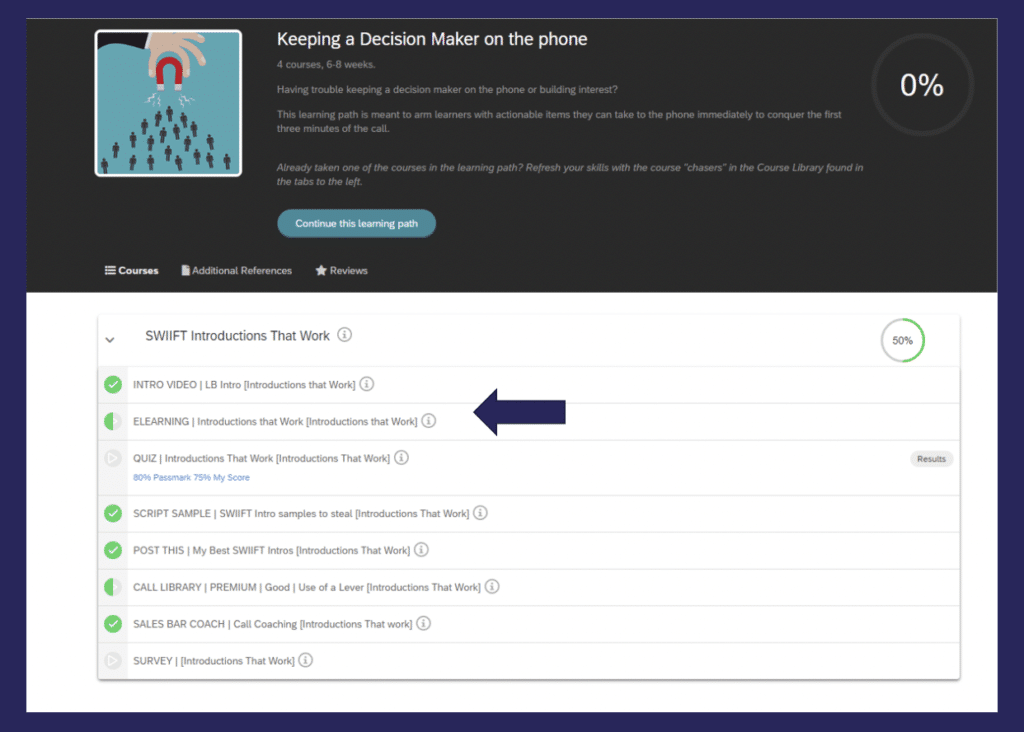
#2 – Vary the Modalities. The modality is the learning format. We use interactive e-learning (more below), video, activities, reading, cheat sheets, and actual skill demonstrations using audio or video. There are different types of learners out there and recorded PowerPoint and video don’t address them all. Kinesthetic learners need to touch it, type it, write it, sort it, and more. This is where most training fails. (BTW, everyone’s favorite feature is the real calls that show the good, bad, and ugly in real (redacted) sales calls.) Here’s a screenshot example of all the different modalities in just one module:
#3 – Make E-Learning Interactive. The reason we can let bad training play in the background is that it doesn’t require us to be present. Interactive training means the learner is choosing his own adventure and touching the content. At Factor 8 we never go more than five pages without interaction. For example, learners click to see more or hear a sample, drag and drop, slide the scale, make a choice, or type in an answer. Interactivity not only keeps learners present and engaged, it is the only way to achieve higher-level learning objectives (read on dear friend…).
#4 – Go Higher with Objectives. Bear with me and my training hat for a moment, but there’s a taxonomy or ranking of learning objectives called Bloom’s taxonomy. If you want learning to be applied on the job, you must get past “remembering and understanding” and get into analyzing, evaluating, and creating. This starts with good learning objectives/training goals and is achieved by getting learners to interact with the data. Don’t just recall it, roll up your sleeves and get your hands dirty with it. (that last part may not be a technical term as much as my term). This is why a company selling you a series of videos as e-learning misses the mark.
#5 – Layer in Live Interaction. The interactive e-learning goes to the next level when you layer in live interaction. Here is where you customize, apply, practice, and role-play. We do this after every 1-2 online modules with a live virtual instructor course. We also do it by assigning activities before and after this live session. It might be to write their own sales messaging, record a good call, or count successful outcomes trying a new skill. It bridges the gap between theory and reality and it’s the only way to get learners to own applying and using the new skills – giving actual behavior change a real shot. Bonus note for trainers: this is how you can make your “generic” virtual training customized for different internal clients.
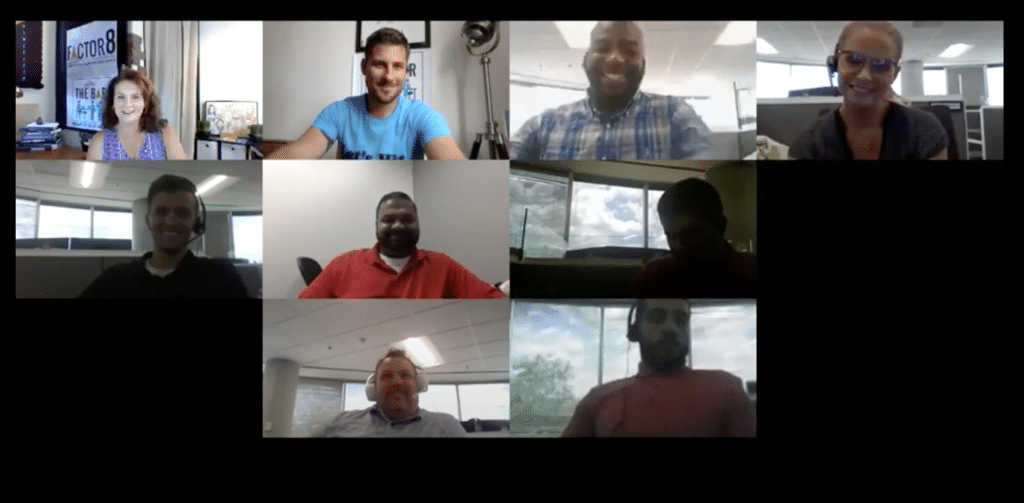
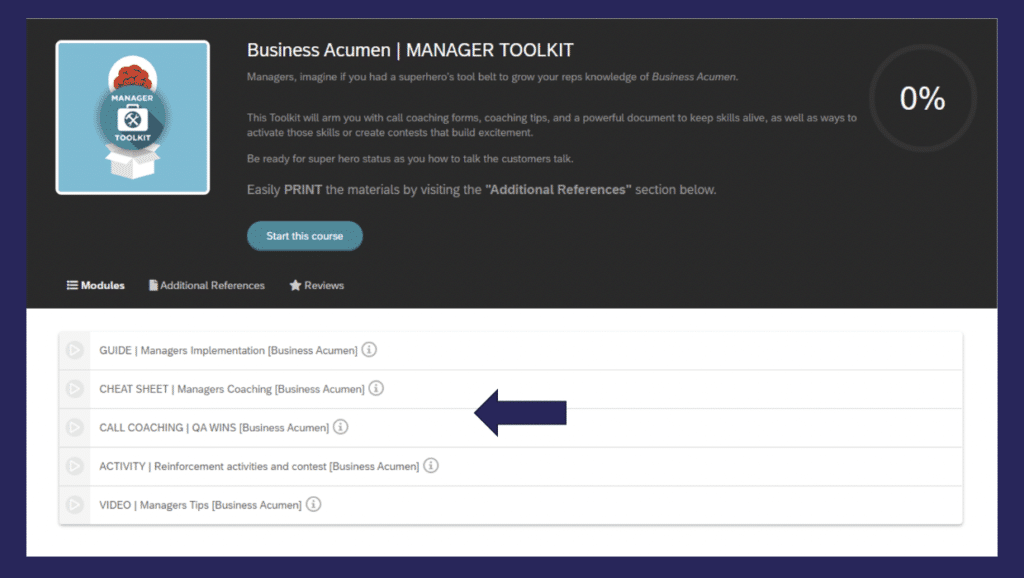
#6 – Involve Leaders. A Training Magazine study a few years ago researched deeply into what makes training stick or not. Answers #1 and #2 had nothing to do with the quality of the training and everything to do with what the learner’s boss said before the training (#1) and after the training (#2). “Forget what you learned, here’s how it really works…” is an example of this not going well. Involve the leaders not just by making them attend, but try having them partner to kick off the training, give input in the needs analysis to build the training, and by assigning them work after the training. We built Leader Toolkits to accompany every module that includes call coaching forms to grade the skill in real calls, a coaching cheat sheet to help them ask the right questions during call coaching, and even activities and an implementation guide to help them roll it out and keep skills alive afterward. Here’s a sample:
Ok, my top 3 tips turned into six, and I still feel like I’m just getting started. In the end, I’m enormously proud of what we built in The Sales Bar and I hope it’s helped you picture a new level of good for virtual instruction. If you’ve seen something here you like and you need virtual sales training for sales reps, sales managers, or sales leaders, click here to learn more about The Sales Bar for your team. It took us two years to build this and we’re not done yet. If you’re just starting, you can save time by outsourcing the sales curriculum to us and focus instead on getting your product, process, and new hire orientation curriculum online internally.
Contact us today to request information on our customizable virtual sales training programs
available for reps (and managers).
If you haven’t heard yet, we’re telling you now! We at Factor 8 have officially launched a brand new e-learning platform where your reps and managers can practice and refresh those skills they learned in our Factor 8 onsite advisor training sessions! And, we couldn’t be more pumped to share it with you.
“Okay,” you’re thinking, “But why do I care? My teams are already receiving Factor 8’s training.” We’re glad you asked.
Here’s why The Sales Bar could be a big deal for you.
Our learners are seeing immediate results. Tom, an SDR leader, says: “Historically, our team gets almost zero callbacks on voicemails. After taking the Factor 8 online course on effective voicemails, we received 25 call backs last week alone!”. Plus, there’s no complicated scheduling. Reps train at their pace whenever they’re free – at home, at lunch, in a box, with a fox…you get the idea. Our anonymous testers are calling it “Easy Online Flexible Training”, and that’s the goal – to make it easier to learn more!
Our testers think it’s “Friendly and Fun!” Learners are exposed to multiple styles of learning and have more fun completing training. Because we think learning only one way is boring (and so do your reps and managers!).
Because everything’s recorded digitally, leaders and managers can see exactly which reps are excelling and which need support and where. It’s like your own secret spy cam!
Sales Bar supports the learning that goes on in our onsite training sessions by breaking down the same skills and offering diversified practice activities to keep them up to snuff long after the session has ended. Studies show that regular reinforcement of training is critically important to protecting your training investment.
You can’t just do training once and expect your reps to continuously improve forever. They need practice and repetition so they can actually see daily improvement at their desks and on the phone. Diane Abraham, Sales Director at RedVector says, “…To me this is what it takes to coach up a team. Not just 4 days in a room but ongoing courses/content with a mix of self guided and manager assigned tasks. We call that blended learning in our world.”
You don’t want to waste time and budget on a product that doesn’t work! The Sales Bar ensures you experience more growth at end of month. For example, Mike, Director of Telesales, tells us, “We had a significant lift, +19% across the entire team on topline growth for the month of May [1st month using the Sales Bar]” And we like those numbers!
The same award-winning company you trust for all your inside sales training can also provide support when they aren’t there! (Hey, that’s us!) The Sales Bar is designed to supplement our onsite sessions, not work against them. You know us. We know you. You’ll get the best ROI because of it.
You know as well as anyone how quickly the inside sales industry is changing (Overnight, it feels like). Newer, more effective techniques are being developed all the time, while others simply fall out of fashion. The Sales Bar ensures your employees are always on the cutting-edge. So, your teams are always given accurate information.
Psst…it’s okay to cheat sometimes! We know those 3-second, handwritten notes won’t get your reps very far past the onsite training session. So, we’ve decked out The Sales Bar with great cheat sheets, guides, and script samples your teams can use everyday while on the floor!
Once the onsite training has passed, your sales reps are often on their own to practice and seek out feedback. And the quality of that feedback can vary manager to manager. With The Sales Bar, your entire sales team will receive consistent feedback and reinforcement, so everyone is best equipped to succeed.
The best part? You can try it out for free to see the difference for yourself!