

Online Sales Training


Inside Sales Training: What Does Good Training Look Like?
Whether you’re shopping around for external inside sales training vendors or working with your internal training department, knowing what good inside sales rep training looks like is the first step to ensuring your training is checking all the key boxes.
We’ve outlined a few of the most important considerations to keep in mind when choosing an inside sales training partner.
Decide What Good Inside Sales Training Looks Like
This shouldn’t be a surprise to any sales leaders out there — but what makes good inside sales training is results. You’ll be able to know whether or not sales training worked simply because it moved the needle.
These “results” look different depending on your company, team, and goals. It’s important to go into the sales training and decide on what those goals are to you — whether it’s sales units sold or market share gained.
READ: How to Measure Sales Training ROI
This is even more important when partnering with an external sales training vendor. The vendor should understand your goals as well as your sales process, product, customers, industry, and competitors. There is so much specialization in the market today, don’t let a vendor bring SDR training to your team of AEs.
In order for sales training to be considered “good”, it must achieve your goals. Outlining what these goals are, and what success looks like, beforehand is a surefire way to get what your team needs out of their training.
We recommend identifying metrics, behaviors, KPIs, and overall results that you expect to shift during and after the training. Metrics and behaviors should lift immediately showing you’re on the right track, and KPIs are early indicators that the results are on the way. Identifying metrics or results only can lead to a miss.
5 Characteristics of Good Inside Sales Training
After the goals are set, here are a few more tips to ensure you’re maximizing your training investment:
1. The Sales Training is Customized
Really great sales training is customized to your industry and product/service.
This ensures your reps aren’t left trying to figure out how to take a broad theory and apply it to their job, customer, or service.
While it’s true that customized sales training is more expensive, the ROI is up to twenty-fold when you consider how much your reps are actually retaining, and how much they can apply immediately to their practices.
Use public seminars and events to help someone get a tip or two. Use custom live training to move the needle on results.
2. Get a Professional Sales Trainer
Aberdeen reported that 85% of the sales teams that are considered “best-in-class” utilize professional sales trainers or resources.
Don’t try and turn your managers or reps into trainers. Let’s face it, they’ve got enough on their plates. Plus, even really good managers and reps have no idea how to train — it’s just not their job! They might be excellent at sales, but they have no expertise in training.
Even worse, don’t let your HR department teach sales. They’re great at training and professional facilitation in many areas of your business, but their bailiwick is in company orientation and sexual harassment training — not sales and selling. They may be excellent at training but have no expertise in sales.
See where we’re going with this?
Make sure to bring in someone who is an expert at both training and sales. That’s the secret to good inside sales training, and it’s what the best in class are doing.
3. Make Sure the Training Has the Right Focus
If you’re training your inside sales reps, make sure they’re attending an inside sales training. It sounds simple, but oftentimes well-meaning sales team leaders are duped into thinking “sales training” is enough. Shoe-horning your company’s existing field training for your inside team may actually do more damage than good.
Most popular sales books and training curricula deal with a very narrow view of selling: The conversation between Person A and Person B. Anyone who has been working in inside sales for a while can agree that the true issue lies in getting that interaction in the first place.
If your reps are struggling with connecting with decision-makers, getting callbacks, finding the right people, figuring out who to call, and capturing attention at the top of the funnel, then conversation selling and overcoming objections will miss the mark.
Make sure that your inside sales reps are being coached on topics like:
- Leaving compelling voicemails that will be returned
- Capturing a prospect’s attention in the first 30 seconds
- Leading with value
- Creating engaging conversations vs. script reading
- How to get a callback or bridge to the next call
- Finding more decision-makers in the company
- Dealing with gatekeepers
It’s important to make sure other aspects of the strategy are covered as well, so the reps can rely on their managers less for questions such as:
- Who should I call first?
- How often should I call?
- Should I leave a voicemail message?
- How often?
- Now, what do I do?
4. Sales Training NEEDS to Be Hands-On
Theory stinks.
During the training, make sure reps are getting on the phones. There’s no reason that training shouldn’t be stopped so that the reps can go try out the skills they’re learning, and role-plays don’t really tell the whole story, do they?
Live calls to live customers using the training guarantees that these training methods are going to be applied. Live calling in a safe space leads to more rep buy-in and builds confidence. When reps see the tactics work in real-time they adopt, apply, and try more often. Training fall-off (the forgetting curve) has the odds stacked against it now!
Make the training stick by actually making calls and building pipeline during training.
5. Make Sure Your Managers Get Involved in Sales Training
Put managers in the reps’ training, and when possible make sure they have their own version of the training class tailored for their needs. Managers need to learn how to recognize the new skills in action, when to coach, how to coach the new skill, when to celebrate it working, and how to keep the momentum alive when the trainers leave. Behavior change lives and dies with the management team, and their buy-in, involvement, and use of the new skills are critical to success.
Ask your vendor how the managers will be involved in retaining the new skills.
READ: Tips for Enablement Leaders to Increase Sales Coaching Focus
Good Training is Ongoing Training
You got it, training is a process, not an event. Reps reported a “Lack of Development” as a top 5 challenge every year for the past five years as reported by the American Association of Inside Sales Professionals. Aberdeen also reported missing development opportunities as the number one rep-reported reason for leaving companies.
Deciding to invest in rep development is a smart choice, but be sure you don’t assume that it is “one and done.” Your teams want ongoing opportunities to learn, grow, and advance their careers.
READ: Why Event-Based Sales Training Falls Short
Training Magazine reported an average number of development hours/year/employee at about 48 hours – or four hours/month. Is your internal training team ready to provide this? Most corporate training teams get quickly maxed by providing new hire orientation and onboarding. Manager coaching can fill some of the gaps, but if you’re talking with learning vendors, check their ongoing offerings as well.
Ongoing training will often nurture and advance skills taught onsite – helping check the box of retaining new skills and providing the ongoing development reps crave.
The easiest way to accomplish this is with vendor-provided online skills training or inside sales training courses after their session to brush up on their skills, hone in on their weak spots, and keep skills in practice.
When evaluating sales training software, look for interactive resources such as:
- Recorded call libraries
- Sample scripts/messaging starters
- Interactive micro e-learning modules
- Printable cheat sheets
- Manager coaching
- Team activities
- Videos
- Sales certifications
Reps want skills on-demand. Learning should be easy, fun, interactive, and flexible. The old days of long-form narrated slides and sales training videos are over. Anyone who has clicked their way through to the final test (or let it run in the background while doing email) can attest to the fact this isn’t engaging or effective.
Again, look for sales training software to engage your management team as well as the learners. New skills and a culture of development live and die on your front lines. Does the software provide manager resources?
How about fast-reference cheat sheets, coaching guides, or contest ideas? Is it nimble enough to allow quick reference before a big call or team meeting?
Get your sales managers involved in testing your top choices.
Are you looking for the best inside sales training programs?
Contact us today to learn about our customizable virtual sales training programs
available for reps and managers.

The Best Sales Coaching Questions Ever
Learning to be a great sales coach is hard – really hard. It’s the hardest thing we teach new managers who were formally reps. Now, it’s not as hard as climbing Mt. Everest or teaching your grandma how to order presents online, but it’s rough.
It’s the #1 skill that most new managers struggle with. If you’re a naturally phenomenal coach, congrats (seriously!), but the rest of us are struggling. Why? We don’t often know what defines great sales coaching. So let’s break it down…
The Difference Between Presenting vs. Facilitation vs. Coaching
The lines are often blurred between presenting, training, and sales coaching, especially when we don’t have staff and resources dedicated to each. Why does it matter?
Well, does this sound familiar?
“I’VE TOLD THEM 100 TIMES!!”
We’ve heard it from managers and VPs (and parents 😉 ). It’s rough, folks. If people aren’t retaining what you’re telling them to do, they obviously aren’t going to do it. So we have to back up a few steps and make sure it gets in their brain and sticks.

What is presenting?
We define presenting as…Introducing new information through speech often using slides/visual aids.
Watching a webinar? You’re listening to someone presenting. Sitting in a lecture hall in college? That’s presenting.
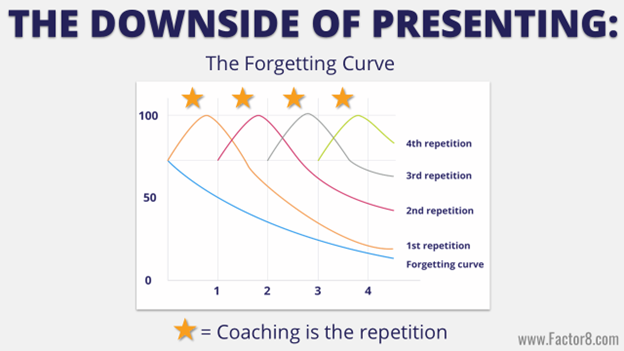
Now the downside to presenting is something called The Forgetting Curve. If you’re in sales enablement or training, you’ve likely heard of it. It shows us that by the end of the day, reps have lost 50% of what you taught them. In a week, they’ve lost 90%. So it’s pretty obvious why they aren’t doing what you told them to do – they can’t even remember it!
There are two ways you can beat The Forgetting Curve.
- By utilizing great facilitation or training. The better (and more interactive) the training, the more likely the skills will stick. The more often reps actually do something, the more likely they’ll remember it and the more likely you’ll get results.
- Through coaching. All you have to do is tell people what to do and then 1:1, 4x throughout the week, go and coach them on the same skill. You’ve got time to do that, right? 😐 Nope! That’s why good facilitation is the better option.
What is facilitation?
Folks the name of the game to get people to do what you need them to do, to get results, to get commission checks is: RECALL. They can’t do it if they can’t remember it.
In order to obtain recall, you need to have good facilitation or training. Unfortunately, most facilitation is broken. You can’t just tell someone to do something and expect them to do it perfectly, they need to practice.
Grab a sheet of paper and draw a picture of the Statue of Liberty based on memory. Assuming your side hustle isn’t as an artist, it’s probably going to look like something a child drew. Why? Well, when was the last time you drew something? Drawing is something we did a lot as a kid until other things became more exciting or interesting. We quit practicing, and when we quit practicing, our skills freeze.
For many of us, teaching is also a skill frozen in time. We think of teaching and we see ourselves sitting in a lecture hall with someone talking at us, telling us what to do. And we know that’s not how people learn.
That’s why we’ve got to redefine teaching and facilitate instead.
We define facilitation using the acronym CUP. It stands for…
- C = Connect. If you want people to remember things, apply them, and do what you tell them to do, you have to help them connect with the information (it’s called Adult Learning Theory). It basically says that adults have filing cabinets in their heads. If you tell a kid something new, they’ll accept it as fact. Adults won’t even log it until you help them find the file folder. That means you’re helping them connect with it.
- U = Use. Great training takes longer because we’re facilitating them actually getting their hands on it. I’ve watched people do systems training where their team is just sitting and watching. Totally hands-off, and totally a waste of time. If we want people to understand, we have to get them to use it.
- P = Practice. We absolutely, positively have to practice. End of story.
By using the CUP method for facilitation, that’s how we beat The Forgetting Curve. Expect 70-80% recall. Get some buy-in along the way, a little practice and roleplay, synthesis with what they do on the job, and you’re looking at 80-90% recall. Plus, you’ll create new habits.
What is sales coaching?
Everyone does it a little differently, but a lot of people confuse sales coaching with leading, but with a few questions sprinkled in.
We define sales coaching as… Ongoing development method used by leaders using questions to inspire and deliver personal feedback on skills.
Pay attention to the bolded words. If you’re just giving people advice or there are 25 people in the room, that’s not coaching. When you’ve got a team of reps in the room, what you’re really doing is presenting.
ACTION: Go and CUP check your virtual sales training. If you’ve got a lot of videos and little practice, people aren’t doing what you tell them to do. Leaders, if you do a lot of announcing without any coaching, follow-up, or roleplays, they’re not doing what you tell them to do. And when it’s something critical like learning how to sell and be successful in new hire onboarding, you’ve got to do all 3.
READ: Why You Need a Sales Training and Enablement Budget
The Power of Sales Coaching
If behavior change is critical, start with the 1-2-3 punch. Begin with the presentation, then facilitate, and then coach. Now, coaching alone CAN be powerful (but not how you think…)
Great coaches have 1 thing in common: they motivate people. Motivation is the key to everything. It affects recall (information + caring = recall).
READ: Tips for Enablement Leaders to Increase Sales Coaching Focus
Our job as managers and coaches is to ensure our reps leave our coaching sessions feeling like superheroes. That’s why we teach the 5:1 method – share 5 positives and 1 area for improvement. It’s also the #1 mistake new managers make. Why? We hear the laundry list of things that went wrong on a sales call and can’t help but tell them every single one of them.
The power of sales coaching is in the questions you ask. Said in another way:
“Leaders who ask more, get more.”
That’s why we coach in questions. It’s called “Instinctive Elaboration”. It’s the secret behind the Factor 8 SWIIFT℠ intro where we’re literally hijacking the brain of the prospect to answer our questions even if they didn’t mean to and it’s why it works to get them talking.
It works like this: how old are you?
Did a number pop in your head? Now it’s halfway out of your mouth.
The brain stops what it’s doing and starts answering questions whether it wants to or not.
Here’s more proof: how much do you weigh?
I know you didn’t want to share it, but you thought it, didn’t you? 🙂
DOWNLOAD: 20 Ways to Increase the Sales Coaching Focus at Work
The Best Sales Coaching Questions Ever (and Why!)
We’ve spent years mastering the art of coaching and have compiled the best sales coaching questions ever (and they’re backed by science).
1. “Tell me about a time you had to do something similar?”
This helps them connect. Unfortunately, not all of us have the time or tech to do the CUP theory. We use a lot of video, but do videos actually teach? We don’t think so (read more about that here.)
2. “Why are you so good at this?”
You can ask this to anybody in any coaching session and something happens in the brain called “Confirmation Bias”. If you ask them a ‘why’ question, they’ll look for the reason that it’s true. This instantly boosts motivation.
3. “What happens when you knock this out of the park?”
This question builds confidence by creating mental imagery, scientifically known as “Functional Equivalence.” You’ve probably heard it with Olympic athletes where they picture themselves doing their gymnastics routine perfectly in their head and it fires the neurons as if they’re doing it. If you can get your reps to picture success, they’re more likely to achieve it.
There’s also something called the “Pygmalion Effect” which says that if your manager believes in you, you’ll believe in yourself more. Read differently:
“Leaders who expect more, get more.”
4. “What are you most proud of on that call?”
If anybody has reps that beat themselves up a little bit, this question is for you. The brain will search for an answer and find it – guaranteed.
5. “What should we do next?”
This is all about active recall; going in and finding the information in the brain. The other question we ask is “what was the customer thinking?” This is out of our head and our noise and puts ourselves into the shoes of the customer which is what we’re trying to do. It shortens ramp time, folks. Ramp time isn’t about me not knowing it, it’s about me not knowing when to use it. And if we can burn the pathways in the brain to recall the information we need at the right time, that’s how we get people to learn and apply skills faster.
6. “What one thing is most important to work on?”
You can use this in any coaching interaction anywhere and the science behind it is called “Implementation Intention.” Studies show that if you work on one thing and put a plan in place, it’s 2-3x more effective.
Coaching your team is more than just sharing information with them—it’s about really changing the way they think and act. By incorporating presenting, facilitating, and coaching, you’ll move from just talking at your team to actually sparking real behavior change.
Subscribe to our email list to receive new content, webinar invites, and training offers.

8 Sales Enablement Best Practices to Partner with Revenue Leaders
This one is for my sales enablement and training pros.
Have you struggled to connect with your revenue leaders?
If you’re in enablement and getting rapid-fire requests or getting ignored by leadership, it’s because…
They don’t get it.
READ: How to Find the Best Inside Sales Training Company
When I was hired to run global sales training years ago, I thought my job was to build training to onboard new salespeople in the digital world.
I was wrong.
Instead, I spent a year traveling the world and meeting with sales leaders to talk them out of what they thought would work.
I had to teach them how people learn. I had to learn their language and build the bridge between revenue and enablement.
WATCH: Sales Enablement Secrets: Actionable Sales Training Tips, Trends, and Advice
So here are 8 effective ways sales enablement can forge a better partnership with revenue leaders:
1. Keep meetings short and fast. Confirm meetings the day before via text if possible.
Revenue leaders have packed schedules, so respecting their time is crucial. By keeping meetings brief and confirming attendance the day before, you ensure that your interactions are efficient and prioritized.
2. Get three or more follow-up resources – top, middle, and struggling sellers, as well as a go-to Sales Manager.
Understanding the perspectives of sellers at different performance levels and involving a reliable Sales Manager can provide comprehensive insights. This helps tailor training programs that address varied needs within the team.
3. Uncover root causes by questioning results, metrics, challenges, sales cycle stages, and KPIs.
Dive deep into the data and ask probing questions about the results and challenges. Understanding the intricacies of each sales cycle stage and key performance indicators will help pinpoint the real issues that sales training needs to address.
4. Get five or more recorded call or video examples so you know where to insert new skills and role-play ideas.
Recorded calls and videos are invaluable for identifying where sales reps need improvement. They also serve as great tools for developing role-playing scenarios that target specific skills gaps. Save these recordings to help develop future reps, showing them the good, bad, and ugly.
5. Move mountains to get going fast but set expectations up front for build time and class time.
Sales leaders often expect rapid results, but it’s important to manage these expectations by clearly communicating the time required for developing and delivering effective sales training programs.
6. Appoint a sales liaison to shadow sales, attend meetings, and translate insights. Ask for the same in return.
Having a dedicated liaison who understands both sales and enablement can bridge communication gaps. This person can provide real-time feedback and ensure that training initiatives are relevant and aligned with sales goals.
7. Always document deliverables, expectations, and commitments in a client “contract.”
Clear documentation of what’s expected from both sides helps prevent misunderstandings. A “contract” outlining deliverables and commitments ensures accountability and clarity throughout the training process.
8. Measure results post-training at two weeks, four weeks, and eight weeks. Raise flags if no movement is detected.
Consistent follow-up on sales training effectiveness is essential. Regular check-ins at defined intervals help track progress and identify areas where additional support may be needed. If there’s no improvement, it’s crucial to address the issues promptly.
READ: How to Measure Sales Training ROI
By incorporating these strategies, sales enablement professionals can build stronger, more collaborative relationships with revenue leaders. It’s about speaking their language, understanding their challenges, and providing tangible value that directly impacts sales performance. When both sides work together seamlessly, the entire organization benefits from improved alignment, communication, and results.
Subscribe to our email list to receive new content, webinar invites, and training offers.

Why Sales Training Videos Don’t Work
Calling All Leaders Training Sellers!
There’s something wild happening in the sales training industry right under our noses, and it’s severely impacting the skill level of your front-line sellers. Truth: Sometimes I’m part of the problem.
Riddle me this, my friends:
If it takes 8 meaningful interactions for a buyer to take action (Salesforce) or 900 digital touches before a major purchase decision (Google), then…
Why do we expect sales reps to try a new skill after watching one video?
Video learning is as passive as it gets (not that anyone ever checked email while playing a training video) and yet we’re “training” sellers with this single touch (not even eight touches like SFDC says we need. Video alone should take hundreds, right?)
Getting a seller to try a new skill = getting a buyer to make a purchase.
And a 30-minute training video = a single commercial.
In other words, sales training videos alone don’t work – they’re not effective in teaching skills. In fact, I’m going to climb up a little higher on my soapbox and say…
Video-based sales training is NOT ACTUALLY TRAINING.
It’s entertainment. “Edu-tainment” at best. In our marketing vs. sales analogy, training videos would be the equivalent of content marketing. Its purpose is to brand, to “passive touch”, and to warm a prospect.
READ: 10 Signs Your Sales Team Needs Sales Training
Unfortunately, not a lot of leads convert from content alone. Especially from a single blog or ad. This is where marketers share the stat that it takes eight “meaningful interactions” before someone will take action. And sales leaders get that “meaningful interactions” are best driven by the sales team – things like asking the right questions, qualifying, customizing the pitch, applying the solution to their world, showing value, etc.
Training works the same way. What we’re selling is a behavior change – the breaking of one habit and the installation of another. Let’s say the goal is to stop sellers from prematurely pitching as an example. We want to replace the habit with a new one like asking prospects 5 questions before delivering a custom pitch.
A great webinar or video on the subject will at best introduce this concept or maybe passively gain some attention or buy-in to the idea. Great first step!
READ: What Makes Good Inside Sales Training?
But as leaders, it is irresponsible of us to leave it there. We left off the entire rest of the learning cycle! If your training is only (or primarily) video-based, then your learners are missing:
- If and how the idea applies to them
- When in the sales cycle it’s happening
- Which behaviors they do today that they need to stop
- How to write better questions
- When to ask new questions
- What to do when they get the answer
- How to ask the questions confidently
- How to bring up the pitch
- When to bring up the pitch
- Practice and support doing this over and over until it’s a habit
The most important parts of training to gain behavior change are missing. Don’t even get me started on maintaining that behavior (heard of the forgetting curve?)
Here’s the hard truth: If your training does not include an opportunity to try the skill, customize the application of the skill, share examples of the skill being done in different situations, practice using the skill, or feedback on the execution of the practice, then I’m sorry to tell you that you’re not training. You’re entertaining.
READ: How to Level Up Your Team with Sales Training
It’s gotten harder to influence buyers to take action with all the “noise” out there, right? Your sales teams are right in the middle of all that noise, and the younger generation is accepting video training as complete. It’s up to us to do it better. It will be a competitive differentiator for those who do.
Please do yourself, your managers, and your salesforce the favor of checking. Here are some questions to ask your training/new hire/enablement team:
- What percent of our new hire (or ongoing/career path) training lessons are video-based?
- What do we do after the video?
- When do they customize and practice the skill?
- Who gives feedback on the execution of the skill?
- What actions are being done to keep it alive?
Sales enablement leaders and trainers, I know you feel me. You’ve been preaching this for years, and you could chart out where video lands on Bloom’s taxonomy and how much real estate is between a video and the confident application of the skill. Need some buy-in? Send this blog, and then go ask your sales leaders these five questions:
- What are you doing to teach new hires basic selling skills?
- How much of their training is video or webinar/zoom-based (aka a “talking head”?)
- What percent of their time in training is spent listening to live calls or practicing the skill?
- What tools do the managers use to reinforce the training?
- Have you taught managers how to coach and reinforce the skills?
READ: How to Find the Best Inside Sales Training Company
Let’s all do this better. There are too many young salespeople failing out of sales. Very few get to sit next to a rockstar to soak in how it’s done. It’s up to the sales and enablement leaders to demand better skills training! I’d LOVE to share how we built 10-15 interactive touches into our training at Factor 8. If you have teams of front-line digital sellers or managers, please let us show you our methodology and our results.
Want more information on why sales training videos don’t work?
Contact us today to request information on our customizable virtual sales training programs
available for reps (and managers).

How to Get Sales Training Buy-in From Salespeople
If you’ve been in sales training and enablement for a minute, you’ve encountered this challenge: How do you engage those who don’t wish to be there?
Sometimes the “crusty experts” who resist training are the longest-tenured, sometimes the highest performers, often just a random non-believer or egoist. So how do you handle them? I have three sure-fire solutions that work like a charm when it comes to getting sales training buy-in from your reps:
1. Let them go. No, really. Nowhere in your job description does it say your job is to sell the Kool-Aid to the non-thirsty. Are you graded on attendance? This approach ends one of two ways:
-
- They’re grateful to leave and the rest of class is happy to see them go.
- They realize they’re being unprofessional and backpedal themselves right into your front row.
DOWNLOAD: Sales Training Vendor Partner Checklist
Here’s what to say (at first break/quiet work opportunity):
“Ethan, do you have a moment? Pop into the hall/breakout room with me? Hey, I feel like I’m wasting your time. I’ve heard a few comments about my approach and your busy schedule, and I just want to remind you that this is optional. If ongoing training isn’t for you or this doesn’t work for you, I’m the last person who is going to keep you.”
If the backpedaling begins in earnest and you really want them gone, try this:
“Actually, Ethan, what I’m suggesting is no longer a choice. The disruptions are now affecting the whole class and I’d appreciate it if you’d grab your stuff and maybe try next time this is offered. Appreciate it.”
Be careful to stay cool. You don’t need to offer lots of evidence he’s being rude, just let him know you noticed and give him the out.
If you want to keep him, then try something simple like:
“Hey, I get busy. You’re welcome to stay but I need you to really be here and act like a role model to…” There’s some good stuff here and I’d love your input if you can get present and stop the commentary maybe?”
2. Stroke that ego! As soon as you see the attitude, assume they’re a top performer superstar and pull their story and tip for the class. “Jane, what do you think about storytelling during discovery, have you seen it work?”
Note: For this to work, we want to pick something where Jane will agree AND give her narrow guardrails, OK? Otherwise, you’ve handed Jane the stage to derail you in front of the entire class on nearly any subject she chooses.
DOWNLOAD: How to Partner with Busy Sales Leaders Checklist
What NOT to say:
“Jane, What do you think”
This invites her to wax on about nearly anything. Good luck getting the spotlight off her and her amazing self.
Try this instead:
“Jane, have you ever tried using the second step of the objections process? I bet you have a great story”
This should give her a headstart in proving your point. Assume she will agree with you, give her a narrow focus, and specific instructions so she knows how long she has the green light. One of two things happens next:
- “Thanks, LB. Yeah, I’ve totally seen this work…this one time I was a hero…”
- “Nope, in my experience this happens instead…”
If I get the latter, I get a few details and then interrupt (stop her momentum before it gets worse) and ask the class, “Do you all agree? Raise your hand if there is no second step of this process? What happens instead?” Now quickly organize into a positive direction. You don’t want ten individual stories, you want a vote so you know where to go. Follow up with, “OK, how can we pivot these four steps to work in this situation?”
READ: How to Measure Sales Training ROI
In other words, be ready to pivot and engage their expertise. Maybe Jane is actually right! If she isn’t, the class will shut it down and pop that inflated ego balloon.
The second benefit of this approach is the learning we do by abandoning script/trainers’ notes. Your credibility will soar with your ability to zig-zag your way to a custom solution the class experts endorse.
3. Option three is best or a 1:1 coaching approach vs. classroom. It’s two steps:
- Enroll their help
- Call them perfect
This approach combines a little of the psychology of options one and two, and almost always lands with the resistant egoist shifting into reverse and backing right into helping you out! Here’s how it works:
Adam: “Do we really need to do this? I’ve got so much to get done.”
You: “No man, we totally don’t! I’m 100% not here to tell you how to get better. You’re the best there is! I was more hoping you could show me what it should sound like in a few of these areas. Talk me through the ultimate demo. How do you kick it off?”
How to Find the Best Inside Sales Training Company
Let the ego stroking ensue – smile, nod, clarify, maybe even a few ooohs and ahhhs – then go in for the kill:
“Would you be willing to do some coaching on this? I’d love to have some of the new guys hear this. Maybe we can book a session with 2-3 guys and have you do some role plays?”
He’s taken the bait, now it’s time to reel him in!
DOWNLOAD: Maximize Free Sales Training Resources
In front of the group, find an opportunity to call Adam perfect. You’ll have to move out of his way he’ll be shifting so fast.
Try this:
“Group, this is Adam and he’s one of our top 10% around here. 10%?! Probably 1%! I heard his demo kickoff and asked him to share it with you all. Seriously, ya’l’ need to keep your eye on this guy. Adam, you must literally be the perfect Account Executive.”
Wait for it…
Adam’s reply will sound like, “Oh, gosh no. I’m far from perfect! I’ve just been doing this a while.”
I’m humble and fabulous, and terribly good-looking.
Now you have a chance to ask what he’s working on and his brain will search for and find an answer in front of the group (or 1:1).
Try something like, “Whatever, humble! No, I really love that even the best are always striving to be better. That’s what makes the greats great right? Tell us about the skills you’re focused on improving right now?”
Pretty soon he’s a coaching role model, assistant coach, and your best friend.
WATCH: Sales Enablement Secrets: Building A Manager-First Approach To Empower Your Team
Have you found a theme? There are plenty of people who may not believe in sales training and coaching and it’s usually ego-related. They’re feeling under-recognized for their skill and maybe a little insulted someone sent you to teach them anything. As soon as we reverse this and give them some spotlight, recognition, and control, the defensiveness deflates and they shape up. They will also become a big YOU fan and you can count on them to help and sing your praises.
Most of the time. (Then I recommend choice one!)
Good luck!
Subscribe to our email list to receive new content, webinar invites, and training offers.

5 Components of a Great Sales Onboarding Experience
What’s the most important component of a sales rep’s onboarding process? If we measure by time spent, most companies’ inadvertent answer would be company history, product, and systems. In an employee’s first few weeks, that’s where the majority of time is spent.
Outside of company orientation, there are five components of a great sales onboarding experience:
- Sales
- Acumen
- Systems
- Process
- Product
I’ve put these in priority order, let me tell you why I rank sales first and product last (you probably didn’t see that coming):
Sales
Sales tactics are the little skills that determine if an employee feels successful in their first 90 days. If you want them to stay, this is critical. Too often young reps quit sales because those first few months are full of calls, voicemails, and rejections. Product training will help them in a few months when they have sales conversations, but we need to focus first on getting them more of these conversations.
DOWNLOAD: Sales Team Retention Infographic
Focus on skills like how to prospect, how to make an outbound dial, how to write a valuable sales email, how to leave a good voicemail, and how to overcome initial brush-offs. When we focus on these skills with new hires, we see results like 200% more productivity than previous new hire classes (HPE, 2023).
Pro Tip: weave sales training and practice into the curriculum daily. Combine with product training to produce better questions, with acumen information to help identify ICPs and do better discovery. Daily practice builds better recall and confidence!
READ: Quick Sales Voicemail Tips to Build Phone Confidence
Yes! Outsourcing sales training in new hire onboarding can be very successful. License a vendor’s online content for a great virtual experience and then come together in live workshops to tailor messaging and role play. You’ll save time and help reps ramp faster.
Acumen
This is business, industry, and customer know-how. What do they care about, what are the challenges, what are the trends, and how do I have an intelligent conversation with them? Then, how do these relate to what I’m selling? New reps are afraid of conversations, and helping them get to know their customer and their customer’s business, lingo, questions, and challenges can fix this.
Use customer testimonials, old call recordings, and lingo bingo to get the voice of the customer.
Systems
I wish I could put systems last, but just like sales, it takes repetition to get good. Please resist the temptation to teach a system start to finish and start instead with the first 10 things they’ll do on the job.
Practice system drills DURING sales role plays. It’s not the individual skill that’s hard, it’s using them together. Systems finals should include multi-tasking and be timed.
Systems and sales are ripe for outsourcing by the way. Use your systems provider’s training – just re-organize it from the rep’s point of view. Using outsourced training helps mix it up, cover different learning styles, and infuse your program with expertise. Same with sales – some things need to be customized but don’t rely on professional training facilitators to coach selling tips.
READ: How to Build Sales Confidence During Onboarding
Process
Process is how to GSD (get stuff done). Try organizing this by the top ten questions managers get and customers ask. Teach reps how to use tools to answer their questions instead of giving them the answers. I like a good scavenger hunt for this and it’s easy to do remotely. Reps need to know how to get accounts assigned to them, do research, send info, answer customer questions – do a day-in-the-life study of your last newbies, and your curriculum is written!
Process training can also cross over into acumen practice. Role-play conversations with customers or use recordings with questions and challenge reps to find the answers.
Product
Finally product. Sure, I overcorrected a hair by putting it last, but there’s such a glut of product training in most programs I wanted to balance it a bit! When we give full-blown product training to new hires, we actually DECREASE their confidence. If you don’t expect a rep to have a conversation about the intricacies of what you provide in the first 2 months, then SKIP THIS. Focus instead on what problems it solves, the customer situations/profiles who love it, and the questions to ask to uncover this situation. Then provide resources just in case to look up answers. Slimming down the product features and functionality helps beef up the “how to sell it” portion.
Pro Tip: do product training daily just before sales training so you can incorporate the product situation questions into your sales questions and be teaching them how to do discovery right from the start.
We’re talking about unconscious incompetence and it’s important. We can’t have reps making outbound dials feel underprepared and afraid. So lop off half of the training you’re doing in the first month and instead drill the basics. If they don’t know the complexities of what they’re selling in month one it’s a win. We will only retain about 50% of what we’re taught in sales onboarding unless we drill it, practice it, and role-play it, so less info and more practice! Bonus: mix it all up and use it together like they will on the job.
Subscribe to our email list to receive new content, webinar invites, and training offers.

Sales Training: How to Get Buy-in From Your Salespeople
Are you having a hard time getting salespeople bought into sales training and ongoing learning? Struggling to get their attention? Unable to get them to try and apply new skills?
It all comes down to behavior change. Getting people to try new things and change their behavior is one of the toughest things out there.
READ: What Makes Good Inside Sales Training?
That’s why I use a model called BLISS.
If you’re having trouble getting adoption, include each of the steps below represented in your training program.
B – Buy-in – If you want a salesperson’s time – their most valuable resource – you better show them upfront why it’s well worth their time. Show them ROI and results, or prove that they may need some help here. Basically, prove they’re in trouble without using the skill OR prove the benefit of using the skill.
L – Learning – As training experts, I don’t need to tell you what good facilitation is. I use the CUP model. C stands for “Connect”, U for “Use” and P for “Practice.” If it’s a video, it’s not learning (more on that topic here).
I – Integration – We have to be able to use skills at the same time when we’re in sales. I can’t just have a folder of product training, skills training, and systems training and not integrate them. So, if you want people to use your new skill, show them HOW and WHEN it’s being applied. Help train the triggers of when to grab this folder and practice it integrated with other skills.
S – Synthesis – Make sure you’re practicing with other skills. If this is something that’s just in theory and sort of left on a shelf, it’s going stay on that shelf. Bring it into the real world. At Factor 8, we always make live calls practicing new skills during training. We’ve learned it, we’ve role-played it, we’ve talked about it, now we’re going to go do it and get some feedback on it.
S – Support – Getting busy revenue leaders to support training initiatives is rough. We’ve got to do buy-in for them as well. My tip here is make it FAST and EASY for frontline managers to support these new skills. Bring them into the training but give them tools to use. We have a manager toolkit for every class we teach with easy-to-use activities in huddles, classes, or training sessions to keep skills alive. Things like call coaching forms or call coaching cheat sheets to help them support the newly learned skills.
Follow the steps in BLISS and you’ll blissfully ensure that salespeople will embrace and apply new skills. Need help? Email me at LB@factor8.com.
Subscribe to our email list to receive new content, webinar invites, and training offers.

How to Build Sales Confidence During Onboarding
I’ve heard from many sales leaders lately that it’s tough getting the next generation of sellers to pick up the phone.
We all know that no one wants to make cold calls, but the endless email and InMail touches and cadences that your reps are using aren’t working.
And, with the new Gmail and Yahoo email restrictions that kicked in this year, it’s more important than ever to go back to basics and get new sellers to pick up the phone.
At Factor 8, we’re focused on teaching reps tactical phone sales skills to help them build sales confidence (so they’ll pick up the phone AND feel great about it!)
Today, I’m talking about new sales hire onboarding.
When you’re bringing on someone new – especially when they’re remote – one of the most important things you can do in new hire onboarding is use call recordings.
READ: Tips for Virtually Onboarding New Sales Reps
The game has changed over the past few years. When sellers are remote, they can’t just sit next to their peers, hear what’s happening, and learn the good, bad, and ugly.
If your company doesn’t record calls, or you’re worried about not having a specific rep’s call recordings, toss that – it doesn’t matter. You can learn so much from any call recording.
In fact, at Factor 8 in our Sales Bar, our online sales training platform, we have thousands of user-submitted recorded sales calls from all different industries, organized by skill (i.e. call intro, overcoming objections, call bridging, closing, etc.)
READ: 7 Hacks to Improve New Sales Rep Onboarding
During onboarding, break down the call and let reps listen to what it sounds like, even if it’s not a good call, because what we’re scared of is what the customer is going to say to us (and the inability to think on our feet to respond to them intelligently).
When reps hear different scenarios on sales calls 20 or 30 times, they begin to feel comfortable and that fear starts to go away and the confidence rises.
And that’s the name of the game, folks: confidence. You’ve got to have it to succeed in sales, and building it begins at onboarding.
Need help building sales confidence in your sales reps? Email me at LB@factor8.com. I’m happy to help!