I’m writing this blog at 9 am tucked into bed with the flu. I started to write it at 7:15 am, but decided on OJ and an episode of American Housewife instead.
In the 45 minutes I procrastinated, I received 74 emails. WHAT?!
Please be clear that I counted the new emails, scanned briefly, and then shut Outlook. Why? Because if I didn’t this article wouldn’t get written this morning – probably not even by end of day. And because if someone really needed me there are at least 3 faster ways they can get a hold of me.
Email is the new snail mail. It’s where un-urgent requests, FYIs, and sales pitches belong, and if you aren’t treating it that way you and your organization could be wasting precious time. Yes, you get enough emails to keep you busy 4-6 hours/day, and if you ignore them all the time they will pile up (you make good points my dear sweet email lover). Alternatively, answering other people’s requests is probably not the most important part of your job, is it?
Our completely normal instinct to deal with something simple that’s in our line of sight is prioritizing other people’s to-do lists over our own.
Here are a few best practices and time-saving tips to take back your day:
Get rid of email alerts. Immediately. If we can agree that email is NOT where urgent items live (read: it has an imminent deadline), then quit interrupting your current screen with them. Every time the pop-up happens, a part of your brain goes down the rabbit hole until it finally just can’t resist a quick alt-tab to email to take care of it. It only takes a minute, right? Sure! Until you see the next one and the next one…it’s like trying to eat just one handful of popcorn at the movies. Impossible. If we could resist we wouldn’t be in our inbox right now. Kill the alerts. Be present in your current task instead.
Designate a time for email. There, that may feel better to my GMail addicted friends. 🙂 I do email once a day at the end of the day. True, my assistant cleans it out for me in the morning, so I’m cheating just a little bit. Carve out two hours/day, put it on your calendar, and be strong. It only hurts for a couple of days. You’re not ignoring. You’re prioritizing. You were hired to coach, strategize, lead…not to type.
Set communication expectations with your team. Have a conversation about what you consider urgent and important tasks and requests. Agree on what task/topic requires an instant message, text, phone, call, drop by, or email. Help team members know when you want to be CC’ed and when you don’t (there’s 50 less per day for you) and help them understand that if they email, they can expect a reply in 2-3 business days. If you choose to reprimand them for “bumping their email to the top” and sending you emails about their emails, that one is up to you. It may also be a great time to let them know when you’ll be doing meetings, coaching, and other activities that may not be interrupted with a minor customer issue or system question.
Assess in a week. Getting more done? Finding times where you wonder what you should be doing? Getting more rep coaching done? These are good signs. If you find you’ve chewed off your nails and you’re staying at work late to do all the email, your addiction is more serious and I’m sorry for recommending this cold turkey. Try some of these gentler adjustments instead:
Start the day by cleaning out emails – just book your first meeting within an hour so it doesn’t go long
Try an email cleaner like Unroll.me that will aggregate your junk mail
Consider delegating – if you’re on email alerts, groups, etc. for leads or training, perhaps someone on your team could monitor these and bring hot topics to a team meeting
Eat lunch at your desk once or twice a week and take the extra hour to respond during that time
Find one email/day your can unsubscribe or junk
I cordially invite you to try several of these time-saving tips and join me in the sweet, sweet freedom of being released from email jail. Looking for more ways to get sales management tasks done in less time? This was one of over twenty hacks in our top-rated sales manager course “Own Your Day”, which is now available on-demand at The Sales Bar.
Subscribe to our email list to receive new content, webinar invites, and training offers.
Help! I’m hiring salespeople, but where do I find them? Well, probably not in the stack of resumes from your recruiting department. Or maybe you already know that and hence the Google search bringing you here. Great sales talent is near impossible to find these days and will continue to be difficult in the coming years thanks to shifting employment rates, aging demographics, and increases in sales hiring. Your ideal candidate profile with a few years of experience in your industry and a college degree isn’t coming to you. So, what do you do?
Here are a few creative strategies and tactics to consider when hiring salespeople:
Get Ready to Win
It’s a seller’s market, not an employer’s market so every candidate you do happen to find will be comparing you to other potential offers. You are competing with other companies, so make sure now that your…
Website reflects a great culture
Glassdoor reviews are positive
Employees and customers have posted good things
Website reflects diversity (they won’t apply if they don’t see it)
Your process moves 2x faster than it used to. If it takes you 4 weeks to hire, they’ll accept elsewhere
Social presence is engaging, recent, and active
Pay and benefits are at, or above, market rate
Company social causes exist and are enticing
Job descriptions aren’t wish lists. Keep them short to fill the funnel (key for females)
Career growth and development opportunities are plentiful
More than ever, employees are shopping employers and the new generations care less about pay and more about career growth, development opportunities, and social causes. Ask yourself: How would they look to their followers if they joined your company? Will their friends think they went back to the dark ages? Or will they have FOMO because the company is totally GOAT?
(If you don’t know what either of these terms mean, it’s OK, I had to look up one of them too. But maybe get a 20-something in recruiting to do the social checks for you 😉)
Get More Candidates
OK, got this all delegated and you’re ready to win the battle? Now it’s time to fill the pipeline. Like any smart sales leader, you know better than to have just one source. Here are some great actions to try this year:
Repurpose a sales headcount to shop LinkedIn for passive candidates
Start a program at local colleges BEFORE they graduate or go to career fairs
Partner with sales colleges to volunteer to speak or judge role plays
Grant a massive bonus for referrals
Comp (or measure) managers for finding their own talent
Go talk to employees in service, marketing, product, delivery who might try sales
Try community college or tech school career fairs (is a 4-year degree totally necessary?)
Use social networks to post (e.g. is there a local mom’s group?)
Try advertising a contest, scholarship, or other promotion for sellers/leaders and use it as a marketing funnel (it’s a lead list! Call it!)
Find your favorite person each week (Restaurant server? Your kid’s teacher?) and recruit
If these seem like desperate measures, then I’ve hit the mark. This is not a time for passive recruiting. Anyone great at selling who isn’t employed already is probably not your hire.
Improve Your Selection
Got folks in the funnel but need help choosing a better fit?
Listen, I made some HORRIBLE hiring decisions my first year in every new position. Bet you have too. It’s critical to remember that your hiring process needs to be a documented and rigorous pipeline just like your sales funnel. Here are a few questions to help:
Is the screening aligned to the job (e.g. phone screens for phone sales?)
Do you have defined gates to pass to the next stage?
Are you involving multiple decision-makers?
Are you looking for experience and skill? Or behavior and aptitude (pick the latter)?
Who’s doing the heaviest lifting and how can you put less on your managers?
Do candidates have a great idea of what to expect? Could a job shadow help?
Are your managers aligned on the definition of a good candidate?
Can managers hire their own teams (trust me, don’t do it for them)
Do your screening tools help you increase the pool vs. decrease (your resume screener or profile tool may be weeding out today’s definition of good)
Have you trained managers on how to interview?
I know, overwhelming – especially with your rag-tag group of new and tenured managers (just guessing). I got your back on this one with our new Sales Bar eLearning course, “Hire Like a Rockstar”, that will help your entire team define good, create a rubric of criteria, and align interview questions + scoring to make consistently better hires. You’re welcome. 🙂
Keep the Talent You Find
Finally, we can’t address keeping your sales team afloat if there’s a hole in the boat. The best way to staff your team is to keep the ones you have. Remember, you make your number every month on the backs of your B players. Work like hell to keep your A, B, and C players coming to work and grow. Here’s what’s most important in this fight:
Monthly sales training opportunities. That’s right, several hours a month is table stakes, and a pass to LinkedIn learning isn’t impressive anymore
Monthly call coaching. Yes, monthly. Make sure your managers are trained on how to do call coaching well and are doing it consistently
A documented career path with clarity on how and when they’ll move up
Access to leaders. Manager meetings, skip levels, feeling close to executives
Company social causes. Volunteering together or a pet charity with hands-on opportunities
Work/life balance. Kids these days (did I just type that?) are uber-focused on having a full life, less stress, and chances to be with family and friends
Basic tech stack. They’re used to a great CRM, engagement tool, call recording, data sources, and more. If you’re using Excel spreadsheets, you’d better rock the rest of this list
A mission to believe in. Listen, even if you sell floor wax, be sure every employee knows how they’re helping change the world
A mentor and/or buddy. Having a great friend and/or confidant at work is a leading indicator of employee engagement.
They have choices, and as soon as they choose you, someone else is recruiting them.
Need to train newly hired sales reps or managers?
We’ve got your back! Contact us today to learn about our customizable virtual sales training programs available for reps and managers.
If you’re a BDR or SDR, you’ve probably heard your fair share of sales objections. And chances are, you’re likely NOT a big fan of them. I’m here to change your mind. Why?
I LOVE objections.
They’re proof a prospect is actually listening, and at some level, they’re even considering buying. I see objections as a challenge to understand prospects better and to showcase the SWIIFT℠ value of my product.
Ready to love objections? Let’s get started.
First, let’s understand the difference between a brush-off and a sales objection. If you’re hearing things like “I can’t talk right now” or “I’m not interested,” what the person on the other end of the phone is really saying is “I’d rather be doing anything than be sold to right now.” In these cases, you are experiencing a brush-off. These are typically heard at the beginning of the call and have almost nothing to do with your product or solution. Brush-offs require their own set of solutions, we’ll get to those in another article.
On the other hand, an objection sounds like “we don’t have a budget for XYZ” or “it’s too expensive” or “this isn’t our top priority.” Prospects with true objections are informed. They know who you are and what you are selling. Their objection is directly related to what you have presented to them (i.e. “We don’t have room in our 2022 budget for XYZ right now”).
Now that we understand the type of push-back that we’re solving for, let’s talk about overcoming objections in sales. Think about sales objections in terms of dating. You’ve poured your heart (your “pitch”) out to this potential customer and they’re quickly trying to show you the door. It’s only natural for us to take it personally. But let’s think about it this way, would you rather hear why a prospect is rejecting you, or be ghosted and left wondering why you weren’t a great fit? If you’re anything like me, you need to know “why?!”
So, let’s go over the 4 easy steps to sales objection handling so you can find both a solution and the answer to that “why?!”
SPOILER ALERT: Most sales reps only follow one step and the majority are unsuccessful! The most important thing to successfully handle an objection is to complete ALL 4 steps!
#1 Acknowledge
When you first hear an objection, you and your prospect are like two people on opposing sides of the table. You need to move to the same side in order to work together. Start by listening closely to what your prospect is saying to help identify the truth behind the objection and to LOWER defensiveness. Be sure to use your active listening skills here, folks. Nodding your head saying “mmhmm” or “I get that” are all useful cues to let them know you hear them. Go a step further by rephrasing their objection to show that you were truly listening to their thoughts.
Skipping this first step will leave you sounding defensive to someone whose guard is already up. That is not a recipe for success. So, let’s listen and acknowledge before moving to step 2.
#2 Ask Questions
The end goal of this step is to truly understand the prospect’s objection. Often, the initial objection is superficial. So, let’s use questions to isolate and clarify before we attempt to handle it. Taking a breath and approaching the questions with a calm tone can really help as well. Below are a few examples of defensive questions vs. calm, open-ended questions.
“What do you mean by that?” vs. “Sure, I get it, tell me more?”
“How could you say we’re too expensive?” vs. “I totally understand. Can you explain more about the cost?”
“You honestly think you don’t need this?” vs. “I hear you. So, what’s your solution to this problem?”
The most important part about this step is asking questions until you fully understand what the roadblock is.
#3 Overcome!
This is the step that most salespeople jump to. Reminder: If you skip steps 1 and 2, you are very likely not getting to the root of their objection and are coming off as defensive. This will lead to an aggravated prospect who will likely hang up on you.
Now let’s talk about addressing the true objection and providing a solution. After years of handling objections, we have found three tactics that show proven results!
Value:
Find the SWIIFT℠ value that the client’s objection embodies and use it to explain how your solution will overcome the objection at hand. (New here? Don’t know about the SWIIFT℠ values, yet? Check out the details HERE)
Money Example: “You know, if we implement this right now, our solution will help save about five times this investment! And that’s just in the first year. Our projections estimate at least $50k in savings right off the bat! I know it’s scary, but the savings are worth it!”
Felt/Found:
This tactic explains the cause and effect of your solution in the context of a previous client or clients.
Example: “I get it. Honestly? At least half of my current customers have FELT this way. It’s scary to invest upfront. But, what each of them has FOUND is that the cost savings more than make up for it – and does so quickly!”
Story:
This is similar to the Felt/Found tactic but goes into more detail. It’s important to remember that this can be a true story that happened to you or one of your co-workers, it could be a story pulled from a research report (with the names and details adjusted to your specific company), or it could be a story based in truth, with a few exaggerations.
Example: “I get it. It’s a totally normal reaction. You know from the beginning, you’ve reminded me of Bob from Spokane. He was shopping for the same solution – although he picked the XYZ model. He hesitated to pull the trigger too, and he has already recouped 75% of his original investment. That was literally just last month!”
When you’re sharing a story with a prospect, remember that good stories have these components:
Time
Place
Main Character
Challenge
Goal
Series of Events (aka Plot)
Outcome
Details (1-2 fun embellishments or random details)
Insider Tip: facts are 20 TIMES more likely to be remembered when they are part of a story! Stories release dopamine to the brain. Which, in turn, causes a deeper sense of emotional engagement with what is said. The brain automatically goes into curiosity and receptive mode (instead of defensive mode). Cool, right!? So, get your clients to drop their guard a bit with a good story!
In this step, you’ve got to confirm that you’ve answered your prospect’s questions and concerns. After confirming, we push the deal forward to either the next steps or to a close. Only about 10% of customers will close themselves. This means 90% of deals will stall out if you skip this step! Check out the image below to see 5 different types of closes. Which one feels the most comfortable for you?
BONUS! Here are a few additional tips to use after you’ve mastered the 4 steps above:
Always run through the proposal live with your client. If you are only emailing a quote you will lose a larger percentage of business.
If you are getting pricing objections from a lot of clients, you are probably selling on features only. You’ve got to include those SWIIFT℠ values!
If you don’t know which questions to ask, then remove the objection. Example: “Suppose you didn’t have ______? How would the situation be different?”
If you don’t know what to ask, then ask “why”? Example: “I’m sorry to hear you feel that way. I would like to understand your concern. May I ask why you say that?”
If you master the 4 steps above, you’ll find those sales objections turning into deals in no time!
Subscribe to our email list to receive new content, webinar invites, and training offers.
I get it – you don’t want to come off as the “used car” sales rep and hound someone to get your deal finalized. Or maybe you’re just nervous and don’t have the full confidence to take that last step.
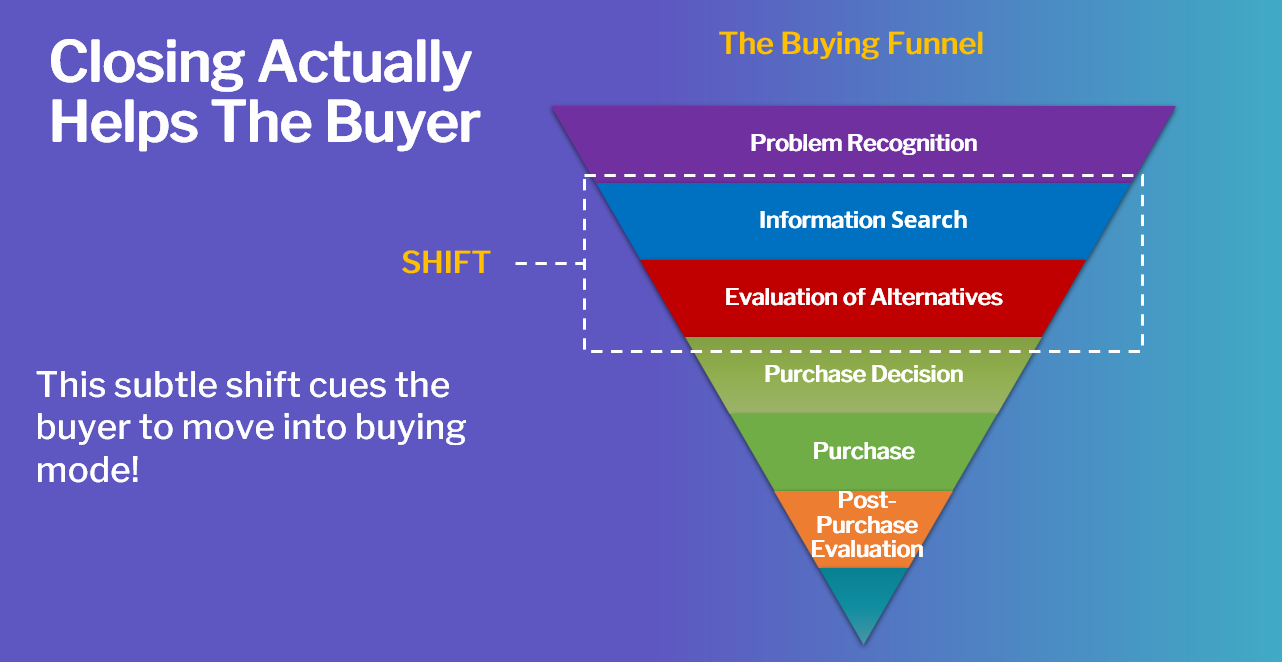
Let me help you out here – take a look at the graphic below of the buying funnel. Most prospects are stuck up in the top half – they’re in research mode!
When you lack the confidence to ask for the close, you’re letting them stay in an endless loop of research and evaluation without clear next steps. The reality is you should be offering clear steps on the VERY FIRST CALL to lead them into the evaluation phase.
Think about it like this: when you go to buy coffee in the morning or stop to pick up lunch, do you walk up and order? Or do you wait for someone to ask you what you want? You probably stared at the menu figuring out what to get and then someone asked if they could take your order, right? They prompted you out of your research and evaluation mode into the bottom half of the funnel!
Helping lead them into those next phases is the core of being a sales rep! It’s not pushy, and not doing it shows a lack of confidence. This is where you decide if you are a true salesperson or not.
Remember: Closing. Helps. The Buyer.
You Don’t Know How To Ask
If you’re worried it sounds too good to be true – it’s not! You can literally just ASK them questions to inch closer to the close. Okay, so the reality is that a lot of those go-to closes rely on cheesy or crappy tactics. Here are a couple good questions and statements for closing sales to steal:
Ask a Question:Did we solve the problem? Did we meet your needs? Ready to move onto the next step?
Make an Assumption:We’ll get this nailed down and start next week. When do you want to take delivery? (You’re acting like you’re already involved in the next step!)
Which pitch: Which solution is a better fit right now? Which option is a better match for budget? Do you like option A or option B?
Timeline: You mentioned wanting XYZ in place by next month – working backward we’ll need to ink the contract by next week.
Add-On: If we can get this wrapped up by the end of the month, we can throw in an extra license and a live training.
Don’t make the super embarrassing mistake of lacking customer insight and information by the time you get all the way to closing!
CSO Insights estimates that 26% of deals are actually LOST because sellers weren’t fully aligned to a buyer’s needs before closing. Save yourself the time and hassle by making sure you know these before you get to close:
What is the agreed customer goal or pain?
What is the “why” behind the buy/value to them?
What’s their budget & timeline?
What does their buying process look like?
What is their current state vs. desired state?
Are there other options/competition?
Any personal motivation here?
(Hint, if you need help coming up with a pitch that aligns with their value – check out SWIIFT℠!)
Closing is a muscle just like anything else – if you aren’t exercising it, you’re not going to know what to do with it when the time comes to use it!
You can close every single call you have with something we like to call closing for commitment.
Think about football for a second. You’ve got your first downs to lock it in – and instead of having to go all the way back, you get to start on THAT yard line. Now when you apply to this sales – even if it’s something small you’re getting a customer to make a commitment to you. That means next time you’re starting from THAT point! You’re taking up mindshare with them.
Here’s an example:
You’ll never have to ask yourself if it’s closed because you will know and you will OWN exactly what you need to do.
Can you guess the most critical stage when it comes to closing?
Gong did a study on this, and believe it or not – the qualification stage is MOST important. Close rates decline by 71% when the next steps are not covered on that first call. Plus – deals that closed the fastest spent 1.53 times MORE talking about those next steps compared to other deals.
If you have a well-defined sales process, you’re 33% more likely to close your deals (TAS Group). And if you don’t know how to gauge when that is or how it plays out – do a trial close! Try something different!
Sometimes you have to abandon your sales script, and that’s okay.
The more confident you get with closing, I promise the easier this gets. So don’t be afraid to get out there, practice, and remember that there’s a closing strategy for each and every one of those fears you might have. You got this – now go get those deals!
Subscribe to our email list to receive new content, webinar invites, and training offers.
Whether you’re shopping around for external inside sales training vendors or working with your internal training department, knowing what good inside sales rep training looks like is the first step to ensuring your training is checking all the key boxes.
We’ve outlined a few of the most important considerations to keep in mind when choosing an inside sales training partner.
Decide What Good Inside Sales Training Looks Like
This shouldn’t be a surprise to any sales leaders out there — but what makes good inside sales training is results. You’ll be able to know whether or not sales training worked simply because it moved the needle.
These “results” look different depending on your company, team, and goals. It’s important to go into the sales training and decide on what those goals are to you — whether it’s sales units sold or market share gained.
This is even more important when partnering with an external sales training vendor. The vendor should understand your goals as well as your sales process, product, customers, industry, and competitors. There is so much specialization in the market today, don’t let a vendor bring SDR training to your team of AEs.
In order for sales training to be considered “good”, it must achieve your goals. Outlining what these goals are, and what success looks like, beforehand is a surefire way to get what your team needs out of their training.
We recommend identifying metrics, behaviors, KPIs, and overall results that you expect to shift during and after the training. Metrics and behaviors should lift immediately showing you’re on the right track, and KPIs are early indicators that the results are on the way. Identifying metrics or results only can lead to a miss.
Really great sales training is customized to your industry and product/service.
This ensures your reps aren’t left trying to figure out how to take a broad theory and apply it to their job, customer, or service.
While it’s true that customized sales training is more expensive, the ROI is up to twenty-fold when you consider how much your reps are actually retaining, and how much they can apply immediately to their practices.
Use public seminars and events to help someone get a tip or two. Use custom live training to move the needle on results.
2. Get a Professional Sales Trainer
Aberdeen reported that 85% of the sales teams that are considered “best-in-class” utilize professional sales trainers or resources.
Don’t try and turn your managers or reps into trainers. Let’s face it, they’ve got enough on their plates. Plus, even really good managers and reps have no idea how to train — it’s just not their job! They might be excellent at sales, but they have no expertise in training.
Even worse, don’t let your HR department teach sales. They’re great at training and professional facilitation in many areas of your business, but their bailiwick is in company orientation and sexual harassment training — not sales and selling. They may be excellent at training but have no expertise in sales.
See where we’re going with this?
Make sure to bring in someone who is an expert at both training and sales. That’s the secret to good inside sales training, and it’s what the best in class are doing.
3. Make Sure the Training Has the Right Focus
If you’re training your inside sales reps, make sure they’re attending an inside sales training. It sounds simple, but oftentimes well-meaning sales team leaders are duped into thinking “sales training” is enough. Shoe-horning your company’s existing field training for your inside team may actually do more damage than good.
Most popular sales books and training curricula deal with a very narrow view of selling: The conversation between Person A and Person B. Anyone who has been working in inside sales for a while can agree that the true issue lies in getting that interaction in the first place.
If your reps are struggling with connecting with decision-makers, getting callbacks, finding the right people, figuring out who to call, and capturing attention at the top of the funnel, then conversation selling and overcoming objections will miss the mark.
Make sure that your inside sales reps are being coached on topics like:
Leaving compelling voicemails that will be returned
Capturing a prospect’s attention in the first 30 seconds
Leading with value
Creating engaging conversations vs. script reading
How to get a callback or bridge to the next call
Finding more decision-makers in the company
Dealing with gatekeepers
It’s important to make sure other aspects of the strategy are covered as well, so the reps can rely on their managers less for questions such as:
Who should I call first?
How often should I call?
Should I leave a voicemail message?
How often?
Now, what do I do?
4. Sales Training NEEDS to Be Hands-On
Theory stinks.
During the training, make sure reps are getting on the phones. There’s no reason that training shouldn’t be stopped so that the reps can go try out the skills they’re learning, and role-plays don’t really tell the whole story, do they?
Live calls to live customers using the training guarantees that these training methods are going to be applied. Live calling in a safe space leads to more rep buy-in and builds confidence. When reps see the tactics work in real-time they adopt, apply, and try more often. Training fall-off (the forgetting curve) has the odds stacked against it now!
Make the training stick by actually making calls and building pipeline during training.
5. Make Sure Your Managers Get Involved in Sales Training
Put managers in the reps’ training, and when possible make sure they have their own version of the training class tailored for their needs. Managers need to learn how to recognize the new skills in action, when to coach, how to coach the new skill, when to celebrate it working, and how to keep the momentum alive when the trainers leave. Behavior change lives and dies with the management team, and their buy-in, involvement, and use of the new skills are critical to success.
Ask your vendor how the managers will be involved in retaining the new skills.
You got it, training is a process, not an event. Reps reported a “Lack of Development” as a top 5 challenge every year for the past five years as reported by the American Association of Inside Sales Professionals. Aberdeen also reported missing development opportunities as the number one rep-reported reason for leaving companies.
Deciding to invest in rep development is a smart choice, but be sure you don’t assume that it is “one and done.” Your teams want ongoing opportunities to learn, grow, and advance their careers.
Training Magazine reported an average number of development hours/year/employee at about 48 hours – or four hours/month. Is your internal training team ready to provide this? Most corporate training teams get quickly maxed by providing new hire orientation and onboarding. Manager coaching can fill some of the gaps, but if you’re talking with learning vendors, check their ongoing offerings as well.
Ongoing training will often nurture and advance skills taught onsite – helping check the box of retaining new skills and providing the ongoing development reps crave.
The easiest way to accomplish this is with vendor-provided online skills training or inside sales training courses after their session to brush up on their skills, hone in on their weak spots, and keep skills in practice.
When evaluating sales training software, look for interactive resources such as:
Reps want skills on-demand. Learning should be easy, fun, interactive, and flexible. The old days of long-form narrated slides and sales training videos are over. Anyone who has clicked their way through to the final test (or let it run in the background while doing email) can attest to the fact this isn’t engaging or effective.
Again, look for sales training software to engage your management team as well as the learners. New skills and a culture of development live and die on your front lines. Does the software provide manager resources?
How about fast-reference cheat sheets, coaching guides, or contest ideas? Is it nimble enough to allow quick reference before a big call or team meeting?
Get your sales managers involved in testing your top choices.
Are you looking for the best inside sales training programs?
Contact us today to learn about our customizable virtual sales training programs available for reps and managers.
In today’s world, it’s (unfortunately) become the norm for deals to stall out—even when everything felt great on the call.
You’re not imagining it, prospect ghosting has increased and sales cycles are longer (it’s brutal). But that doesn’t mean you’re helpless. By making some tweaks and improvements to your approach and outreach, you can get deals moving again.
Whether it’s ensuring you’ve locked in next steps, gotten a commitment from your prospect, or revived stalled conversations, these tactics will help you avoid deals slipping through your fingers.
1. Close Every Call
If you’re not securing the next step before you hang up, you’re missing out. Deals don’t move themselves, you have to drive them forward. That’s why it’s crucial to close every call. The best way to do this is by using the 4 Cs of closing:
Check-in: Ask your prospect, “Did we hit all your top questions today?” This ensures they feel heard and reassures them that you’re paying attention.
Commitment:Make sure everyone knows what’s expected before the next call. Are you sending them more info? Are they bringing pricing from a competitor? Clarify all deliverables to ensure everyone’s prepared. It sounds like, “Will you send over the pricing you received from the competition next week after your meeting?”
Call bridge: Here’s where the magic happens. Lock in the next step on the spot. Don’t settle for a vague promise of a follow-up. Instead, say, “How does Tuesday at 10 AM look for us to review the proposal?” Pull up your calendars and nail it down before you hang up. No next meeting means no progress. Important: Don’t wait to do this 2 minutes before the call ends! Give yourself time to schedule the next call (so they’re not eagerly rushing to their next meeting).
Close: Finish strong with a positive sign-off. “Thanks, I’m looking forward to our next call!” Leave the prospect feeling good about keeping the deal in motion.
Now, to ensure no prospect ghosting ensues, you need to lock in your next meeting with these three key steps:
Calendar Invite: Don’t leave the meeting up to chance! Get them to pull up their calendar and schedule it right then. If it’s not on their calendar, it doesn’t exist.
Reminder: As soon as you hang up, send a meeting invite with a clear agenda. This helps keep both of you accountable and sets expectations for the next conversation.
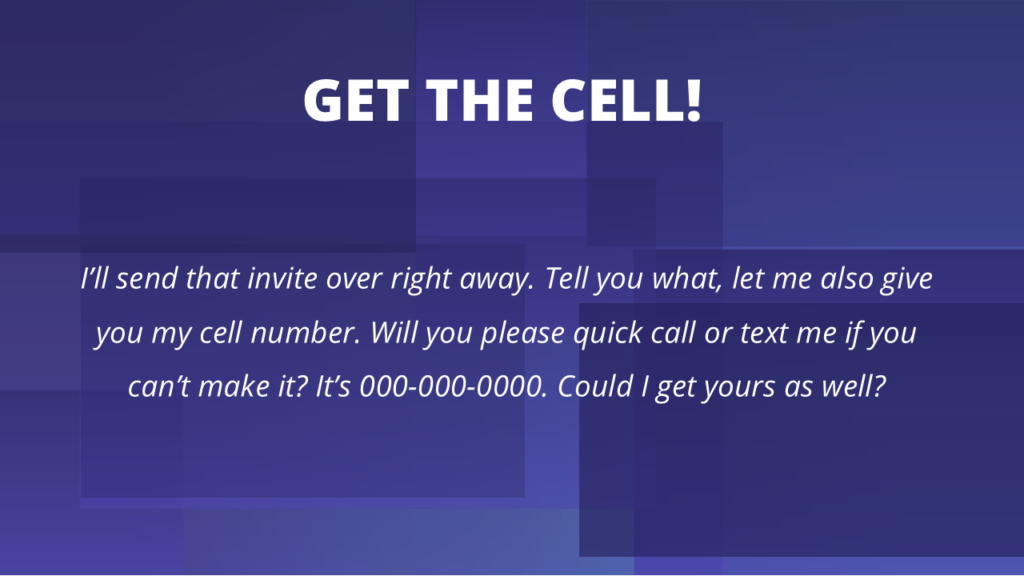
Cell Phone: Always, always get their cell number. This is your backup plan in case they go dark. Having a direct line makes all the difference when it comes to securing that next call.
Combine the 4 Cs with these three steps, and you’ll ensure that every call ends with a solid plan and keeps your deals moving forward. No more ghosting, no more stalled deals!
2. Get a Customer Commitment
Don’t let the conversation end without getting a customer commitment. It’s simple: give them a little “homework” before the next call. When you ask a prospect to bring something to the table for your next meeting—like competitive pricing or feedback from their team—you secure mindshare.
Why does this work? People are less likely to ghost you if they’ve agreed to do something for the next step. It turns your prospect into an active participant, making them more invested in the process and, ultimately, the deal. This tactic keeps things moving forward while solidifying your partnership.
Here’s another way to think about it: Imagine your friend invites you to a party and asks you to bring the beer. You agree, but when the day comes, all you want to do is stay home in your sweats and binge Netflix. Then you remember, you promised to bring the beer, and your friend is counting on you. So, you get up, get dressed, and head to the party, knowing they’d be upset if you bailed after committing. That’s how mindshare works. By giving you a responsibility, your friend increased the chances you’d follow through.
Securing even a small commitment can be the difference between a deal that fizzles out and one that’s locked in with purpose and momentum.
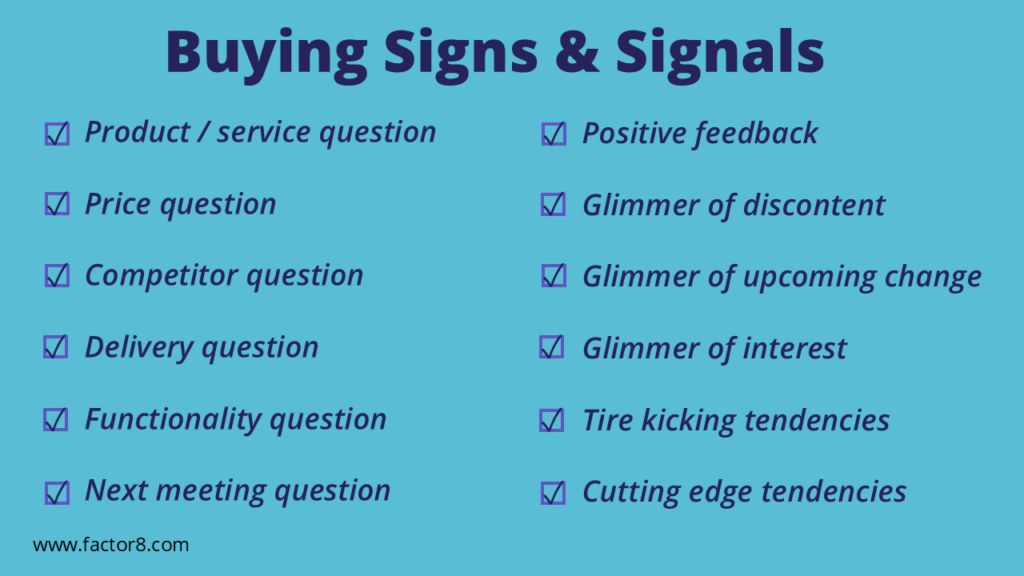
When a deal stalls or a prospect ghosts, it’s easy to assume all is lost. But a stalled deal doesn’t mean a dead deal! To re-engage those quiet prospects, you need to get creative and tune into buying signs and signals. What’s going on under the surface? Are they asking about functionality or delivery times? Are they showing glimmers of interest but not committing? Recognizing these signals helps you approach the next touchpoint strategically.
Mix up your communication channels and don’t just stick with email. Reach out through LinkedIn, send a personalized video, or even text (that is, if you’re text buddies). Keep your messaging light but direct. Something like, “Hey, are you buried in work? Let’s reconnect when you’re ready,” shows empathy. Or, if you want to go a bit bolder, say, “Did I drop the ball somewhere?” to draw out what’s really happening.
Urgency also plays a role here. Is there a deadline approaching or a new feature/product that could catch their attention? Mention that to reignite their interest and get them back in the conversation. And when you do get them back on the phone, don’t book them two weeks out. Leave room for urgent follow-ups so you can capitalize on those buying signals.
In this tough sales environment, deals won’t close themselves (in fact, only 10% of customers close themselves). You need to be proactive in securing next steps, getting commitments, and re-engaging prospects when things slow down. Whether it’s using the 4 Cs to bridge every call, locking in a prospect’s commitment with small tasks, or mixing up your re-engagement tactics, these strategies will get your deals moving and keep them on track for a win.
The insight in this article was shared in our webinar, “3 Tips to Get Deals Moving NOW (So You Hit Quota!)”
Learning to be a great sales coach is hard – really hard. It’s the hardest thing we teach new managers who were formally reps. Now, it’s not as hard as climbing Mt. Everest or teaching your grandma how to order presents online, but it’s rough.
It’s the #1 skill that most new managers struggle with. If you’re a naturally phenomenal coach, congrats (seriously!), but the rest of us are struggling. Why? We don’t often know what defines great sales coaching. So let’s break it down…
The Difference Between Presenting vs. Facilitation vs. Coaching
The lines are often blurred between presenting, training, and sales coaching, especially when we don’t have staff and resources dedicated to each. Why does it matter?
Well, does this sound familiar?
“I’VE TOLD THEM 100 TIMES!!”
We’ve heard it from managers and VPs (and parents 😉 ). It’s rough, folks. If people aren’t retaining what you’re telling them to do, they obviously aren’t going to do it. So we have to back up a few steps and make sure it gets in their brain and sticks.
What is presenting?
We define presenting as…Introducing new information through speech often using slides/visual aids.
Watching a webinar? You’re listening to someone presenting. Sitting in a lecture hall in college? That’s presenting.
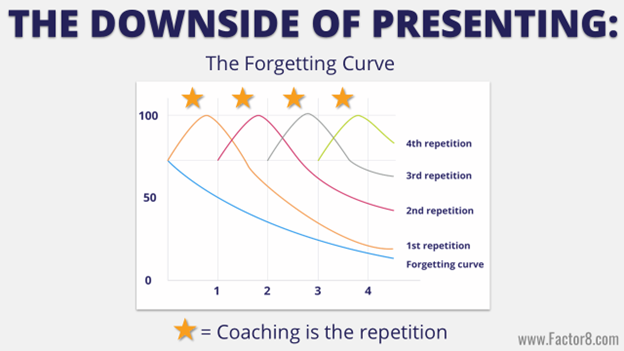
Now the downside to presenting is something called The Forgetting Curve. If you’re in sales enablement or training, you’ve likely heard of it. It shows us that by the end of the day, reps have lost 50% of what you taught them. In a week, they’ve lost 90%. So it’s pretty obvious why they aren’t doing what you told them to do – they can’t even remember it!
There are two ways you can beat The Forgetting Curve.
By utilizing great facilitation or training. The better (and more interactive) the training, the more likely the skills will stick. The more often reps actually do something, the more likely they’ll remember it and the more likely you’ll get results.
Through coaching. All you have to do is tell people what to do and then 1:1, 4x throughout the week, go and coach them on the same skill. You’ve got time to do that, right? 😐 Nope! That’s why good facilitation is the better option.
What is facilitation?
Folks the name of the game to get people to do what you need them to do, to get results, to get commission checks is: RECALL. They can’t do it if they can’t remember it.
In order to obtain recall, you need to have good facilitation or training. Unfortunately, most facilitation is broken. You can’t just tell someone to do something and expect them to do it perfectly, they need to practice.
Grab a sheet of paper and draw a picture of the Statue of Liberty based on memory. Assuming your side hustle isn’t as an artist, it’s probably going to look like something a child drew. Why? Well, when was the last time you drew something? Drawing is something we did a lot as a kid until other things became more exciting or interesting. We quit practicing, and when we quit practicing, our skills freeze.
For many of us, teaching is also a skill frozen in time. We think of teaching and we see ourselves sitting in a lecture hall with someone talking at us, telling us what to do. And we know that’s not how people learn.
That’s why we’ve got to redefine teaching and facilitate instead.
We define facilitation using the acronym CUP. It stands for…
C = Connect. If you want people to remember things, apply them, and do what you tell them to do, you have to help them connect with the information (it’s called Adult Learning Theory). It basically says that adults have filing cabinets in their heads. If you tell a kid something new, they’ll accept it as fact. Adults won’t even log it until you help them find the file folder. That means you’re helping them connect with it.
U = Use. Great training takes longer because we’re facilitating them actually getting their hands on it. I’ve watched people do systems training where their team is just sitting and watching. Totally hands-off, and totally a waste of time. If we want people to understand, we have to get them to use it.
P = Practice. We absolutely, positively have to practice. End of story.
By using the CUP method for facilitation, that’s how we beat The Forgetting Curve. Expect 70-80% recall. Get some buy-in along the way, a little practice and roleplay, synthesis with what they do on the job, and you’re looking at 80-90% recall. Plus, you’ll create new habits.
What is sales coaching?
Everyone does it a little differently, but a lot of people confuse sales coaching with leading, but with a few questions sprinkled in.
We define sales coaching as… Ongoing development method used by leaders using questions to inspire and deliver personal feedback on skills.
Pay attention to the bolded words. If you’re just giving people advice or there are 25 people in the room, that’s not coaching. When you’ve got a team of reps in the room, what you’re really doing is presenting.
ACTION: Go and CUP check your virtual sales training. If you’ve got a lot of videos and little practice, people aren’t doing what you tell them to do. Leaders, if you do a lot of announcing without any coaching, follow-up, or roleplays, they’re not doing what you tell them to do. And when it’s something critical like learning how to sell and be successful in new hire onboarding, you’ve got to do all 3.
If behavior change is critical, start with the 1-2-3 punch. Begin with the presentation, then facilitate, and then coach. Now, coaching alone CAN be powerful (but not how you think…)
Great coaches have 1 thing in common: they motivate people. Motivation is the key to everything. It affects recall (information + caring = recall).
Our job as managers and coaches is to ensure our reps leave our coaching sessions feeling like superheroes. That’s why we teach the 5:1 method – share 5 positives and 1 area for improvement. It’s also the #1 mistake new managers make. Why? We hear the laundry list of things that went wrong on a sales call and can’t help but tell them every single one of them.
The power of sales coaching is in the questions you ask. Said in another way:
“Leaders who ask more, get more.”
That’s why we coach in questions. It’s called “Instinctive Elaboration”. It’s the secret behind the Factor 8 SWIIFT℠ intro where we’re literally hijacking the brain of the prospect to answer our questions even if they didn’t mean to and it’s why it works to get them talking.
It works like this: how old are you?
Did a number pop in your head? Now it’s halfway out of your mouth.
The brain stops what it’s doing and starts answering questions whether it wants to or not.
Here’s more proof: how much do you weigh?
I know you didn’t want to share it, but you thought it, didn’t you? 🙂
We’ve spent years mastering the art of coaching and have compiled the best sales coaching questions ever (and they’re backed by science).
1. “Tell me about a time you had to do something similar?”
This helps them connect. Unfortunately, not all of us have the time or tech to do the CUP theory. We use a lot of video, but do videos actually teach? We don’t think so (read more about that here.)
2. “Why are you so good at this?”
You can ask this to anybody in any coaching session and something happens in the brain called “Confirmation Bias”. If you ask them a ‘why’ question, they’ll look for the reason that it’s true. This instantly boosts motivation.
3. “What happens when you knock this out of the park?”
This question builds confidence by creating mental imagery, scientifically known as “Functional Equivalence.” You’ve probably heard it with Olympic athletes where they picture themselves doing their gymnastics routine perfectly in their head and it fires the neurons as if they’re doing it. If you can get your reps to picture success, they’re more likely to achieve it.
There’s also something called the “Pygmalion Effect” which says that if your manager believes in you, you’ll believe in yourself more. Read differently:
“Leaders who expect more, get more.”
4. “What are you most proud of on that call?”
If anybody has reps that beat themselves up a little bit, this question is for you. The brain will search for an answer and find it – guaranteed.
5. “What should we do next?”
This is all about active recall; going in and finding the information in the brain. The other question we ask is “what was the customer thinking?” This is out of our head and our noise and puts ourselves into the shoes of the customer which is what we’re trying to do. It shortens ramp time, folks. Ramp time isn’t about me not knowing it, it’s about me not knowing when to use it. And if we can burn the pathways in the brain to recall the information we need at the right time, that’s how we get people to learn and apply skills faster.
6. “What one thing is most important to work on?”
You can use this in any coaching interaction anywhere and the science behind it is called “Implementation Intention.” Studies show that if you work on one thing and put a plan in place, it’s 2-3x more effective.
Coaching your team is more than just sharing information with them—it’s about really changing the way they think and act. By incorporating presenting, facilitating, and coaching, you’ll move from just talking at your team to actually sparking real behavior change.
Subscribe to our email list to receive new content, webinar invites, and training offers.
Call bridging is the art of gaining the next call before leaving the current conversation. It’s a critical skill if you’re used to face-to-face selling and now working the phones.
In my previous posts, I talked about call productivity and setting call goals as critical skills when transitioning from traditional selling to virtual selling. It’s because we often accomplish less on phone sales calls than in traditional face-to-face sales meetings. But we only build a pipeline when we’re able to execute multiple calls. The key to getting multiple calls is Call Bridging.
Call bridging happens at the end of a call. It’s a key phrase or question that paves the way for calls #2, #3, etc.
How to Use Call Bridging to Secure a Follow-up Sales Call
When it’s an established relationship, it’s as easy as setting up the next meeting. The key here is being sure you’re showing value during the ask. Everyone is busy and we’re easier to blow off (blow out for my UK friends) when we’re on the phone. It sounds like:
“This has been fantastic Mr. Customer. Thanks for the insight. We didn’t get a chance to cover XYZ, nor for me to share some insights I’ve gained from my network that I think you’ll find valuable. Let’s set up a follow-up call. Does this time next week work for you?”
Note: We aren’t saying that we need to cover key insights about our product or service. We aren’t saying we need to learn more to sell more. We’re offering “cross-pollination” value or the voice of our collective customer in the industry. This intel is a hot commodity!
If it’s a colder outreach, we may need to be more assumptive and simply GIVE ourselves permission. It sounds like:
“Thank you for your time and insight. I’ve learned so much from you and want to return the favor. I’ll call you back later this week so we can finish up.”
There are a million variations of this. Think of them as bases. A home run is their agreement to a follow-up, an appointment set and on the calendar, AND they bring another party to the call or take an action item (we call this “Getting Deals Moving” – Check out The Sale Bar for a full class on the subject)
Third base might just be an agreement to meet and an appointment set.
Second is their agreement to take your call.
First base is them basically NOT saying, “No, don’t call me back.”
Make it a habit to always bridge to the next call. Go for the home run and even if you land at second you’re doing better than starting over cold.
Bonus tip: Send the calendar invite even if they don’t agree or accept the invite. It will show up on their calendar even if they don’t accept it and they may be more willing to pick up the phone when you call (you MUST call during this time! Don’t just set a task to follow up, put it in your calendar too!). And if they don’t pick up, you’ve at the very least gained some mind share and a little bit of guilt on your side. When they do finally take your next call, they may even apologize and/or be a touch more open.
Subscribe to our email list to receive new content, webinar invites, and training offers.
Great news. You’ve got proof of concept, found your ICP, and gotten some funding. Now it’s time to build out your BDR team.
Bad news. Once you win the war for talent, the real work of sales training begins. Since most SaaS startups aren’t hiring classes of 15 reps and a trainer, you get the task of onboarding one or two at a time. And then again. And again. And again.
Here are some sales manager tips to save your sanity when onboarding new BDRs:
Start a Google Doc now with everything they’ll need to know. Brainstorm in the following categories:
Industry acumen
Product knowledge – feature, function, benefit
Customer knowledge
Ideal customer situations
Business acumen
Competitor acumen
System logins and skills
Company info – who’s who, relevant background, etc.
Questions to uncover ideal customer situations and challenges
Call recordings to hear good, bad, and ugly calls
Phone sales skills like leaving good voicemails, intros, uncovering contacts, and delivering value props on the phone
Wherever possible, start hyperlinking to internal and external sites, videos, and resources so reps can self-serve for the info. Why go back and re-find that email 20 times?
Now identify what you can outsource. Trust me, if you try to hire, train, coach, and lead the team you will either explode or mess a few of these up in a serious way.
Buy the system training if your vendor offers it or go find free forums and videos to link to.
Sales skills are another area. Your job is to coach them, not teach them from scratch. Outsource the heavy lifting and stick to leading the team and coaching the delivery. The Sales Bar has hundreds of phone sales resources for new BDRs and Managers. They’ll also want some basic LinkedIn skills. I like Vengreso or Frontline.
Find internal experts. Use your CEO, product geeks, and past customers and get them to do a video or recorded webinar to teach key points. Keep them short and on track with some guidelines during your request; these folks typically aren’t natural trainers! And if they do it live, get it recorded, I promise they won’t be available every time. Where you can’t record, set up a lunch or coffee chat vs. a formal presentation. Get your new rep to record it, plus their notes!
Start a schedule and get your document in chronological order with about 6 hours of learning work/day to start. Make the schedule about 2 weeks long and ramp the training time down while call time goes up. So by the end of the second week, they may be doing 1-2 hours of training/day and 6 hours of work. Show that training doesn’t stop and they have some assignments every month! Bonus: show a path to the next level in their career, even if it’s just a footnote. In addition to the learning, your schedule should include:
Call shadowing with you or other reps. Bonus: have them score it using your coaching form. Side note: get a coaching form
Calls to past customers to hear their stories and happy outcomes
Research on their own – e.g. top features of competitors
Outbound calling – even if it’s just to capture contacts, qualify accounts, data cleanse, etc.
LOTS of time with you where they bring their questions, you talk shop, build a relationship, and make your newbie feel important
Hook them up with a buddy/mentor. Reps who build strong friendships at work are happier and stay longer according to Gallup. With the average lifespan of a BDR under 18 months, it’s worth the effort. Pay for their first lunch and ask them to get together weekly for the rep’s first month. If it doesn’t stick after that, you’ve at least planted some seeds. Bonus: they’ll come to you less often for their questions when they have a buddy.
This approach will help your reps be more independent while saving you at least twenty hours per rep. Each hire can help make the document better and old hires can support the new.
Make updating the document and improving it part of their work assignment so it stays current and off your to-do list.
May this also help you resist the temptation to hand your new rep a script and wish them good luck on the phone. Millennials are searching for career development and time with their boss at work, and they make their employment decisions based on this. Spend a few bucks, give them some structure, buy them some training, and you’ll see the payoff in their faster success and tenure!
Want some help onboarding new BDRs?
We’ve got your back! Contact us today to learn how you can incorporate sales training into your new BDR onboarding process to speed ramp time and improve retention.
Are you looking for the best inside sales training company? With all of the noise out there and everyone claiming to be the best, how can you tell when a training vendor is truly great and different from the rest?
Allow me to introduce Factor 8. Unlike most training companies, we were built by people who get sales. And we try really hard to not be apples. In fact, let’s call this the apples to…um…beer…comparison. 🙂
Here’s why you should drink beer with us instead of buying apples from them (this is getting better and better!):
THIS ISN’T YOUR DAD’S SALES TRAINING
We teach digital sales/phone sales/inside sales/telesales/voice-to-voice sales… however you and your company phrase it. If you run a team that doesn’t primarily sell by knocking on doors, setting up face-to-face meetings, or giving live PPT presentations, we’re your vendor. Not sure the difference? Go ask any inside rep who’s been forced to attend the field’s training. We hear horror stories about this about once a month. We’ve all tried it. It. Doesn’t. Work. And in addition to wasting precious selling time, it makes your inside reps feel insignificant. Instead, teach them strategies to get people to call them back, start a call, navigate phone trees…you get it.
Don’t want sales downtime? Sick of skills not getting applied? We got you covered baby. In every Factor 8 class, we teach a skill, practice the skill, and then go back out onto the floor and get on the phones to try that skill! No kidding. Nobody else does this. Here’s why you should care:
You may get better sales results during a training day than on a regular sales day. Yes, that happens a lot.
You may pay for the sales training before the training is over. Again, really common.
If you’re paying for new skills, why not make sure your people can actually do them before your trainers leave?
When reps try the skill, see it works, and get results, “training fall-off” is really a non-starter. In the wise words of a recent rep who came back to class over fifteen minutes late, “This Factor 8 shit really works!” He was asking the prospect questions and just couldn’t get him to stop talking to get back to class in time! High-class problem, right?
CUSTOMIZED TRAINING
This is a really big deal. Even if you don’t consider using us, ask vendors to show some specific examples of their materials customization. If your reps have to “translate” the generic sales theory in their heads to figure out how to use it, well, they’re not going to use it. I think this is the number one reason we see fall-off from training application. They can spit back a “right answer” right after training because it’s in their short-term memory. But they don’t know how to use it and aren’t using it post-training so no wonder they can’t remember it a month later. Our workbooks include messaging examples, references to your product, your customer’s top objections, and even recorded calls from YOUR reps. Seriously, we’ve never taught the same class twice. Don’t practice selling a widget. Get experts to help you practice selling your services to your customers in your industry. THEN it sticks.
Quick Note: you guys, this is why most of you haven’t heard of Factor 8. It’s really HARD to customize each class. It’s not uber PROFITABLE to customize each class. It certainly isn’t SCALABLE to customize each class. This is why the big dogs don’t do it. They’re in the business of selling workbooks. Pre-printed, mass-produced workbooks. That’s why their idea of customization is a one-page role-play at the end of a chapter. Not bad, but not good. Kind of like comparing apples and beer. By the way, it IS super EFFECTIVE to customize each class. That’s why most of you came to us by referral.
EXPERT COACHING
Here’s my last thought. Every Factor 8 Advisor has made the calls, coached the calls, and probably even run the team. My facilitators are ex-reps, ex-managers, ex Directors, and ex VP’s. ALL from Inside Sales. And in every class, we coach live calls and recorded calls. Don’t let an adjunct professor or HR employee teach your people how to sell! Anyone can read a facilitator’s guide, how many can add value to messaging and delivery right on the spot?
Bottom line
Your sales training should get immediate results. By providing the right training with customized materials with live practice and expert coaching, we get SPIKES in performance. Account managers uncover millions in the pipeline. Hundreds of new buying contacts are added to the database. Triple the voicemails get returned. Close percentages double. These are pretty standard Factor 8 results. Check out the case studies!
Thanks, ya’ll. This has been a lot of fun. When I’m talking to prospects on the phone, it isn’t polite to throw up values and differentiators! It certainly isn’t helpful to LIST them all! (We teach your reps to never “stack” values, we teach them to ask questions and then pick the differentiator and value that best matches!). But man it’s fun when you just get to brag.
We’ve built something amazing over here. We’re not trying to be the biggest, just the best. That’s why each year over 50% of our business is from referrals. I hope you’ll use these differentiators to demand more from your own providers. And if they can’t deliver…we’ll be right here waiting for you. With a beer!
Looking for the best sales training company?
Contact us today to request information on our customizable virtual sales training programs available for reps (and managers).





![SALES TEAM RETENTION [INFOGRAPHIC]](https://no-cache.hubspot.com/cta/default/3471041/919bf4d3-fb8e-4f9a-b406-209898c4dd34.png)