Margaret, a CMO, shared a phenomenal story at her company’s “Gals in Sales” event in Seattle.
In a previous role, she was asked to interview candidates to be her new boss. But halfway through the process, she realized…
“I can do this job.”
Problem was, she’d never let anyone know.
Margaret’s story isn’t uncommon. We see this all the time with high-performing sales reps and managers. They’re doing great work, hitting goals, and showing leadership potential… but they’re not actually communicating what they want next.
More than one-third of #GirlsClub participants say they hesitate to ask for development or discuss their career goals for fear of wasting people’s time. This fuels the “Confidence Gap” that HP identified a few years ago, showing that women tend to wait until they feel 100% ready before raising their hands for a role, while men often do so at around 60%.
What you may not realize yet is that Margaret is amazing. Microsoft. Intel. Wharton. Northwestern. I’m feeling more and more inferior as I type this. Ladies, if Margaret felt intimidated to raise her hand, it’s more than fair for the rest of us to feel that way too.
But this story has a different ending.
Because Margaret found the courage (I call this putting on my big girl pants) and asked her boss to be considered for the position.
Please note: She didn’t complain that she wasn’t considered. She didn’t blame him for the experience of interviewing people she felt less qualified than. She didn’t assume she was being disrespected or marginalized.
She simply realized she hadn’t communicated and fixed it.
And his reaction?
“I had no idea.”
Margaret quickly found her way to the top of that organization and others. I won’t say it starts with raising your hand, because it doesn’t. It starts with being exceptional, working hard, having great ideas, following up. You know, all the things you’re already doing.
But the next part of your story starts with raising your hand and communicating what you want. Because confidence isn’t just personal, it directly impacts your performance, visibility, and career trajectory. If your manager doesn’t know what you want, they can’t help you get there.
Not sure how?
Check out our webinar, “Earn That Promotion: Asking For It The Right Way,” where we cover not only how to throw your hat in the ring, but the earlier step of letting people know you even have a hat and want to learn more about the ring. (And yes, this is something we coach sales teams and leaders on all the time.)
In summary, I hear this story over and over. Why aren’t there more women in sales?
Sure, there’s bias in job descriptions. There are still boys’ clubs that make us feel like outsiders. The numbers aren’t always in our favor.
But we are often our own biggest blocker.
If you’ve read this and haven’t talked with your boss in the past six months about where you want to go in your career, make that appointment.
Not to demand. Not to complain. Not to convince.
To discuss, learn, absorb advice, and consider.
This is one of the simplest, most overlooked skills we see in sales organizations. The people who grow fastest are the ones who communicate early and often about where they want to go.
It’s step one.
And it certainly worked for Margaret.
Subscribe to our email list to receive new content, webinar invites, and training offers.
Sales metrics are your early indicators, your coaching roadmap, and your proof of sales training ROI.
They show you what’s working, where your team needs help, and whether your sales training investment is actually paying off.
But not all metrics tell the full story.
Activity is easy to measure and quota attainment is easy to celebrate. But by themselves, those numbers don’t tell you if reps are building skills, progressing deals, or gaining the confidence to hold real sales conversations.
That’s why we’re breaking down the top sales metrics to track by role.
Because every sales position contributes to pipeline and revenue in different ways, and tracking the right metrics helps you spot success earlier, coach more effectively, and tie enablement wins to revenue.
Let’s take the guesswork out of performance and start measuring what matters.
BDR/SDR Metrics
Confidence shows up in activity. Skill shows up in conversion. That’s why the best BDR metrics don’t just tell you how many calls they made, but what actually happened after they hit “dial.” You won’t measure all of these, but pick 2-3 that are easily reported in your world. Focus on quantity and quality.
Here’s what you can track:
New hire ramp – How long it takes to meet quota. Measure training effectiveness against past class baselines or use a control group. Four to six months to goal is average.
Dials – Baseline activity matters, especially with newer reps. Just don’t stop here. Outbound BDR/SDR should average 50-100 dials a day.
Dial-to-connect rate – Are they reaching humans? If not, it’s probably a data issue. Look for a 3-10% connect rate.
Average talk time – Measure by call or daily total by rep. Good top of funnel calls are 2.5 – 10 minutes in length and focused reps should spend at least 2.5 hours/day on the phone.
Connect-to-conversation rate – If a call lasts more than 2 minutes, that’s a human connection worth tracking. If you’re below 25%, reps need help with skills.
Daily conversations –An average number of quality conversations per day (over 2 minutes). Aim for 3-5 conversations/day.
Positive outcomes –A less common stat that can add “small wins” like accounts qualified, referrals gained, or follow-up meetings scheduled – anything that’s not quite a meeting. Aim for 25% plus.
Meetings booked – Conversion from connect to meeting booked. Cold calls convert 2-5% on average, top reps and situations closer to 33%. Always pair with the next metric.
Meeting show rate – AKA “hold rate.” Are these meetings actually happening? 50-60% is a good starting point, top performers come in around 90%.
Percentage of qualified meetings – AEs will help you define what “qualified” means here and they’re always pickier than the SDR team. If more than 50% are being accepted, you’re winning.
Lead to opportunity conversion – What percent of meetings actually wind up in the pipeline. An average is 1-3% of leads being added to the sales pipeline.
Inbound calls – SDRs should be leaving messages, and good messages get returned. Great messages plus consistency will get up to 25% of calls returned.
Call quality scores – This is where skill execution lives. Use your coaching rubric to track growth.
Call engagement scores – A new AI feature from your conversational intelligence tool. No industry benchmarks yet, but like call quality scores, a smart add to your balanced scorecard.
These metrics help you go beyond the mindset of “more dials = better rep.” You’ll see who’s dialing scared, who’s winging it, and who’s actually applying the skills from training.
Skills That Move Metrics (and how to track them):
Call intros and brush-offs – A great opener gets the prospect talking within the first 10 seconds and keeps them after an initial brush-off (it’s like an objection, but not). If they’re engaged, your talk time and connect-to-conversation increase along with your positive outcomes, and meetings booked. Take SWIIFT℠ Introductions That Work andOvercoming the Brush-off.
Voicemails and prospecting planning – If callbacks and connects spike post-training, reps are implementing new and improved voicemail messages and email/social messaging. Take Messages That Get Returned and Planning for Prospecting.
Deal qualification – When reps find the right people and pre-qualify leads by asking the right questions, the percentage of qualified meetings and meeting show rates spike immediately with lead-to-opportunity conversion following. Take Capture Contacts and Qualify and Categorize.
Discovery – When reps improve questioning and engagement techniques vs. script reading and survey-taking, customers engage, and results show up in connect-to-conversion rate, daily talk time, positive outcomes, and meetings booked. Take Question Like a Proto improve sales call discovery.
Closing – SDRs lacking confidence struggle to have real conversations and ask for meetings. Reps improving in confidence and closing will show improvement in positive outcomes and meetings booked. Take Transitioning to Closeto help close every call.
Call quality – Not sure what to track in the conversation itself? Step one is using a standard coaching form so you can track progress.
When BDR/SDR training is working, reps get more voicemails returned, keep prospects on the phone longer, and confidently set next steps. These are your first signs that sales training or coaching is making an impact.
Inside Sales Reps do it all: prospect, qualify, demo, and sometimes close. That’s why tracking ISR performance requires more than just activity. You need to know if they’re creating pipeline, overcoming early objections, and setting up seamless handoffs (or closes).
Here’s what to track:
New hire ramp – how long it takes to meet quota. Measure training effectiveness against past class baselines or use a control group. For ISRs six months is pretty average.
Activity rate – Like SDRs, ISRs need a healthy outbound routine. Look for fewer outbounds than SDRs as ISRs balance demos, longer conversations, and orders, but insist on at least 10 outbound calls and 3-5x total activities including email/social per day.
Initial call/lead conversion – Good initial calls convert into leads and follow up meetings. In addition to longer calls and talk time, top reps will convert above 30% of initial calls to a discovery call. Newbies and cold calls under 10%.
Opportunities conversion – The conversion from discovery call into actual pipeline ranges from 10-30% on average.
Demo conversion rate – Wherever “show and tell” falls in your cycle, watch what percent of opportunities progress past this stage. Benchmarks vary from 20-60%. Use your team’s history.
Win rate – What percent of total opportunities in pipe ultimately close? Standards vary by industry and tenure from 15 to 50%.
Follow-up attempts – Persistence matters, especially in a full-cycle role. Leads not getting at least five attempts are wasting money. Well-qualified leads should show 10+ attempts.
Average sales cycle length – Are those opportunities moving forward? Or stalling out? Dividing the total number of days it took to close all the deals by the number of deals gives you baseline velocity.
Pipeline generated – What is the average dollar amount added to pipeline per rep per period?
Revenue/Profit – Actual revenue or margin closed. Use historical data for baselines and watch out for cyclicality.
Average deal size – ACV/AOS depending on industry (average contract value/average order size).
Quota attainment – Percent of goal achieved.
Number of deals – Watch for efficiency and hustle by not just measuring dollars closed.
Call/Demo quality scores – Customer engagement and rep skills are even more critical as deals progress. Measure standard discovery, communication, objection handling, demo, and closing skills. Keep coaching forms consistent between reps and teams.
*SaaS companies will track a few additional standard metrics like Customer Acquisition Cost, Lifetime Customer Value, MRR, and Customer Churn.
These metrics show you how effectively ISRs are turning conversations into qualified opportunities and moving deals through the pipeline. They help pinpoint where in the sales process training can create the biggest lift.
Skills to watch (and how to track them):
Discovery and qualification – Reps who listen and adapt during discovery ask better follow-ups and surface real business pain. You’ll hear it in call recordings, and you’ll see the impact in higher opportunity conversion, shorter sales cycles, and higher pipeline revenue generated. Go deeper than SDR discovery with SWIIFT℠ Discovery Dialogue.
Customer engagement – Great ISRs can lead a conversation and follow the customers’ lead – all while driving deals forward. That means next-level rapport, listening, and acting like a consultant. Mid-funnel engagement pays off in opportunity conversion, average deal size, and overall win rate. Focus on skills found in, My Role as a Consultative Seller.
Demo/presentation – ISRs that give the same demo multiple times a day likely have low conversion rates. Great interactive presentations will pay off in call quality, demo conversion, average sales cycle, and pipeline generated. Take Demos That Don’t Suck to see lift here.
Proving value – If you’re getting to the close but aren’t seeing conversion, we aren’t building enough value during the sales cycle. Reps who do this well have higher win rates, larger number of deals and faster sales cycles. Take Proposing with Value to help.
Objection handling – Seasoned ISRs hear it all, from “This isn’t a priority right now” to dead silence. Tops performers will have higher follow up numbers, win rates, and quota attainment. Take Overcoming Objections and Selling With Stories to sharpen skills.
When ISR training is working, you’ll hear better discovery calls, improved demos, stronger objection handling, and confident next steps. And you’ll see it in stage-by-stage conversions in your pipeline.
AEs get judged by the number, but that doesn’t tell the full story. You can close a big deal and still be losing pipeline behind the scenes. That’s why it’s critical to track not just what they’re closing, but how they’re progressing deals, and where they’re getting stuck.
Here’s what to track:
Opportunity-to-close rate – A high rate means reps are moving qualified deals across the finish line; a low rate can reveal gaps in qualification or closing skills.
Stage conversion rates – Show where deals are moving forward and where they’re getting stuck, helping you target coaching where it’s needed most.
Days in deal stages – Longer times in a stage can point to stalled opportunities, poor follow-up, or hidden objections.
Win rate – Indicates overall effectiveness at closing deals compared to total opportunities worked.
Forecast accuracy – Builds trust in the pipeline by showing whether reps are correctly predicting which deals will close.
Deal size and margin – Reveal whether reps are consistently landing high-value business or leaning on discounts to close.
Pipeline coverage ratio – Highlights whether reps have enough in the pipeline to stay on track for quota.
New opportunities created – Tracks how much pipeline reps are sourcing themselves versus relying on handoffs.
Follow-up attempts per opportunity – Shows persistence in advancing deals and staying top of mind with prospects.
Average sales cycle length – Gives insight into deal velocity and whether reps are moving opportunities forward efficiently.
Call/demo quality scores – Reflects the strength of rep communication, objection handling, and ability to progress deals during live interactions.
These metrics give visibility into each stage of the sales cycle so you can see where deals are progressing smoothly and where they may need coaching or additional support to move forward.
Skills to watch (and how to track them):
Discovery and uncovering customer needs – Great AEs don’t ask generic questions. They dig until they uncover the real business pain. When this skill is sharp, you’ll hear deeper conversations in call recordings and see more accurate opp qualification, faster stage movement, and fewer stalls after demos. Take Question Like a Pro to learn advanced questioning techniques that turn scripts into real, value-driven conversations.
Demo/presentation – A strong demo isn’t about showing every feature, it’s about telling the right story. Great AEs tailor the conversation to the prospect’s needs, show the exact value they care about, and make it easy for them to see themselves using your solution. You’ll see this reflected in higher stage conversion rates, stronger call/demo quality scores, and more stakeholders engaged after the call. Take Demos That Don’t Suck to learn how to engage, adapt, and close more deals from your presentations.
Demonstrating customer value – It’s not about pitching, it’s about showing how your solution impacts their business. If reps are demonstrating value well, you’ll see less discounting, stronger deal size, and customers pulling in stakeholders instead of ghosting you. Take What Customers Care About to map buyer motivators to your solution and propose in a way that resonates.
Driving deal momentum – If deals are sitting in the pipeline, it’s not because they’re bad deals, it’s because they’re not being worked. AEs who drive momentum confirm mutual next steps, secure time on the calendar, and keep the deal moving. You’ll see this in shorter days in stage, cleaner notes in the CRM, and fewer “stuck” opportunities with no recent activity. Take Getting Deals Moving to keep deals advancing and commitments in place.
Handling objections – Objections at this stage often signal deeper unaddressed concerns. Reps who respond effectively keep deals alive and increase win rate. Take Overcoming Objections to apply a proven four-step process that addresses concerns and moves the conversation forward.
Consultative selling – AEs who operate like business advisors uncover more opportunities and face less pricing pressure. Look for this in higher-quality CRM notes, increased stakeholder engagement, and higher ASP (average selling price). Take My Role as a Consultative Seller to sharpen your business advisory approach and build trust faster.
Proposing with value – When done right, proposals clearly connect your solution to the customer’s goals. Look for higher proposal acceptance, fewer stalls, and improved close rates. Take Proposing with Value to create compelling proposals that drive decisions.
Closing confidently – Reps with strong close skills don’t beg for business, they ask with clarity and confidence. You’ll hear it in recorded calls and see it reflected in win rate, number of deals, and reduced discounting. Take Closing Confidently to find your go-to close statements and build muscle memory for asking.
When account executive training is working, you’ll see cleaner pipeline stages, stronger discovery, and tighter forecasting. It’s less “I think it’s coming in” and more “Here’s where we are, here’s what’s next.”
Account Managers and Customer Success Managers are the face of your brand after the deal closes. But renewals and growth don’t come from check-in emails and good vibes. These reps need to earn trust, uncover new opportunities, and consistently demonstrate value. That’s how you keep customers, and grow them.
Here’s what to track:
CSAT (customer satisfaction score) – Tracks how happy customers are with your product or service. However you measure it, monitor changes over time by rep to spot trends and coaching opportunities.
NPS (net promoter score) – Measures customer loyalty and likelihood to refer you to others. A higher score can indicate strong relationships and a healthy base of brand advocates.
CLTV (customer lifetime value) – Shows the total revenue a customer is expected to bring over the course of the relationship. Helps you prioritize and protect high-value accounts.
Customer retention rate – Indicates what percentage of customers stay with you over a given period. High retention signals strong account management; declining retention may point to service gaps.
Churn – Tracks the percentage of customers leaving. Monitor closely to flag at-risk accounts early and take action to prevent turnover.
Renewal rate – The ultimate retention metric. Shows how often contracts are successfully renewed and can highlight patterns by rep or segment.
Expansion revenue – Measures revenue growth within existing accounts. A rise here means reps are finding and closing new opportunities in their current book.
MRR (monthly recurring revenue) growth – Tracks the increase in monthly recurring revenue from existing customers, indicating steady, predictable account growth.
Average purchase value – Look at the average transaction size. Growth here often signals effective upselling and cross-selling strategies.
New SKUs – Measures the number of purchases in new product or service categories, showing whether accounts are broadening their adoption.
Active buyers – Counts the number of individual buyers within an account making purchases. Growth suggests successful expansion to new departments, teams, or locations.
Customer health score – Combines product usage, engagement, and satisfaction into a single view to identify accounts at risk and those ready for expansion.
CES (customer effort score) – Tracks how easy it is for customers to get what they need from your team. Lower effort correlates with stronger loyalty.
Activity-to-engagement ratio – Compares how much time you spend with customers versus the quality or impact of those interactions. Reminds reps that more meetings don’t automatically mean more value.
Time to renewal/expansion opportunity – Measures how long it takes to uncover new value and growth potential in an account, helping you assess how proactive your AMs/CSMs are.
These metrics provide a clear picture of account health and growth potential, helping you spot risks early and identify where strategic conversations can open new opportunities.
Skills to watch (and how to track them):
Gaining referrals – Loyal customers don’t just renew, they advocate. If reps are asking the right way (and at the right time), you’ll see an uptick in warm intros and referral opportunities logged in the CRM. Take Gaining Referrals to build confidence and a proven process for turning satisfied customers into your best lead source.
Uncovering new opportunities – Great AMs don’t wait for customers to raise their hand. They ask smart questions, connect dots, and bring proactive solutions to the table. Track this by monitoring qualified expansion opportunities created and account mapping activity. Take Uncovering Sales Opportunities to uncover needs and position solutions that drive account growth
Increasing wallet share – If reps are building trust and delivering value, you’ll see increases in upsell, cross-sell, and product adoption across existing accounts. Take Growing Account Revenue to create targeted growth plans and confidently expand within your book of business.
Customer engagement – Great AMs create value in every interaction, not just touch base calls. Measure follow-up rates, meeting conversion, and customer survey comments. Take Engaging Your Customers to build excitement and keep customers invested in the relationship.
Consultative selling – Top AMs bring insights, not just checklists. Listen for strategic questions in call recordings and look for greater opportunity conversion and deal size. Take My Role as a Consultative Seller to elevate customer conversations and earn trusted advisor status.
Business acumen – AMs who understand the customer’s industry, org structure, and goals hold better conversations. You’ll see longer calls, better engagement, and more strategic expansion plays. Take Business Acumen to speak the language of executives and lead more impactful discussions.
When account manager training is working, you’ll see AMs running stronger account reviews, finding new revenue inside existing customers, and proactively addressing risks before they become churn. They’re not just retaining customers, they’re growing wallet share, keeping renewal pipelines clean, and avoiding last-minute surprises.
Good managers build great reps. That’s why your manager scorecard should go beyond team quota and focus on how well they coach, develop, and retain talent. The best metrics show whether their reps are getting better, faster, and sticking around. You don’t need all of these, but pick a few that help you measure both leadership impact and team performance.
Ramp time – How long it takes new hires to hit quota; use past averages or compare trained vs. untrained cohorts to track manager impact.
Percentage of team to goal – The percentage of reps consistently hitting their number; a sign of strong leadership and accountability.
Promotion rate – Tracks how many reps are promoted from the manager’s team; high rates show strong development and bench-building.
Retention and engagement – Use surveys or attrition data to gauge whether reps are staying and thriving under their manager.
Forecast accuracy – Compares manager forecasts to actual revenue; accuracy indicates strong deal coaching and pipeline visibility.
Team skill improvement – Use training assessments, call scores, or certifications to track rep skill growth over time.
Consistency of performance – Measures if the team hits quota quarter after quarter vs. riding the rollercoaster; stability = good leadership.
These metrics measure a manager’s impact on team development, consistency, and overall performance, giving you insight into both leadership effectiveness and team health.
Skills to watch (and how to track them):
Coaching – A strong coaching culture improves rep performance and morale. You’ll see the impact in faster ramp time, higher call quality, and consistent team skill improvement. Take Call Coaching 101 to build a positive, interactive coaching style that leaves reps confident and ready to apply new skills.
Time management – Burned out or reactive managers cancel 1:1s, skip coaching, and lose focus. Look for low coaching frequency, weak consistency of performance, and manager survey scores to identify this early. Take Own Your Day to prioritize what’s important over what’s urgent and create space for high-value management activities.
Goal setting – Managers who translate team targets into clear daily expectations drive better accountability and percent of team to goal. You’ll also see more consistent performance over time. Take Driving Performance with Goals to break big goals into actionable milestones and behaviors that stick.
Having tough conversations – Strong leaders don’t let poor performance slide. This skill shows up in better team retention, improved engagement, and shorter time-to-improvement for struggling reps. Take Having Difficult Conversations to gain a framework and confidence for handling the hard talks effectively.
Developing talent – Growth-minded managers build the bench. High promotion rates, better rep retention, and higher engagement scores are clear signs this skill is in play. Take Developing Your Team to learn practical ways to inspire and grow your people between training events.
Strategic deal planning – Managers who support reps with territory, lead, and deal strategies improve forecast accuracy and drive stronger quota attainment and rep confidence. Take Sales Strategy Meetings to guide reps through targeted, high-impact planning sessions that move deals forward.
Hiring & onboarding – Smart hiring and strong onboarding reduce early attrition and shorten ramp time. Track first-90-day performance and how often their hires stick. Take Hire Like a Rockstar to build a best-practice interview and selection process tailored to your team.
Meeting effectiveness – Organized managers who run purposeful meetings drive stronger consistency of performance and better engagement. Check for cadence completion and team survey feedback. Take Essential Manager Meetings to create a proactive meeting cadence that keeps your team on track and engaged.
When sales manager training is working, you’ll see faster ramp times, stronger forecast accuracy, and more reps hitting quota consistently. Team skills improve quarter over quarter, retention goes up, and promotions happen more often. Great managers coach with purpose, run effective meetings, and keep their teams performing without the burnout rollercoaster.
Tracking the right sales metrics isn’t just about managing performance, it’s how you prove what’s working, where to coach, and when your sales training is actually paying off. Whether you’re investing in new training programs or reinforcing skills with your current team, these metrics are your clearest window into what’s driving real behavior change and revenue impact. Because when you can connect skill development to pipeline movement, you’re not just improving performance, you’re proving sales training ROI.
Subscribe to our email list to receive new content, webinar invites, and training offers.
How do you build a top-performing sales team? Short answer: Skills. Confidence. Coaching.
Every sales team has a few all-star reps. The ones who just get it and crush it. The question is, how do you clone that kind of success?
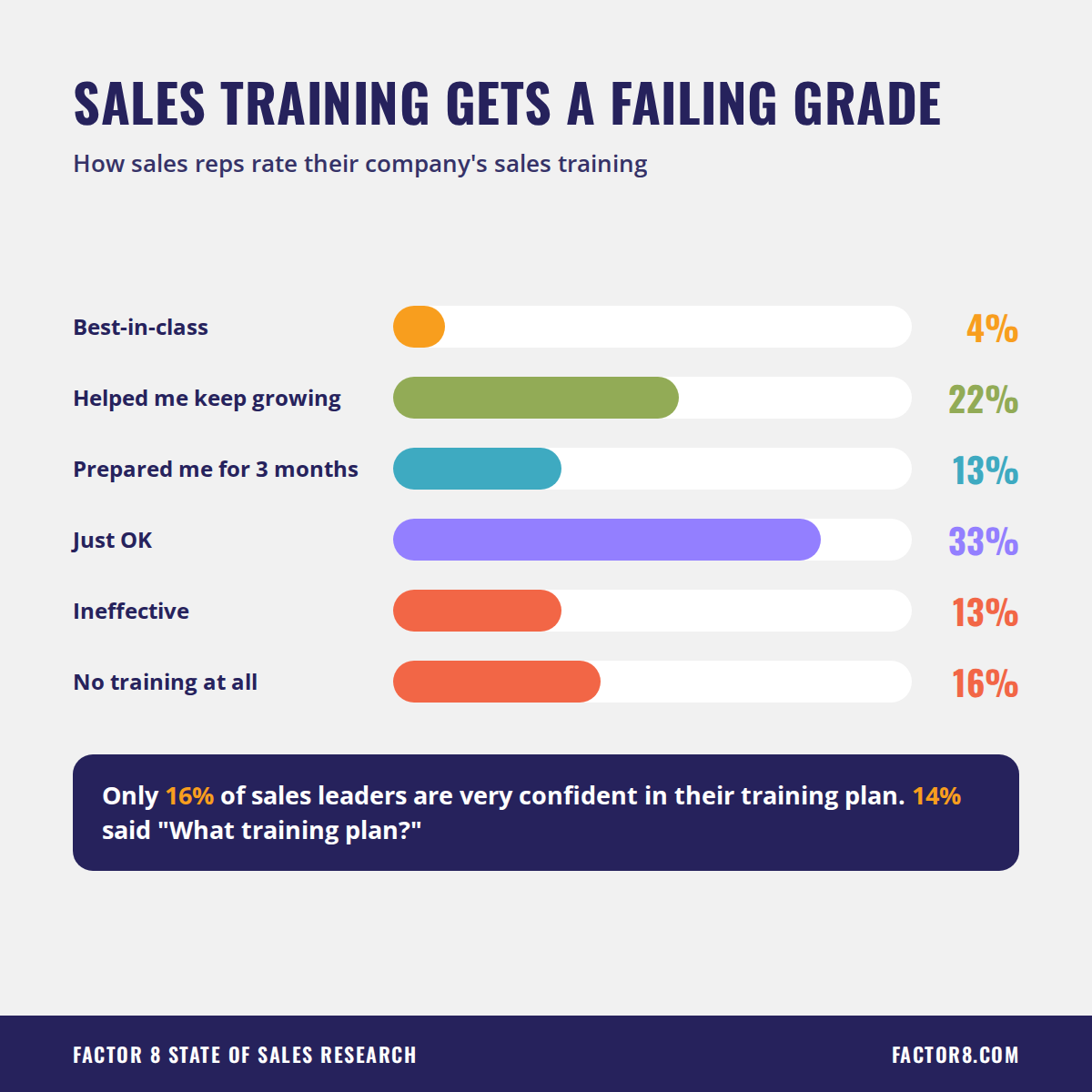
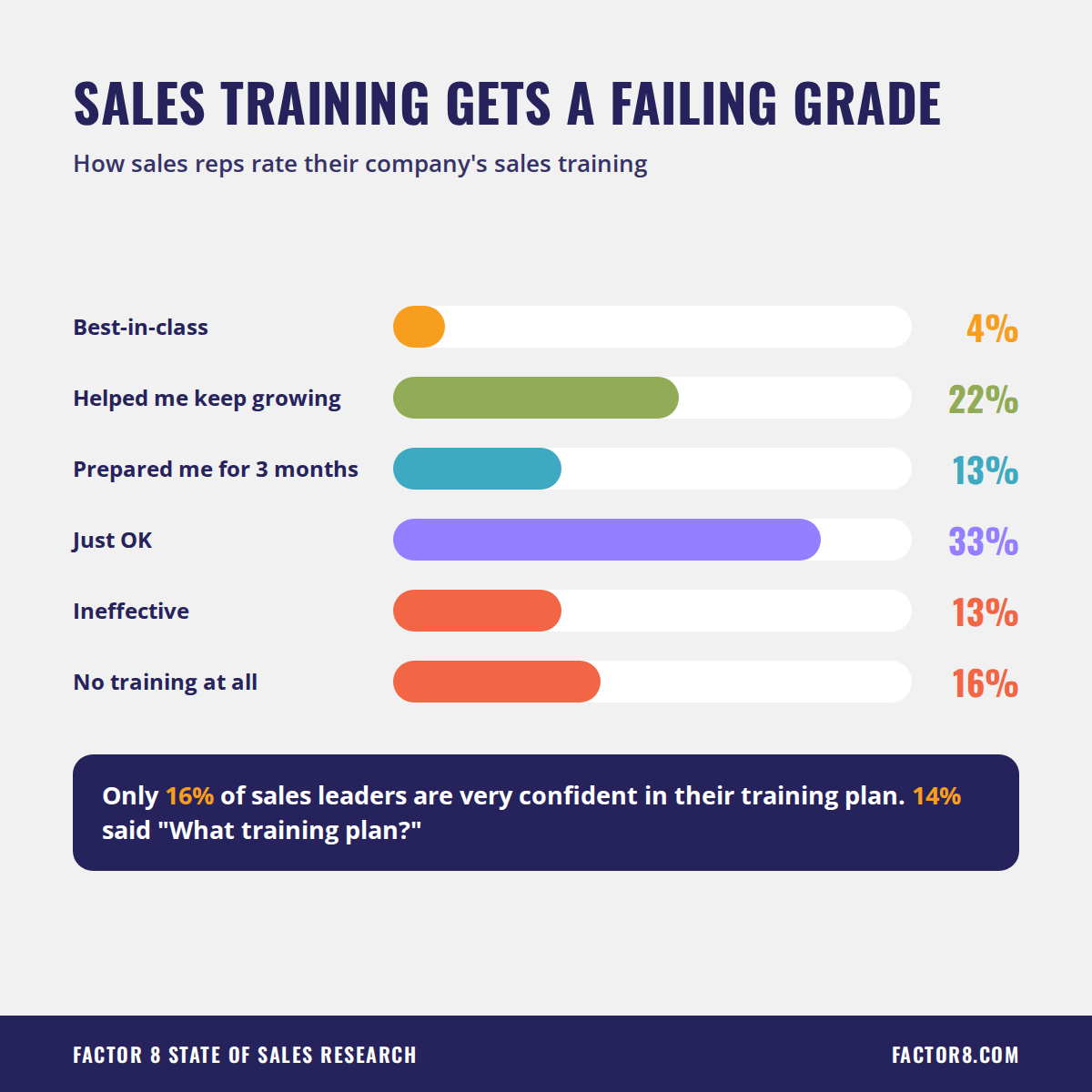
Here’s the truth: some people are born with drive, curiosity, and that inner fire to win. But top-performing sellers aren’t just born, they’re developed. They learn the skills, build the confidence, and have managers who coach them along the way. The good news? Every bit of that can be taught.
If your reps are struggling to find the right contacts, freezing up when someone actually answers the phone, or taking forever to ramp, it’s not a talent problem. It’s a skills and confidence problem.
So, whether you’re building a team from scratch or helping seasoned sellers hit the next level, here’s how to turn potential into performance.
Getting Started: What’s Holding Sellers Back?
Before you can grow a high-performing sales team, you have to figure out what’s slowing reps down. For most, it starts with confidence. New sellers don’t know the language yet, feel unsure about the tools, and get stuck just trying to figure out who to call.
Here’s what sales leaders say are the top challenges:
Fear of the phone
Low business acumen
Poor time management
Struggling to find the right contacts
Stalled or ghosted deals
And even when they do reach the right people, getting them to engage (and knowing what to say next) isn’t always natural.
Confidence doesn’t just appear. It’s built, one conversation, one small win at a time.
Build Confidence from Day 1 by Training These Skills
New hire sales training often tries to do too much. But what sellers need most in their first few weeks is confidence, the kind that comes from actually knowing what to do and say in real situations.
Skip the deep dives into quoting systems or pricing battles. In the beginning, focus on the basics that make up 90% of their day:
Leaving voicemails that get a callback
Knowing what to say when someone actually answers
Keeping prospects on the line
Handling “Who the heck are you with?”
Finding the right people and getting them to engage
Delivering your value prop with confidence
Capturing key contacts on the call
That’s the heart of just-in-time sales training. Teach what reps need for their first 30 days, not their first 300.
Tip: When new reps leave training feeling confident, they come back hungry for more. That’s how you build a learning culture and ramp faster.
One of the most effective coaching tools out there is the Pause Game. It’s simple and powerful:
Play any recorded call (it doesn’t even have to be their own)
Pause every 10 seconds
Ask two questions:
What’s the customer thinking right now?
What would you do next?
This exercise pulls reps out of their own heads and into the customer’s world. It builds active recall, which science shows is five times more effective than passive learning.
The game teaches reps when to apply knowledge, not just what to say. That small shift in awareness can shave weeks off ramp time.
Tip: It’s not just about knowledge. It’s about retrieval. Helping reps recognize when to use the right skill is what separates good from great.
Create call libraries and show reels of top reps in action
Run timed CRM drills during training to build speed and multitasking skills
Digital Sales Rooms (DSRs) are must-have sales tools. These microsites let sellers organize resources, track buyer engagement, and keep deals moving with mutual action plans and real-time visibility.
Tip: Tools like DSRs don’t just help reps. They make it easier for buyers to stay informed and move deals forward. That’s a win-win.
Retention, Career Paths, and Coaching the Coaches
If you want to keep your top reps, you have to do more than teach them how to sell. You have to show them what’s next.
Reps are motivated by success stories, recognition, and growth. So give them that:
Share real win stories across the team to celebrate success and boost morale
Create safe spaces for loss stories to promote learning and vulnerability
Build clear career paths from BDR to AE to manager, with skills mapped at every level
Coaching plays a massive role here. Too many managers run 1:1s, review pipeline, and put out fires, but never actually coach.
That’s why developing your managers matters. Coaching certifications give them a repeatable system to build skills, boost confidence, and grow their people.
Tip: If managers don’t know how to coach, reps don’t improve. Equip your frontline leaders to develop people, not just push deals.
Just-In-Time Training, Simplified Tech, and Manager Reinforcement
Let’s be real. Most reps are buried under too many tools and use none of them well. The average tech stack is a juggling act, not a system.
Keep it simple. Your learning, content, and call-intelligence tools should actually talk to each other so managers can move fast, coach smarter, and see what’s working.
Manager dashboards should show trends, not snapshots; who’s improving, who’s stuck, and where to step in.
And here’s the kicker: about 90% of what managers say in a 1:1 is forgotten within a week. Real learning sticks when it’s reinforced, coached, and repeated until it becomes a habit.
This article is based on insights shared during a Sales Shot webinar featuring Lauren Bailey and Devyn Blume, Sr. AE at Allego. Watch the full session here.
Subscribe to our email list to receive new content, webinar invites, and training offers.
In the past decade, inside sales has been out-pacing field sales by a 10-15x ratio. Scalability is a challenge inside sales leaders will continue to face for years to come.
While I normally focus on building your process, today my job is to talk about the people angle. Although, a good half of my people’s suggestions are process suggestions! Allow me to highlight the top 3 common pitfalls we have all faced when trying to scale your inside sales team and a few outside resources that can help.
Pitfall #1: The success of a massive growth number will live or die in a rep’s ramp time.
Ramp time means something different to each company. It could be time to quota, paying for their overhead, or something unique to you. Whatever your ramp goal, you’ll be creating projections to hit a 1.5x, 3x, or even 5x number and you’ll be doing it with a new headcount.
That means your success hinges on the ability of your headcount to:
Be hired on time
Be trained on time
Hit goal on time
Really dig into your new hire training program, and start doing it six months before your first hiring wave. If you haven’t onboarded recently, check out our sales rep onboarding best practices. And if your offices are still remote, brush up on virtually onboarding new sales reps
Pro Tip: Hire a sales-focused training leader NOW. Most new hire training programs need a LOT of work, and the good ones can cut your ramp time by HALF.
Pitfall #2: We don’t change our hiring process.
Even if you previously onboarded an awesome team that is still with you today, your process likely needs a few tweaks before being pressure-tested during scaling. We usually see breakdowns in two key places:
The pool isn’t as deep any longer. We are in a hiring crisis, folks. Many companies stole great talent when they were new on the scene, but now they’re competing for headcount like everyone else. So even if the number of candidates and job postings are similar, you may find the depth of talent more shallow.
The hiring and onboarding process wasn’t built for volume and is probably too dependent on your managers (but the slew of new hires on the floor will need them more too!) At launch, these managers had all kinds of time to hire. If you triple your model (then double it for the shallow talent pool), think of how many hours per day they will be in interviews. Ouch!
Pro Tip: Pull hiring out of HR and to a recruiter – even if you need to re-appropriate a sales headcount. You need someone doing passive recruiting on the front end, AND who can handle a phone screen for sales. It’s the only way to free up your managers’ time. Make sure you tie the recruiter’s compensation to the RIGHT hires that align with your goals, instead of fighting a recruiting company’s goal of straight-up bodies. I’ve seen way too many new hire classes filled with “live bodies” by recruiters only to have to rehire a replacement class a month later. Sales leaders make no mistake, the need to retrain or rehire is how your hiring goals will be perceived in a culture of scale.
Also, check your hiring process. It should look like your pipeline, with your managers involved only toward the final stages. Oh, and let them hire their own team, OK? (Managers, you can send your cash directly to the Factor 8 HQ for that tip).
Pitfall #3:Develop your managers, NOW.
I’m watching a friend’s floor triple in size right now. They’re super successful and swimming in leads. They need a headcount to maximize the revenue. What they’re missing is strong leadership, definitions of what ‘good’ looks like, and consistency among the management team. And folks, it’s being held together with duct tape and rainbows right now. These managers are SO (say it like a teenage girl) green. Everyone runs different reports, they all manage a different sales process, there are seven disparate call methodologies, no one can forecast because pipelines are atrocious, teams are mixed and matched constantly (because managers are leaving the chaos!) and no two are managed the same. I’d say they’re all marching to a different beat, but no one remembered to hire the drummer.
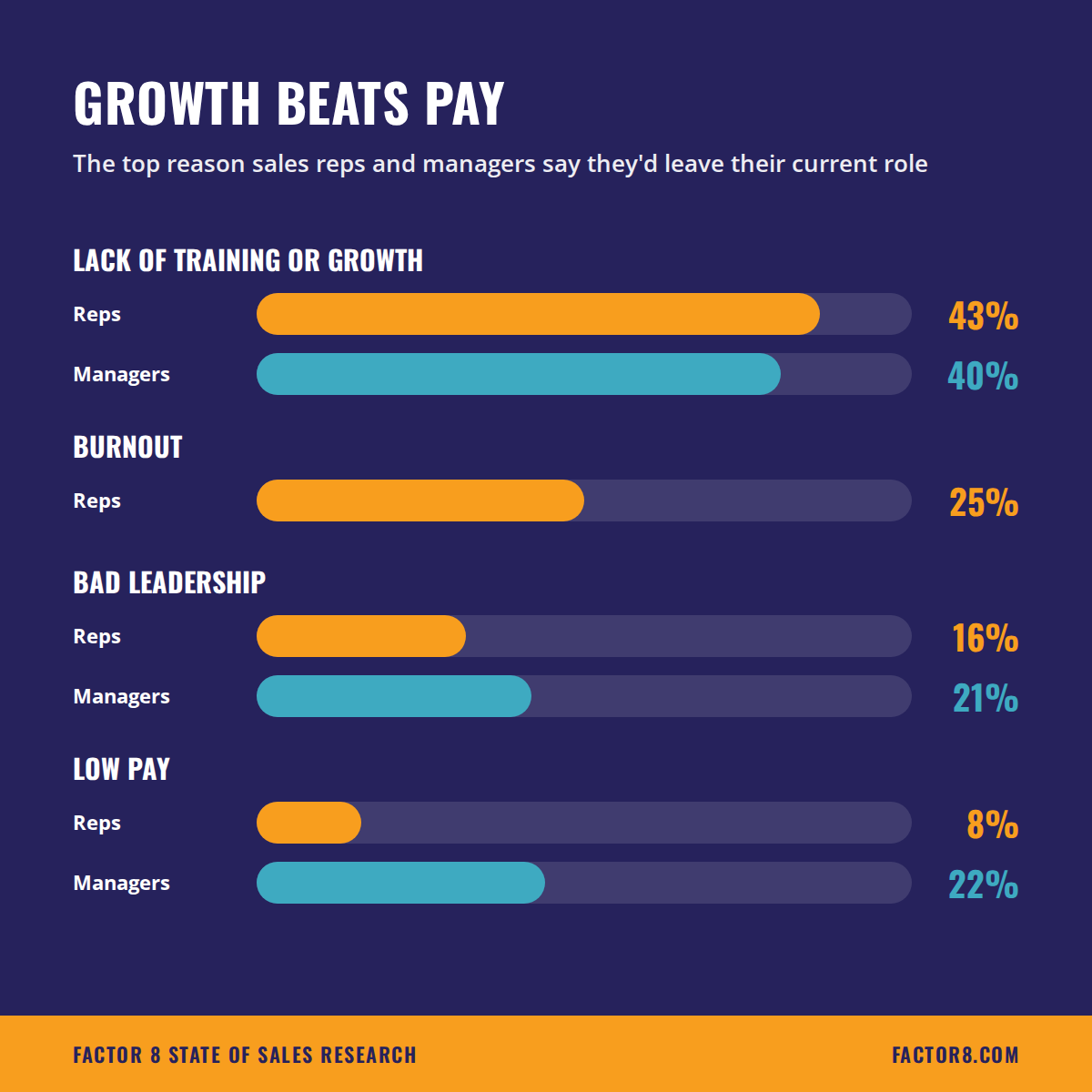
Pro Tip:Hire a drummer…as long as that drummer is a series of documented processes (management cadence, performance improvement, sales handoffs, sales process to name a few). Then, TEACH your managers how to execute against them. You and I both know these people were reps five minutes ago. They need training. They need help being better leaders (or you’ll quickly wind up back at #1 hiring even more bodies). Reps join companies and quit bosses, right? New managers are going to FLAIL in a rapid-growth environment, and your reps will be confused, frustrated, and complain about a lack of development (which also happens to be the number one reason reps leave).
So, save yourself some time and a headache by updating your training program, and getting the professionals to help you with hiring, and developing those managers! I promise, the work now will be worth it once your sales floor is full (and stays that way!).
Subscribe to our email list to receive new content, webinar invites, and training offers.
Sales is changing fast. AI is accelerating everything, buyers are harder to impress, and mediocre selling is getting exposed.
That’s the bad news.
The good news is also simple: the teams that win are going to be the ones who get clear, get current, and double down on human skills that actually move deals forward.
Here are the trends I’m seeing, and the practical moves to make right now if you want a strong year.
1. Get crystal clear on your goal (because nobody is coming to save you)
We’re living in the noisiest time in history. Tools. Tactics. Hot takes. EVERYONE SHOUTING (😉).
If you wait for clarity, you’ll be waiting forever.
Set your own clarity:
What is the actual outcome you want this year?
What do you want to be known for?
What do you want your next role to be?
What’s the one skill you’re unwilling to be mediocre at?
Then act like you mean it. Put it on your calendar. Build your plan around it. Stop drifting.
2. AI is not replacing you, but it is replacing “entry-level effort”
AI will absolutely wipe out a lot of low-level tasks. Anything that looks like copying, pasting, summarizing, basic research, first drafts, list building, and “good enough” outreach is getting automated fast.
So here’s the play:
Use AI to get efficient
Use humans to get effective
If you’re a rep, AI can help you research, organize, and prep. If you’re a frontline manager, AI can help you spot trends, clean up pipeline signals, and prep for better coaching conversations. If you’re a sales or revenue leader, AI can help you scale what’s working, identify risk earlier, and make better growth decisions without losing visibility into the human side of performance. If you’re in enablement, AI can help you reinforce consistency in skills and training, but it should not define what “good” looks like.
6. Demos are changing: shorter, tighter, more customized
The era of the 45-minute “power demo” is fading.
Teams are moving toward:
Micro-demos
Self-serve exploration
“Show me exactly what I asked for” experiences
Recordings that help buyers sell internally
If your demo is still a feature parade, you’re doing product theater, not selling.
Make demos:
Smaller
More specific
Tied to their use case and decision criteria
7. Call bridging is one of the fastest ways to prevent ghosting
Ghosting isn’t new. Buyers disappearing mid-deal is basically a sport now.
One of the simplest skills that helps is call bridging: setting up the next step while you still have them, with clarity and agreement, so follow-up isn’t chasing.
Quick example language:
“Before we hang up, what needs to be true for you to feel good about moving forward?”
“If we’re aligned, what’s the next best step on your side and mine?”
“Let’s lock the next conversation now so we don’t lose momentum.”
When I became the Global Head of Enablement at SAP, I was given one monumental task: launch outbound virtual sales training FAST.
I had no team. No curriculum. And a deadline that did not care.
In four weeks, 37 reps were scheduled to sit in a classroom in Barcelona. And I had nothing. No content. No internal resources. No time to build it all from scratch.
So I did what most enablement leaders in that situation do. I started shopping for sales training.
What I found was the same thing you still see everywhere today. A standard two day workshop. One version for Sales 101. One for Sales 201. One for managers. One for leaders. A little pre-work, maybe a little post-work, but essentially a one-size-fits all experience that was not designed for our motion or our customers.
When I asked vendors for customized sales training, I paid an extra ten thousand dollars and got two role plays printed on paper and shoved into the back of the workbook.
That was the “customization.”
It was not just frustrating. It was unusable. I did not want a vendor. I needed a partner. I needed content that actually fit our inside sales training reality and that my team could reuse, adapt, and build on, not a one time event.
That experience stuck with me. It shaped how I think about sales training, and it is a big reason I am on a mission to make customizable sales training the norm instead of the exception.
If you have ever sat through generic sales training, you already know why it fails.
Most programs are built for delivery efficiency, not real world application. They are designed so a trainer can fly in, deliver the same deck to a different audience, and fly out again.
On paper, it looks like this:
One standard curriculum
One format, often a two day workshop
One path, regardless of role or segment
One moment in time, then it is over
In reality, this creates three big problems.
#1 Engagement
Reps and managers are busy and overloaded. The human brain is always scanning for reasons not to change. The second they hear an example that does not match their buyers or their sales cycle, they check out. “This is for field sellers.” “Our buyers are nothing like that.” “This feels like theory, not inside sales training.”
#2 Application
Even great ideas die if the rep has to translate them alone. When training is generic, you are asking each seller to figure out how to apply it to their role, their accounts, and their conversations. A few high performers will do it. Most will not.
#3 Retention and ROI
We know from learning science that people forget the majority of what they hear in class within days if they are not actively recalling and using it. If there are no real calls, no role specific activities, and no coaching built around the new skills, the investment evaporates fast.
That is why truly customizable sales training matters. Not because it sounds fancy, but because relevance is what keeps reps engaged long enough to try something new, and trying is the first step toward results.
The Real Build vs. Buy Dilemma For Enablement Leaders
If you run enablement or revenue, you are caught in a familiar trap.
Option 1: Build your own sales training
You control the message and the motion
You align to your process, customers, and tech stack
You can design role specific paths for BDRs, AEs, AMs, and managers
But you also run into the reality:
It takes months, sometimes years
Your team already has a full time job
Internal credibility can be uneven
Content gets outdated faster than you can update it
Option 2: Buy external sales training
You get outside expertise
You get something faster
You get a facilitator with instant credibility
You get structure you did not have to build
But the tradeoffs are real:
Content is often generic and one size fits all
It is hard to plug into onboarding and ongoing development
You often do not own the materials
Two years later the playbook and slides are still sitting where you left them
Enablement leaders live in that tension. You want the speed and quality that comes from buying, but you also need the control and customization that comes from building.
Revenue leaders feel it from a different angle. They see the price tag and ask if this sales training will move pipeline, conversion, and quota attainment. The answer depends almost entirely on whether the content feels relevant enough to use and simple enough to apply quickly.
That is the heart of the build vs. buy dilemma. It’s not about training for training’s sake. It’s about behavior change, time to impact, and whether the organization will actually adopt what you invest in.
Why Customizable Sales Training Matters For Both Enablement And Revenue
This is where customized sales training and modular sales training become a strategic lever, not a “nice to have.”
For enablement leaders, customizable sales training means:
You can align content to your stages, roles, and motions
You can plug modules into onboarding, everboarding, and refreshers
You can keep building on the same foundation instead of starting from zero every year
You get a shared language for managers to coach to
For revenue leaders, inside sales training that is truly customized means:
Faster ramp and shorter time to first meeting and first deal
Higher adoption because reps recognize themselves in the examples
Less rework and less “shadow curriculum” created by individual teams
Better visibility into what “good” looks like on actual calls
At its best, sales training is not a one time event. It is a system that combines short, tactical learning, manager coaching, live call practice, and reinforcement activities over time.
Generic content cannot support that system. Customizable sales training can.
What Customized Sales Training Actually Looks Like At Factor 8
This is exactly the gap we’re filling at Factor 8.
Instead of a single, fixed workshop, our inside sales training is built from more than 40 mini modules that we mix and match based on real data about your team. We start with an assessment. We listen to calls, review metrics, talk with leaders and reps, and identify where deals stall and where confidence breaks down.
From there, we design a custom enablement plan that often includes different paths for different roles. A BDR, an AE, and a manager should not all sit through the same day and hope to extract what they need. Each role gets the skills and scenarios that match their reality.
Customization shows up in the delivery too. The decks do not talk about “selling ice to Eskimos.” They use your buyers, your stories, your competitive landscape. Activities, role plays, and even customer logos are built around your sales motion. Reps often bring real calls into the room. We give feedback on actual conversations, not hypotheticals.
We also use a blended learning model that puts application at the center. Reps take short eLearning first to learn the core concepts. Then they complete customized homework that applies those concepts to their world, for example writing their own intros or value statements. When they come to the live workshop, they are already working from their own talk tracks and we coach them up from there.
After class, we keep going. Reps and managers come back together for accountability sessions where we review recorded calls, give next level feedback, and layer in more advanced tips. Managers then meet with us separately so we can calibrate what “good” sounds like and make sure they are reinforcing the skills in one on ones, huddles, and team meetings.
That is customized sales training in practice. It is inside sales training that is specific to your world, built to be used, and supported by your managers, not just a trainer.
Now here is where the model really shifts for enablement.
We heard the same thing from leaders again and again. They loved the training. They loved the outcomes. And they wanted more control. They wanted to keep building on the content with their own voice, their own products, and their own expertise.
With All Access, you still get the full Factor 8 experience, including the assessment, the modular curriculum, and our trainers. But you also get the editable soft copies of our workshops and materials, along with train-the-trainer support and LMS ready files.
That means:
You can license customizable sales training content that already works
You can brand it, adapt it, and plug it into your own LMS or run it in ours
You can build role-based paths for reps and managers without starting from scratch
You can keep content evergreen by updating it as your motion evolves
In plain terms, we help you solve the build vs. buy dilemma.
You get the speed, expertise, and credibility of buying outside sales training. You get the control, flexibility, and ownership of building your own. And your reps get inside sales training that finally feels like it was made for them.
If you are tired of choosing between generic workshops and year long build outs, this is the middle ground. Customized sales training that is modular, practical, and actually yours to keep.
Are you looking for customizable sales training?
Contact us today to learn about our customizable virtual sales training programs available for reps (and managers).
Here are some easy benchmarks and warning signs to help determine if your sales team needs sales training:
1. Your New Hire Training Doesn’t Include Sales Training
I know, you hired for sales talent. You shouldn’t need to train them. If I had a nickel every time I heard that… Trust me, they need training. Why? Their old company did it differently, the sales motion was slightly different, they love a different methodology, and maybe they were loyal sellers but not great ones. I’ve had 15-year sales veterans in my virtual sales skills classes and often their learning curve is the steepest. (Head here for more info on what good virtual sales training looks like)
2. The Last 4 Classes Were Product Related
If you’re thinking: “I do training all the time!”, I invite you to check the content. Reps are used to getting product/service updates and company updates, but not skill refreshes. Sales skills should be taught in onboarding AND at least once a quarter ongoing.
Think of sales calls as “game day.” How often did you practice before then?
3. There’s Been a Strategy Change
About half of our clients come to us because it’s been a struggle to change behaviors now that ______ has changed. Sometimes it’s a go-to-market strategy, client coverage, or an addition of a product or service line. You get it. What seemed simple in the boardroom can prove crazy-making when trying to align 50 junior reps and their managers. Just remember, telling them in the meeting only opens the door. Most employees don’t have the capacity nor the inclination to then translate how this will change their approach, their conversations, their goals, etc. Tell, TRAIN, then coach.
4. You Just Listened to Sales Calls and Your Ears Are Bleeding
If you’ve recently implemented a conversational intelligence tool like Gong, Chorus, or ExecVision, you probably thought it would be fun to listen to the customer’s voice. By the ninth call recording, I’m willing to bet you summoned your team leads and training liaison and had a serious talk about rep skills. Enter professional sales skills training.
5. You’re Losing Gen Z or Millennials
If the last 3 exits or thanks-no-thanks job rejections were Gen Z or Millennials, check your training package. A recent article cited “opportunities for development and advancement” as the number one requirement for these job seekers. New hire product and systems training won’t cut it if you want to attract and keep today’s talent.
Are you considering alternate hiring pools and need to teach former teachers, retail workers, vets or tradespeople how to sell?
Assign this task to the professionals, your HR trainer is probably not equipped for that heavy overhaul. Alternatively, congratulations on your brilliant strategy. Great training programs will open multiple hiring pools to you that won’t be open to your competition, and I love finding behavioral traits in an existing hire rather than teaching the skills to someone new!
6. It’s Playbook Time!
If you’ve grown to the point where it’s time to capture best practices and “how a bill becomes a law” at your shop, I’m guessing you have more than 10 reps but under 50 and you’ve been selling between 1 and 3 years. It’s time to document! Before you do, grab some new best practices from a professional sales trainer. The perfect time is after draft one and before it’s finalized. Invariably, clients who just finished their playbook have gone back to update it with our skills and strategies. If you’re not sure which to do first, I do recommend starting the playbook so that what’s already created can be standardized and uniformly improved with training.
7. Flat Growth
If you’ve used the same conversion ratios the last 2-3 times you’ve done headcount projections, it’s time for some training. In other words, rep staffing isn’t always a quantity equation, you should bank on quality improvements as well. Not sure? Ask yourself how many heads you could save in your budget with a 15% improvement in your top-line conversion metric (whatever that may be). We regularly clock 30-70% improvements allowing sales leaders to lower sales headcount! Shift that spending to your “want” list instead!
Now let’s check in on manager training. Most companies invest in new hire training, then ongoing rep training, and maybe finally manager development. Makes sense, there’s only one for every ten or twenty reps, right? Unfortunately, most reps we promote to manager fail in the first 24 months (50-70% according to the Corporate Executive Board), and they can take down great customers AND reps with them. Here are three signs to check:
8. Your Turnover Is Over 65% or Increasing
If you don’t have annualized employee turnover/exit rates on your dashboard, get them – and by manager. Your star sales managers are keeping their teams and promoting reps rather than suffering high attrition. This is a red flag that you have a struggling manager – perhaps one who hasn’t been taught how to lead people yet.
9. Low Employee Engagement Scores
Consider this a leading indicator KPI of attrition. It is NOT a buyer’s market anymore and if you have a great rep they are actively being recruited out. New generations demand ongoing development opportunities, so be sure you have a line item in your budget every single year. If not, you simply won’t be able to compete for talent.
10. You’ll Be Scaling in the Next 18 Months
If you’ve proven your concept (product fit and funding or even the voracity of digital sales vs. field selling), you’ll be planning to add headcount. When doubling (or more) in size, the critical path is your management team. Sales management training helps provide a consistent rep experience (teams will juggle), a consistent sales process, a consistent definition of what is a good call, consistent performance evaluation, and consistent hiring. I think you’re getting the keyword here. Consistency will allow for a smooth scale. Without it, you’re trying to replicate the Wild Wild West and you’ll experience a spike in rep (and manager) attrition 3-9 months after your hiring waves.
Bonus: Before you scale is also the right time to upgrade your onboarding experience. You’ll need a standard curriculum, testing, wave-based hiring, sandbox systems, and a professional sales curriculum. Do this before tripling the team’s volume in class!
If you’ve found a few signs that your team needs sales training, I hope you’ll reach out and have a conversation. We’re happy to help you decide what skills would help most even if you don’t ultimately outsource to us.
Ready to invest in sales training?
Contact us today to request information on our customizable virtual sales training programs available for reps (and managers).
By now you’ve heard that the sales rep onboarding experience is a major factor in how they ramp to quota and ultimately affects how they feel about your company.
There are about 3 million moving parts in an onboarding program since it happens across so many departments, mostly outside of sales. Because of this, it’s easy to lose our way during onboarding. One of the most important hindrances is the lack of investment — both in effort and money — in onboarding.
Insidesales.com did a study that found organizations spend an average of 3x more on rep tools than on rep development, with the average rep having between 5-10 tools. Similarly, Training Magazine found that organizations spend on average 25x more on recruiting than development.
Moreover, Training Magazine tells us that a good onboarding program can cut ramp time and attrition by 50%. If we focus more time on crafting an onboarding program that will help retain the reps we recruit, we save time, money, and energy down the line.
So let’s do this! Here are 8 best practices you can dive into fixing right now.
Integrate These 8 Best Practices Into Your Sales Rep Onboarding
“Just-in-time” training
Leverage sales (not HR) professionals
Balance software and traditional training methods
Continue onboarding long after the rep is “ready”
Adopt the six critical components of a training program
Use ample multimedia resources
Create a formal, but flexible, rep training program
Set realistic, data-based expectations
Let’s dive a little deeper into why and how to integrate these tips into your onboarding.
1. “Just-in-time” Training
When building an onboarding program, it’s tempting to start by listing all the things “Johnny” may ever need to know and start from the top. Instead, try slicing off only what Johnny needs to know in month one.
It can be tempting to dive deep into company waters with things like histories, organizational charts, and other detailed and specific areas. It’s more effective to shift this information to the backburner for the time being and focus only on what the new rep needs in the first month to be successful. After all, how often does a customer quiz your rep on key events in the company’s founding?
Onboarding training should mirror what a rep’s day-to-day activities will look like once training is finishedduring the first month on the job (and only that first month). This ensures reps don’t feel like a fish out of water when the time comes to execute the tactics taught in training.
Why stop at month one? Because we want our reps to come out of onboarding feeling confident! We want them ready to pound the phones and execute what they learned! If we start introducing them to all the sales process complexities, advanced products, and deep conversations, then we run the risk of scaring or overwhelming them.
This is a time when “you don’t know what you don’t know” is a good thing. If your reps will likely spend that first month talking to existing happy customers or cold calling and leaving a lot of voicemails, stop training there. Bring them back later for the rest.
2. Leverage Sales (Not HR) Professionals
Aberdeen reported that 85% of the sales teams considered “best-in-class” use professional sales trainers or curriculum. But the majority of us outsource our onboarding to HR.
This absolutely does not mean that your sales managers should be the trainers. It means that as a sales leader, you have sales managers and a sales training manager reporting to you (or at least attending your meetings). It could also mean that you have a sales manager who acts as a liaison to training.
But what it definitely means is that you and your sales team all know what is being taught, agree with the how, and are thrilled with what reps can do when they graduate from the onboarding training.
Some companies shy away from investing in an expert for new hires due to the high turnover rate. But, by investing in good sales training and following best practices, companies can reduce new hire turnover rate and save money in the long run.
3. Balance Online and Classroom Training
What we use to teach reps is another balancing act between digital learning and resources and traditional training methods.
Best practice? Use technology for about 30% of your overall curriculum. Much more and we’re missing the opportunity to engage new reps and ensure their first month is lonely and, let’s face it: boring.
Online learning is easiest to leverage for one of the following areas:
Rote knowledge that isn’t likely to change. This includes policies, laws, company history, and unchanging products.
Already-created, third-party curriculum. Commonly this is from technology vendors like Salesforce or basic Microsoft how-to assets
Trusted adviser curriculum. If you’re working with social, sales, or marketing experts already and have adopted their methodologies, ask about online resources to onboard new reps.
Leverage your training department’s learning management system with whatever you’re doing. You’ll want to track what reps have and haven’t done and add a layer of accountability with reporting and testing.
4. Don’t Let It End! Continue Training Even After Onboarding
Rep development should be ongoing. Don’t ever fall into the trap of “They’re trained! My job here is done.” That’s akin to the NFL putting players in preseason camp and then stopping practice when the regular season begins.
Development is an ongoing sport.
At Factor 8, we’re huge champions of sending new reps to the phones early and often. But that is with the assumption that they’ll come back to the classroom to address the gaps they find while out on the harsh streets of your sales floor. It’s also assuming that managers are closely keeping track of rep progress and development needs.
How do you facilitate this?
Try to organize the curriculum into three levels:
Level 1 maps to onboarding – the foundational/month 1 skills.
Level 2 is “just in time” after reps master level 1 and get 6-12 months under their belt. They’re ramped to quota, and it’s time for ongoing development to keep growing and do the whole job well.
Level 3 maps to the mastery of the job in years 2 to 3 — more advanced skills to help them be superstars.
Between each level we add exercises, activities, assignments, and refreshers to keep the skills top of mind, show new ways to try certain tactics, and help managers engage reps in 1:1 and team skill development. The Sales Bar helps us make all of this accessible on-demand so teams can learn what they want to when they want to while still keeping track. We also drip new content monthly and use leaderboards to keep things fresh and different so users want to log back in.
Use this as an example of the microlearning and ongoing development young reps crave. Millennials expect a certain percentage of learning to be in the classroom and online, and they expect opportunities to develop themselves long after onboarding.
Offering blended learning, leveled learning, and ongoing learning checks all those boxes.
5. Adopt the 6 Critical Components of a Sales Training Program
If you’re just starting to build your program or you’re going in to assess yours, start by evaluating what’s being trained. It’s easy to go deep into systems and products, but those are just two of the six components of well-rounded onboarding training:
Systems and tools — Your CRM, intranet, engagement tool, dialer, etc.
Product and service — What you’re selling. Tip: Focus on “how to sell it” versus a full rundown of product history, speeds, and feeds. This harkens back to best practice #1 and maintaining training relevancy. If your product people are teaching this, chances are your reps don’t need half of it and are using this time to snooze.
Sales — Even if you hire for experience, reps need to be taught how to sell your services to your customers in your industry over the phone. Haven’t met a new hire yet who doesn’t.
Process — Think of how your leads and orders get processed internally and who a rep goes to for the top customer questions. In other words, how do you get stuff done at your company?
Acumen — Sorry folks, they’re not coming out of school with business acumen and certainly not industry and customer acumen. This is a big gap, and filling it will drastically shorten ramp time.
Manager integration — this is where tip #5 really comes to life, both during and after onboarding. Reps need to see their leaders often, and training needs input and oversight.
6. Utilize Ample Multimedia Resources
No two reps are identical when it comes to learning style. Make sure you’re meeting every new hire where they’re at by using a mix of helpful resources.
Mixing up these methods not only appeals to reps with different learning styles but also helps keep training exciting and fresh. Who wants to sit and listen to someone else make calls all day and slap a “training” label on it?
7. Create a Formal, but Flexible Rep Training Program
If you’re not putting all new hires through the same rep onboarding process, how can you ever tell if what you’re doing is working?
As we said: Different reps have different learning styles, so it is important to remain flexible to an extent. Just make sure you have some core pillars of onboarding training in place so all new hires are experiencing the same process.
This helps you measure KPIs and tweak your processes if weak spots surface.
8. Set Realistic, Data-Based Expectations for Your New Reps
How many times have your managers set sky-high call quotas for new reps? How many times have they failed to reach it? But, most importantly, how many times has this been documented?
The only thing more frustrating (for both rep and manager) than someone consistently underperforming on quotas, is for there to be nothing in place to fix it moving forward.
Make sure when you’re setting expectations and KPIs for new hire reps that they are based on data. Once you have a fleshed-out onboarding process, it will be easier than ever to keep track of this information.
Find a Tool That Works for Your Onboarding Needs
What if we told you there’s a tool that complements in-person sales training, allows managers to monitor new hire learning during onboarding, and offers a wide variety of inside sales resources?
It’s not magic — it’s The Sales Bar. Fill out the form below to learn more.
Want more information on our sales rep onboarding programs?
Contact us today to request information on our customizable virtual sales training programs available for reps (and managers).
What’s the most overlooked factor in sales growth? Your frontline sales managers.
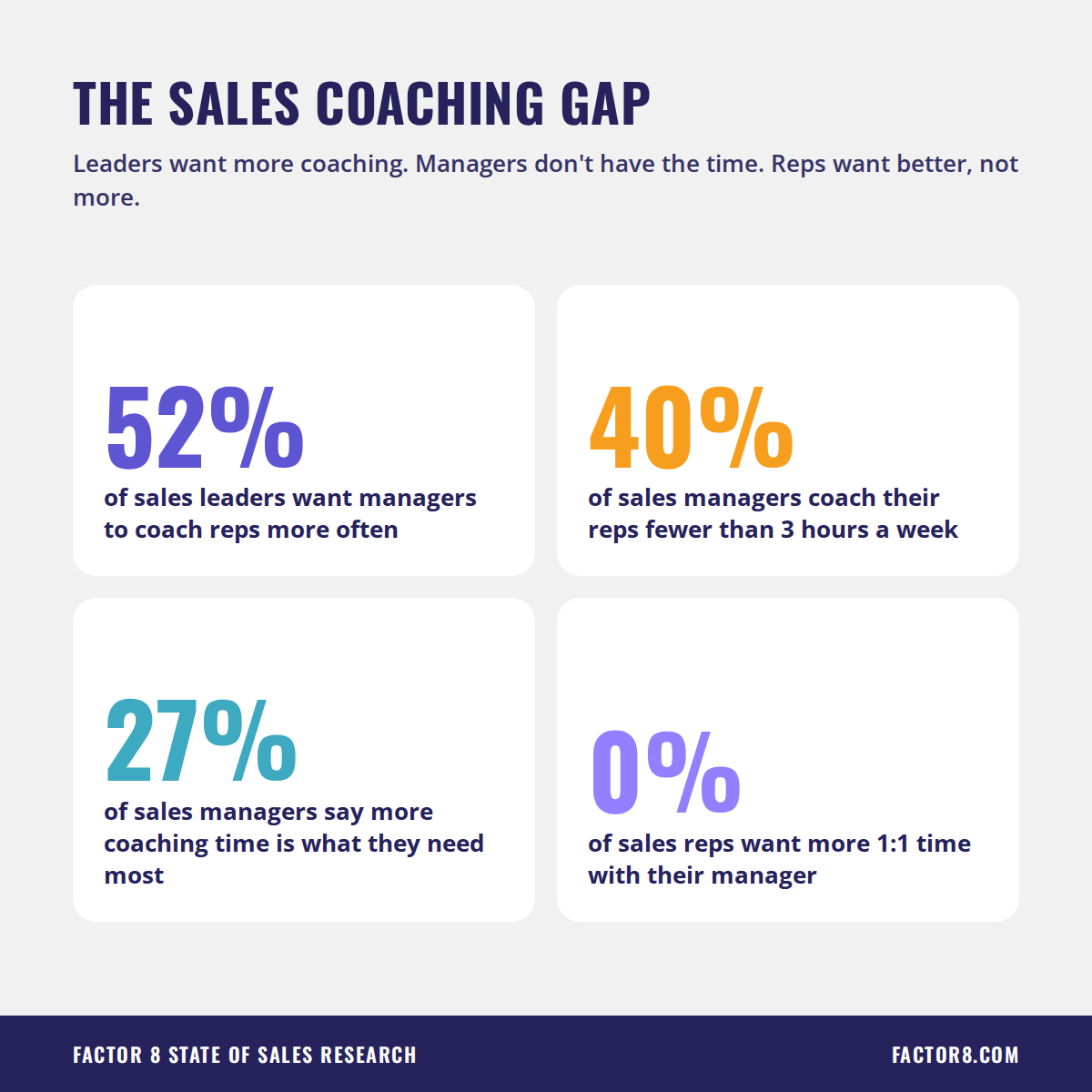
They influence every deal, every rep, every forecast, and yet about 60% of new managers report they never received training when they stepped into leadership.
Let’s stop looking past the obvious. Your frontline managers are the secret to scaling sales growth.
If you want more reps hitting quota, more deals converting, stronger forecasts, and less burnout across the board, it starts with your managers. Not your tech stack. Not your latest AI tool. Not another rep enablement platform (though these are important and we love them, check out our friends at Allego).
I’ve worked with thousands of sales teams and here’s the hard truth. Most companies are investing in everything except the role that has the biggest impact on team performance and revenue growth.
And when we flip that, the results are massive. We’re talking 20 to 47% increases in rep conversion rates. And we didn’t even touch the rep. Just by developing their manager.
So if you’re planning for growth, keep reading. Because managers aren’t a bottleneck. They’re your biggest growth engine.
1. Managers Bring Consistency (and That’s What Scales)
Change is part of growth. Reps switch teams. Territories shift. Comp plans evolve. But in the middle of it all, your frontline managers keep the team focused, engaged, and aligned.
That only works when they’re supported.
Too often, every manager ends up running their own playbook. Not because they want to, but because they’ve never been shown what “good” looks like. And even when you have playbooks, they don’t get translated into everyday actions and team rhythms.
Here’s where the cracks usually show up:
Hiring: Everyone’s looking for different things. Even with a profile in place, managers need support identifying what good sounds like in an interview.
Performance management: Breaking down a big quota into measurable KPIs isn’t intuitive. And very few new managers have been trained to do it.
Rep engagement: Some managers meet weekly. Some meet monthly. Some skip 1:1s entirely. Most spend time reviewing pipeline, not developing skills or coaching.
Pipeline hygiene: Definitions for deal stages vary across teams. That makes forecasts unreliable and coaching hard to scale.
Consistency is what turns momentum into real, scalable growth. And it starts at the manager level.
Give them the tools to:
Hire with confidence using a shared rubric
Set goals and track KPIs that actually drive performance
Run a standard meeting cadence that blends coaching, performance, and career conversations
Clean up pipeline processes so everyone’s speaking the same language
Even tenured managers benefit from this kind of clarity. One enterprise team we worked with had over 10 years of management experience and still walked away from this training saying, “I wish I’d had this years ago.”
2. Great Managers Build People, Not Just Pipelines
Most sales managers were promoted from rep roles. And as reps, their entire world revolved around winning. So when things get tough, what do they fall back on?
Closing the deal.
They hop on the call. They take over the demo. They second-voice the close. It’s not bad intentions, they’re just doing what worked for them. But when a manager becomes the deal hero, the team stops learning.
And that’s when reps leave.
They leave when they don’t feel developed
They leave when they’re not hitting quota
They leave when they don’t have a strong relationship with their manager
The revolving door hurts growth. Every open seat is lost pipeline. Every green rep takes months to ramp. Every exit chips away at morale.
What helps? Redefining the manager role and giving your leaders a new toolkit.
Help them shift from deal-doer to rep-developer
Give them interaction frameworks like COACHNso coaching doesn’t feel like guesswork
Recognize managers for building people, not just saving quarters
Because a manager who builds skill, confidence, and trust is someone who retains reps, not replaces them.
We all love to say coaching is the silver bullet. And it is. But only when it’s done well.
Real coaching moves the needle on performance, confidence, and retention. But too often, what we call “coaching” is just a pipeline review in disguise.
If you’ve ever listened in and heard:
The manager doing all the talking
A rep leaving with three disjointed to-dos
A session that feels more like a performance review than a development convo
Then chances are, your managers need support here.
The most common trap? The Mini-me. That’s the manager who coaches every rep to be a version of themselves. It works for the one or two reps with the same style. Everyone else gets frustrated, disengaged, or overlooked.
Good coaching is consistent, rep-centered, and rooted in skill development, not deal rescue.
That’s why we don’t treat coaching like a one-hour workshop. It’s now a six-hour, three-part course here at Factor 8. Because shifting behavior and building confidence takes time. And when it clicks, reps perform. They stay. And they grow.
If You’re Skipping Manager Development, You’re Skipping the Scale
Let’s be honest. The biggest miss isn’t the manager. It’s us.
We’ve skipped the basics. We assume managers will figure it out because we did. We prioritize tech over training. We fix people problems with process or platform investments.
But if you want more reps to hit quota, you don’t need a new tool (yet). You need stronger conversations first.
That comes from skilled, supported, confident managers.
Most reps today get a sliver of what they need in onboarding. Then they’re tossed five tools and a quota. They’re still learning the basics. And the person who owns the rest?
Their manager.
So let’s invest in them. Train them. Coach them. Give them a framework, a cadence, and a community. Make development part of the rhythm, not a one-time event.
Because your reps aren’t going to grow if your managers aren’t growing too.
Managers are the secret to scalable revenue growth. Let’s stop hoping they figure it out, and start helping them knock it out of the park.
Subscribe to our email list to receive new content, webinar invites, and training offers.
AI is transforming how sales and enablement leaders work, but not every tool is worth your time. The real win comes from using AI to cut through busywork, speed up planning, and empower your team to perform at their best.
Here are the AI tools, prompts, and use cases worth stealing (and what you should skip).
Practical AI Use Cases That Are Saving Leaders Time
The biggest takeaway from our panel? AI is already drastically changing the game for sales and enablement leaders, and not in a distant future way. It’s helping them cut hours of work, make better decisions, and focus on the human parts of their job that matter most.
Helen shared a genius way to scale call reviews. Instead of sifting through hundreds of recordings, she uploads batches of transcripts into ChatGPT to surface competitor mentions, objection patterns, and whether reps are locking in next steps. It’s like a virtual coach doing the analysis for you, so you can spend time actually coaching.
Prompt to steal: “Here are 20 discovery call transcripts. Create a table summarizing top objections, competitor mentions, and whether a next meeting was secured.”
Another smart move came from Rose, who built her own “clone” using Gemini. This persona enforces the company’s tone, writes in an active voice, and ensures content is clear and consistent across teams worldwide. The result is scalable sales training that actually sticks.
Prompt to steal: “You are a sales enablement expert. Write onboarding instructions in an active voice, using customer-centric language at an 8th-grade reading level.”
AI can also help sales managers think faster and coach smarter. By feeding pipeline data into ChatGPT, Casey uses it to surface coaching priorities, the same insights an experienced leader would draw out, but in minutes instead of hours (grab Casey’s free AI toolkit for 6 AI prompts sales leaders need).
Prompt to steal: “You are a frontline sales manager. Analyze this pipeline report and highlight three coaching priorities for my next one-on-one.”
Richard is taking a different angle by using AI to power better top-of-funnel strategies. He pairs Claude with Crystal Knows to understand buyer personality types, helping him craft outreach messages that feel personal, not spammy.
Prompt to steal: “Here’s my target persona and their LinkedIn profile. Write a personalized outreach message that matches their communication style.”
These aren’t hypotheticals. They’re working right now. The leaders using AI this way aren’t just saving time; they’re leading smarter.
AI isn’t here to replace coaching (or training), but our panel proved it can make coaching a whole lot more impactful. By letting AI handle the heavy lifting behind the scenes, leaders are freeing up more time to actually coach and connect with their teams.
One of the standout examples came from Helen, who built a custom Love Your Team bot to help leaders role-play tough performance conversations. Managers can pick a scenario (easy, medium, or hard), practice with the bot, and get scored on how they did. It’s a safe way to prepare for conversations most leaders dread.
Prompt to steal: “You are an underperforming rep. Role-play a tough performance conversation with me and grade my responses.”
Rose is embedding AI directly into enablement the right way: skills first, AI second. Her team uses NotebookLM to create an interactive, searchable knowledge base from training content. Reps can ask it questions, generate FAQs, and even turn the material into podcasts in multiple languages, making learning easier to access and retain.
Prompt to steal: “Based on this training content, create an FAQ for reps that focuses on what they need to do, not just what they need to know.”
GRW also came up as a powerful tool for role-play coaching, giving reps a safe environment to practice calls and get real-time feedback based on proven sales frameworks (like the Factor 8 COACHN Model).
Casey encourages leaders to train their GPT to think like them. By feeding it prompts that teach their leadership style and decision-making frameworks, managers create a digital “thinking partner” they can lean on for coaching plans and tough conversations.
Prompt to steal: “Here is how I coach and communicate with my team. Learn my style and use it to draft coaching plans for these three reps.”
AI works best when it reinforces fundamentals instead of replacing them. Richard uses it for pattern recognition in sales scenarios, helping reps see what makes deals successful before they automate a thing.
Prompt to steal: “Analyze these sales scenarios and identify patterns in what led to successful outcomes.”
The bottom line? AI makes coaching and training more scalable and personal, but it only works if you use it to strengthen (not sidestep) the human connection.
Table Stakes for Using AI Safely and Effectively
AI is only as good as the guardrails you set around it. The panel made it clear that using AI safely and effectively isn’t optional, it’s table stakes.
Privacy and data control came up first. Casey stressed that leaders must lock down privacy settings before letting teams run wild with new tools. Without clear guardrails, you risk exposing sensitive information.
Prompt writing was another critical theme. Richard shared that the best outputs come from clear inputs: provide context, be specific, and always state your desired outcome. “Bad prompts get bad results,” he said. That’s why he often uses Claude to refine his prompts before sending them to other AI tools.
Helen showed how simple prompts can turn messy CRM data into clean, actionable summaries. Instead of spending hours in spreadsheets, she asks ChatGPT to create a table showing seller progress against objectives, giving her an instant snapshot of where to focus.
Rose brought it back to basics: start with the customer, not the tool. AI is there to help you serve buyers better, not to replace thoughtful strategy. When teams lead with AI instead of empathy, they risk losing the human connection that closes deals.
The message from all four leaders? The tools will not save you unless you teach them who you are, control what they see, and use them to make your work and your relationships stronger.
One of the best parts of this session was hearing the little hacks leaders use to save time without cutting corners. These weren’t big, shiny tech demos; they were practical shortcuts anyone can use.
NotebookLM was a fan favorite for Rose, who uses it like an interactive playbook. Instead of digging through static training docs, her reps can ask it “how do I” questions and instantly get answers. It can even generate FAQs or spin training material into podcast episodes in multiple languages, making learning accessible and easy to consume.
Casey shared how she teaches leaders to train ChatGPT to think like them. By feeding it prompts that define their leadership style, tone, and decision-making process, they turn it into a virtual assistant that knows how they would respond. This saves managers countless hours on repetitive tasks like drafting coaching plans or preparing for one-on-ones.
Richard uses Claude to sharpen his prompts before sending them to other tools. He calls it a “prompt coach” because it helps him ask better questions, which leads to better outputs everywhere else.
Helen keeps her workflow lean by asking AI to summarize CRM and call data into quick performance snapshots. Instead of pulling endless reports, she gets an at-a-glance view of what’s working and what’s not so she can spend her time coaching, not crunching numbers.
Fathom was another fan-favorite for turning meeting recordings into clear, actionable summaries, so leaders and reps can skip manual note-taking and focus on next steps.
For me, Oliv is the standout AI tool for saving time. I raved about it during the webinar, sharing how it delivers all my pre-call research straight to my inbox. No digging, no scrambling, just everything I need ready to go before the call. Oliv’s AI agents handle the admin grind behind meetings, from updating CRM fields to building follow-ups and proposals. For leaders, it automates forecasting and pipeline reviews, keeping everything accurate without the manual chase.
These hacks may seem small, but together they save hours each week and keep leaders focused on what really moves the needle.
What AI Tools Are Worth It (And What to Skip)
When it comes to AI, there’s no shortage of shiny new tools, but only a handful are truly moving the needle for leaders. The panel didn’t hold back on sharing their favorites and the ones they’d leave behind.
For writing and content creation, Claude was a unanimous favorite. Both Richard and Rose rely on it for everything from drafting social content to formatting training materials. Richard even uses Claude to help craft better prompts, giving him cleaner outputs faster.
On the enablement side, Rose swears by her custom Gemini persona, the “Rose Clone,” to enforce tone and consistency in every piece of training content. She pairs it with NotebookLM to turn training materials into interactive, searchable resources that reps actually use.
For leaders coaching teams, Casey’s toolkit is full of must-haves. She loves using ChatGPT to analyze pipeline data, surface coaching priorities, and act as a sounding board for tough management decisions.
The session also spotlighted presentation tools worth bookmarking. Richard uses Napkin and Beautiful to quickly create clean, high-impact visuals, and pairs them with Canva for easy team collaboration. These tools make it faster to produce presentations that actually engage audiences without spending hours designing slides.
Not all tools got glowing reviews. Helen warned against relying on AI to write prospecting emails or LinkedIn outreach. Tools that blast generic messages do more harm than good. Her advice? Skip the automation here and pick up the phone. “Calling is back,” she reminded us. (We don’t think it ever went away 😉).
The panel also flagged a common mistake: blindly trusting AI outputs. Whether it’s using ChatGPT to summarize CRM data or leaning on any tool to draft content, accuracy isn’t guaranteed. Every AI output still needs a human eye before it goes out the door.
The takeaway? Tools like Claude, ChatGPT, Gemini, NotebookLM, and even quick-hit design tools like Napkin and Beautiful are worth the investment because they solve real problems. Tools that replace personal outreach or encourage copy-paste shortcuts? Skip them.
What’s Next for AI in Sales Enablement
The session wrapped up with a clear message: AI is here to stay, but how you use it determines whether it helps or hurts.
Helen reminded everyone not to let AI erode trust with customers or teams. Human connection still wins, and AI should support (not replace) that.
Richard sees the next wave already forming. AI agents acting like digital employees are coming fast, and they’ll change how leaders think about efficiency and staffing.
Casey urged leaders to focus on amplification. Use AI to make what you do best even better instead of trying to automate it all away.
And Rose left us with the simplest but most important reminder: no AI tool fixes bad fundamentals. Skills come first. Layer AI on top to scale and reinforce, not as a shortcut.
The future of sales and enablement isn’t human vs. machine. It’s human with machine, and leaders who embrace that balance are already pulling ahead.
When I asked the panel if AI would replace sellers, the chat blew up with a resounding “NO.” That moment sparked an important reminder from Casey about how we should approach AI:
“AI will only replace humans if we let it. Use it to make yourself better, not to take yourself out of the equation.”
The Best AI Sales & Enablement Tools
Here are the top AI tools from our panel and how they’re being used to save leaders time, improve coaching, and scale enablement:
Beautiful – Creates polished, high-impact presentations without needing a designer.
Canva – Makes it easy to design presentations and enablement content quickly with team collaboration.
ChatGPT – Analyzes call transcripts, summarizes CRM data, role-plays tough conversations, and acts as a manager’s thinking partner.
Claude – Used to draft content, refine prompts, and create cleaner outputs for training and social selling.
ConnectAndSell – Speeds up live calling efforts and list enrichment for sellers.
Crystal Knows – Helps tailor outreach messaging based on buyer personality profiles.
Fathom – Automatically summarizes calls and meetings into actionable notes.
Fireflies – Transcribes and summarizes meetings, saving time on manual note-taking.
Gamma – Builds presentation slides in minutes with AI-generated layouts and content.
Gemini – Powers custom personas like Rose’s “clone” for consistent content creation and translates training content across languages.
Gong – Analyzes call recordings to surface buyer sentiment, track deal risks, and give managers data-driven coaching insights.
GRW – Acts as a sales role-play simulator that provides real-time feedback based on proven coaching frameworks.
Kronologic– An AI-powered scheduling assistant that automatically books meetings by recognizing when a lead is ready and sending a calendar invite from the rep’s email.
Magi – Gives leaders access to multiple AI models like Claude and GPT in one interface, streamlining experimentation and prompt testing.
MidJourney – Generates high-quality visuals and creative assets for content and enablement.
Napkin – Quickly generates clean slide visuals and presentation graphics.
NotebookLM – Turns training materials into interactive playbooks, searchable FAQs, and even multilingual podcasts.
Oliv – Delivers pre-call cheat sheets with bios, company background, and personalized icebreakers to reps.
Perplexity – Acts as an AI-powered research assistant for quick, accurate information retrieval during content creation or planning.
RightBound – Uses natural language queries to create targeted prospect lists quickly, saving time on manual filtering.
Bonus: AI Tools Recommended by Attendees
Our audience came ready to share their own favorite tools. Here are a few worth exploring:
Adobe Firefly – Leveraged for generative design and creative content projects (shared by Jim).
Autobound – An AI-powered email writing tool that combines Claude and Gemini to craft smarter outbound messages (shared by Jason).
Calendly – Now includes AI-powered note-taking, recording, and meeting summaries to streamline follow-ups (shared by Viveka).
Copilot (Microsoft)– Used by several attendees to act as a virtual assistant, helping with meeting prep, drafting content, and automating repetitive tasks to boost productivity (shared by Jessica, Sandra, Angela, and Shawn).
Custom Personas for ChatGPT – A resource with 300 pre-built persona templates to customize ChatGPT for specific roles or scenarios (shared by Demont).
Otter – Helps transcribe meetings and create searchable notes; also praised for its robust subprocessors (shared by Demont).
n8n – Used for building automation workflows that connect multiple tools and processes seamlessly (shared by Jason).
ScreenApp – Captures and analyzes face-to-face meetings, providing outputs similar to Fathom for call insights (shared by Guy).
Vengreso FlyEngage – Designed to boost LinkedIn engagement through personalized messaging and workflows (shared by Viveka).
ZoomInfo – Used to create buying groups and surface intent signals to target prospects more effectively (shared by Glenn and Demont).
Subscribe to our email list to receive new content, webinar invites, and training offers.