
How to Build a Strong Sales Pipeline: Prospecting Tips That Work [Webinar Recording]
How to Build a Strong Sales Pipeline: Prospecting Tips That Work
[Video Recording]
[Video Recording]
[Video Recording]


If your reps are still using AI like it’s 2023 (or not using it at all), they’re already behind. In our Sales Shot, I sat down with four sales pros and AI enthusiasts whose teams are actually using AI for sales prospecting, not just talking about it. We’re talking AI-enhanced targeting and prospect research, coaching bots, live conversation sentiment tracking, even inbound AI voice agents that are outperforming humans (yes, really – so, will AI take over sales jobs? That’s a topic for another blog!)
Here’s what went down, and the best AI tools, tips, and prompts you’ll want to steal.
We kicked off with a game-changer: using AI to make sure you’re calling the right people. David Kreiger, SalesRoads, shared how his team uses Clay to qualify leads before reps ever pick up the phone. It pulls company data and uses AI to tell you if a prospect actually fits your ICP, saves hours of manual research, and gets your team focused on the right accounts.
John Buckley (from Sell Better’s Daily Sales Show) showed us Agent.ai, a no-code agent that scores a company for outbound fit with a single URL. He’s trained it on his ICP so it gives a quick thumbs-up or “hard pass.” No prompt writing needed.
Jax Gill (from Inspira Financial) took it even further. She trains ChatGPT to review a company’s website and her prospect’s LinkedIn profile, then find common ground to help her build rapport fast. She even gives it a list of her solutions and asks for possible pain points to reference in the convo. It’s like AI-powered pre-call prep, minus the rabbit holes.
Prompt ideas to steal:
Let’s talk outbound emails. Doug Gibb’s team at Waste Management uses Conquer with GenAI email, which drafts emails based on past conversations and makes sure they don’t miss a promised follow-up. It pulls call and email history straight into Salesforce, so everything’s in one place.
David dropped this gem: if you write more than three emails a week, build a custom GPT. He’s trained his to match his tone and voice. Upload 50 of your best emails, and now your GPT can write in your style. It’s faster, but more importantly, it’s better.
WATCH: How to Build a Custom ChatGPT (shared by David)
James added Oliv to the mix. This tool sends him a cheat sheet before every call with company background, team bios, and even icebreakers. “Ask Chloe about her transition from radio hosting to content marketing” is way better than “Hope you’re well.”
One big reminder from everyone: AI-generated emails shouldn’t sound AI-generated. If your message is filled with fluff, jargon, or emojis in every line, it’s going straight to trash. Your prospects can smell it. Use AI to help, but still bring your brain.
Prompt ideas to steal:
AI isn’t just helping reps do the work. It’s helping them get better at it. David recommends using AI to coach yourself after calls. His reps drop their call transcripts into ChatGPT and ask for feedback. What could I have done better? What questions did I miss? It gives them a score and action steps to improve.
Jax uses AI before the call. She practices objections with ChatGPT in persona-mode. “Be a tough IT Director. Push back on cost.” It gives her reps a safe space to screw up and get better.
Doug’s team uses Conquer to transcribe and summarize every call. It flags sentiment dips, highlights next steps, and scores reps on their delivery. That all feeds into Ambition, where managers get a full coaching report before every one-on-one. And yes, even new managers can coach like pros because the system shows them exactly what to focus on.
We also shouted out Grw AI, a tool for roleplay call coaching. Reps can practice calls and get feedback based on real frameworks. It’s like flight simulator training for sellers.
I also shared how much I love using Fathom for call notes. I just click a button and boom, it gives me a clean sales summary with top pain points, current situation, and next steps. It’s fast, easy, and way more useful than generic transcripts. Use it for internal calls too to help you take notes and create to-dos.
Prompt ideas to steal:
Sales moves fast. Reps don’t have time to dig through notes or scroll LinkedIn for the latest news. That’s where real-time insights come in.
James’s tip: Use LinkedIn Sales Navigator alerts. Ring the bell on your top prospects and accounts. You’ll get notified when they change jobs, get promoted, or post. Instant reason to reach out. That’s prospecting fuel your team is probably ignoring.
Doug’s team uses Ambition’s pre-read feature to prep for coaching. It pulls 90 days of call scores, KPIs, pipeline data, and even sentiment analysis so managers walk into meetings ready. Their AI-based pipeline insights show if deals are stuck, what changed, and where to focus.
David shared Trellus, a power dialer that lets reps pause mid-call to get AI-powered coaching suggestions. It’s like having a manager in your ear without the pressure.
Prompt ideas to steal:
You didn’t think AI was just for outbound, did you? David’s team is using Sela for inbound calls, and it’s outperforming human reps in tier-one qualification. The AI calls the lead, asks 2–3 qualifying questions, and routes the hot ones straight to an SDR. It’s efficient, repeatable, and for simple calls, often better than a live person.
James brought up Sybill, which reads facial expressions and body language during video calls. It sends post-call insights like, “Your buyer leaned back and widened their eyes when you said pricing.” That’s gold for follow-up and helps reps refine their messaging and emotional timing.
And of course, Doug’s team uses Microsoft Copilot, a company-approved, closed AI system integrated into their workflows. Their AI governance committee ensures compliance, which matters when your team is 50,000 strong.
Bonus tip from Jax: Use ChatGPT as your personal hype woman. “Give me a pre-call pep talk.” Or ask it to roast you. Either way, you’re showing up more confident.
Prompt ideas to steal:
READ: Confessions from a Late-Adopter: The Truth About AI for Revenue and Enablement Leaders
This session wasn’t fluff. These are real leaders, using real tools, getting real results. If your team is still scared of AI or waiting for some “perfect system,” you’re already behind.
The final takeaway?
TL;DR – Here are the best AI sales tools and how our panelists are using them:
[Video Recording]

Lauren Bailey, known to many as “LB”, is a sales leader, enablement leader, and entrepreneur and founder of 3 successful brands: Factor 8, providing front-line job training for inside sellers and managers, The Sales Bar, a subscription-based virtual sales training platform, and #GirlsClub, a community and development program helping more women earn leadership positions in sales.

My mission is to walk alongside sales professionals as they develop the skills and best practices needed to find sales success. Our purpose is to show salespeople their true worth as the tip of the spear. I have the pleasure of hosting the best minds in sales every day and creating content that elevates the sales profession.
Connect with me @saywhatsales on Instagram, TikTok, and Twitter. Join us live daily to learn and grow into a top-performing sales professional.

Jacqueline Gill is a Senior Manager in Sales Enablement who’s been at TTEC for 12 years—which in BPO years is basically a lifetime. While her official job is enabling sales, she’s also been known to jump into learning services sales conversations once the executive sellers work their magic. Think of her as the closer with a curriculum. Outside of work, she’s a proud mom of four and a firm believer that AI can help with just about anything—except maybe laundry.

Forty-seven years’ experience managing teams and processes across two primary industries, Retail Department stores and Environmental Solutions/Logistics. The last eleven years have been invested with the Inside Sales Teams at WM, including managing retention and acquisition teams, then progressing to exploring, sourcing, procuring and implementing 3rd party tools and solutions to significantly improve both our customer’s and Sales Team’s experiences.

David Kreiger is the founder of SalesRoads, a leading sales outsourcing firm with over 17 years of experience helping businesses drive revenue growth by building winning sales teams. A seasoned entrepreneur and host of the “Sell Like A Leader” podcast, David champions a philosophy that sales success hinges on talent development and a people-first mindset.
[Video Recording]

Let’s face it, every seller has been brushed off (and probably quite often).
“I’m not interested.”
“We’re all set.”
“I don’t have time right now.”
Sound familiar? If you’re making outbound sales calls, cold or warm, you’ve heard these before. But here’s the good news: Brush-offs are not objections. And when you know how to handle them, you can double your talk time, increase your conversion rates, and book more meetings.
I’ve broken down my 6 tips and tactics to help you beat the brush-off and turn dismissals into meaningful conversations. Let’s dive in!
Objections happen late in the sales cycle after you’ve made your pitch and the buyer has concerns, usually about price, timing, or fit. Brush-offs? They happen early, and they’re not objections at all.
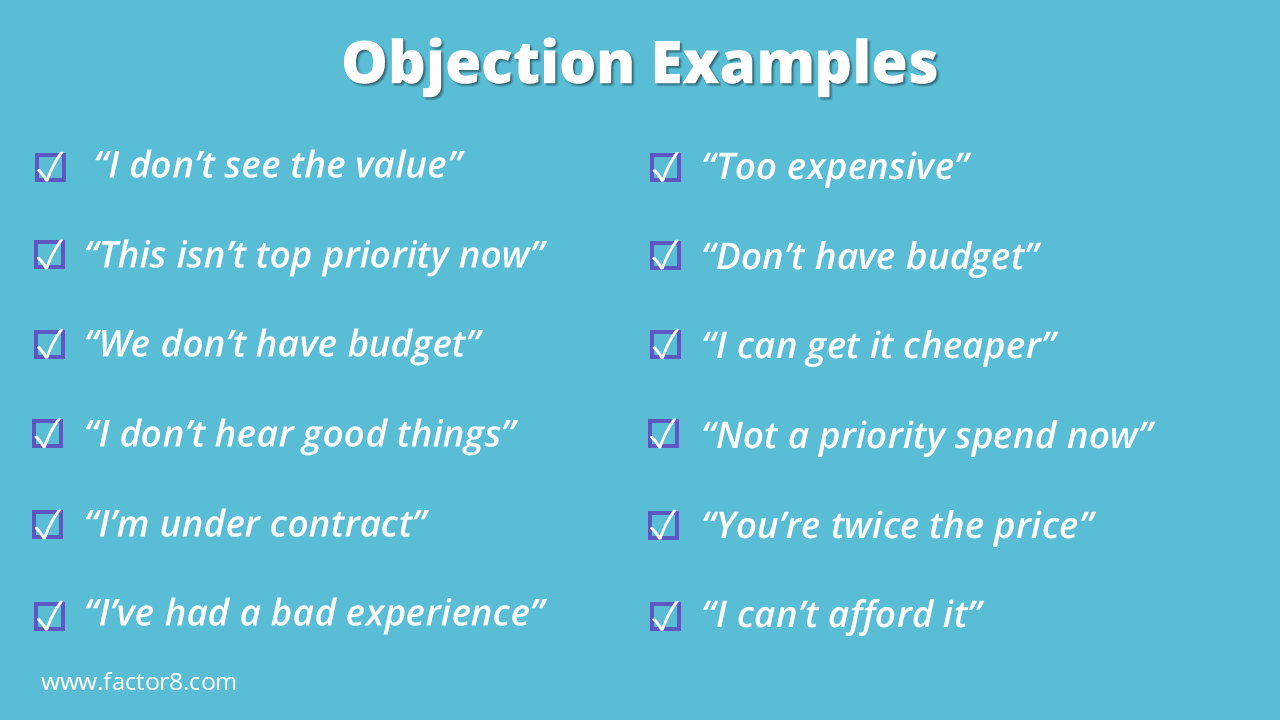
Think of a brush-off like an automatic reflex. It’s the prospect’s way of saying, “I don’t have time for a sales pitch right now.” That’s all it is. And it doesn’t mean they aren’t a good fit or won’t buy from you later. It just means they don’t know you… yet.
So, what’s your job? Keep the conversation going, show them you’re different, and provide value ASAP.
READ: How to Keep Prospects on the Phone
Prospects brush you off because they don’t know who you are or what you’re selling. That’s great news! It means they haven’t actually rejected you, they just haven’t heard your value yet.
This is why you should never “kill” a lead based on a brush-off. Too many sellers give up too quickly, assuming the lead is a dead end. In reality, the prospect just isn’t paying attention.
Here’s why you shouldn’t take brush-offs personally:
Your instinct might be to respond to the brush-off directly (“Oh, but we can save you 20%!”). DON’T DO THAT. That just gets you lumped in with every other pushy salesperson. Instead, sidestep it. Keep the conversation going by staying confident and trying again.
By understanding that brush-offs are uninformed and automatic, you can push past them and start real conversations.
When someone brushes you off, what are they really saying?
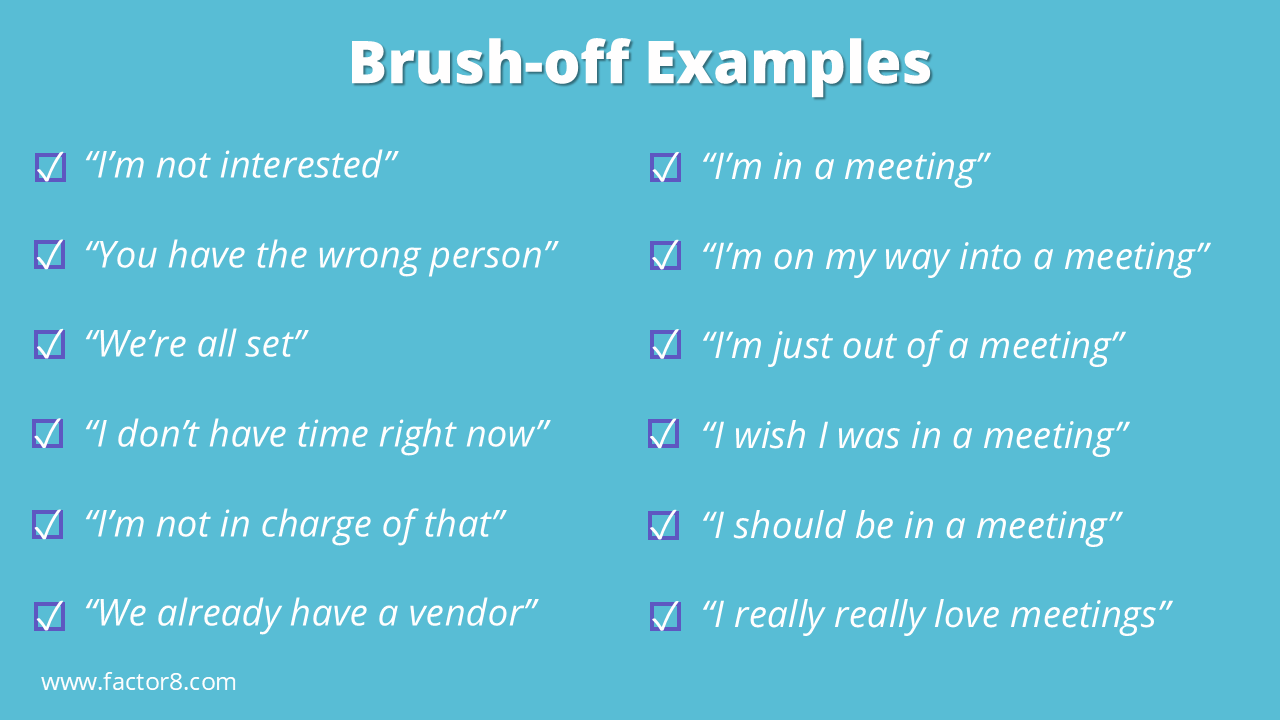
The key to overcoming a brush-off is understanding what’s underneath it. Most brush-offs aren’t real objections, they’re reactions to an interruption. Your prospect isn’t rejecting your solution; they’re rejecting the idea of being sold to in that moment. Your job is to shift their perception of you.
Here’s how to uncover the real meaning behind their response:
The goal isn’t to argue with their brush-off, it’s to help them rethink it.
WATCH: How To Overcome Brush-Offs On Sales Calls
If you’ve ever bought someone a drink at a bar, you know the goal isn’t to “close the deal” in 30 seconds. It’s to start a conversation. The same applies here.
When a prospect gives you a brush-off, they aren’t thinking deeply about your offer, they’re reacting instinctively. Your job is to interrupt that instinctive response and guide them into an actual conversation.
The best way to do that? Use the CCO Framework (Closed, Closed, Open) to break through their initial resistance. Start with simple, closed questions to get them talking, like “Is this a crazy time of year for you?” or “Would you say Q4 is typically your busiest quarter?” Once they’re engaged, move to an open question that invites more thought, like “Is this for a short sales cycle, or do deals take months to close?” By following this structure, you can take control of the conversation and steer it toward a meaningful discussion.
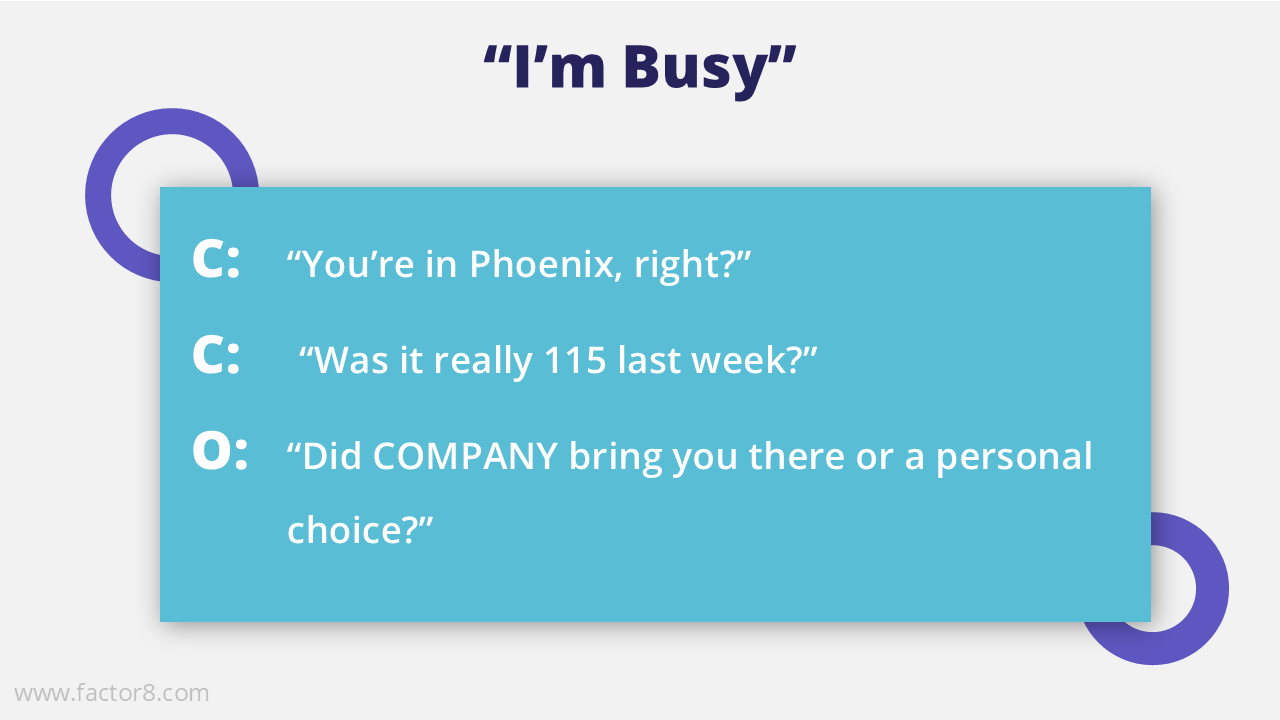
As a reminder, a brush-off is different from an objection. An objection is a real, considered response to your pitch, something they’ve thought about and have a concern over, like pricing, timing, or relevance. A brush-off, on the other hand, is a knee-jerk reaction designed to end the conversation before it even starts. Your job isn’t to overcome an objection here, it’s to keep them talking long enough to break their automatic dismissal.
DOWNLOAD: 4-Step Process to Overcome Objections
Shaking up the conversation with a pattern interrupt gets them to stop and engage. Small talk about something unexpected (like their location, the weather, or a recent event) can lower their defenses and make them more receptive. People also love talking about themselves, so guiding them toward a topic related to their role or priorities can naturally steer the conversation toward business without feeling forced.
Once you start recognizing brush-offs for what they really are—automatic, uninformed reactions—you’ll realize they’re not personal and they’re not final. The key to overcoming them is choosing the right approach. You can take the direct path by breaking the ice with the CCO Framework (Closed, Closed, Open), easing your way into the conversation until the prospect naturally engages. Or you can sidestep the brush-off completely by shifting the conversation to something unexpected, like their location, the weather, or a relatable topic, disrupting their auto-response and creating an opening for dialogue.
Either way, the goal is to bypass their defenses and turn a brush-off into a real sales conversation. Try it out, test both methods, and see what works best.
Plenty of sales reps love the convenience of email and LinkedIn prospecting. But poorly crafted, AI-generated messages do little to build rapport and trust with your prospects.
That’s why, as much as some people despise it, you have to pick up the phone.
As young reps continue to phase into the sales force, there is a growing challenge for them to get beyond the keyboard. And while the pandemic certainly didn’t help matters, fostering those face-to-face (or voice-to-voice) connections has become more critical than ever.
Suffice it to say that salespeople can’t afford to rest on their laurels. We have to fight harder to build pipeline, persuade prospects, and win deals.
That means moving from behind the keyboard, picking up the phone, and utilizing videos in prospecting.
If you’re ready to crush it, here are seven tips that can help our reps make the most of phone and video in their prospecting efforts.
It’s important to connect with people on social and email, certainly. But think about it: when’s the last time you bought something over email?
Never mind that people are wary of scammers and phishing attempts. No one buys from text on a screen.
People buy from other people. More importantly, they buy from people they trust.
That doesn’t mean you shouldn’t use email. But there are ways to make email more engaging and personal.
For example, emails that use video get a 96% higher click-through rate than those that don’t. It makes sense: video shows off your face, which helps to foster that personal connection.
So if you’re relying on a “spray and pray” approach to email where you’re sending as many as you can hoping for something to stick, just stop. You’ve got way more tools at your disposal.
Just getting started using video in your prospecting efforts is a great first step. But if you really want to maximize your chance of success, then you need to make your videos as watchable as possible.
Most people drop off of videos 70-80% of the way through. So it’s important to structure your video so you get their attention and deliver necessary value as quickly and efficiently as possible—before they click away.
Here are some tips to make your videos more watchable:
The first few seconds of a video are key to getting your relationship with the prospect off on the right foot. One great way to do this: use the prospect’s name.
This goes back as far as Dale Carnegie: people perk up when they hear their own name. When you use their name, you set the tone of the relationship as a familiar one, which increases their likelihood to trust you.
What’s more, when you use a prospect’s name in a video, it’s proof that you aren’t batch-sending messages. You’re taking the time to record a personalized message, which shows that you’re putting effort into building that connection.
WATCH: 10 Tips for Building Human-to-Human Connections on Sales Calls
It’s no surprise that phone calls used in tandem with email help to increase the likelihood of a response.
The problem, however, is that only 10% of sales reps make more than three attempts to reach a prospect. Calling more than three times may seem like a lot, when you consider that it takes anywhere from seven to fourteen touches to get a conversation with a prospect, then frequent follow-up is key to making that conversion.
Also remember that while email and social media are powerful tools, they have one purpose: to get you on a call with the prospect. That’s the only way you’ll be able to sell them.
Spray and pray is popular because it’s quick and easy. Even if half the data is incorrect, you’re spending so little time on each prospect that it nets out positive.
But when you’re taking the time to follow up multiple times, record videos, and build relationships with prospects, investing in the wrong people can be a significant time sink.
That’s why it’s important to do your homework. One tip we recommend at Factor 8 is if you get a voicemail, hit the 0 button to find the directory or talk to someone else in the company.
What I tell people is: try to be James Bond for about 10 dials. You’re going to learn something critical that will help you find the right person or provide you with important information that you can then use to land the deal:
Use your personality, talk to people, and get some critical account information that can help you become more successful as you build your relationship with them over time.
READ MORE: How to Use Sales Intelligence to Boost Profits
First of all: sales qualification is not the same as lead qualification. The latter is a marketing indication that a prospect may be ready to buy due to their engagement. Sales qualification is about how much money you can make with a particular account—what’s the potential that they’ll buy from you?
There are a number of factors that go into play here:
One great tip for this: don’t blow past the gatekeepers! In your haste to get to the decision maker, you may end up missing the opportunity to gain some vital information on the company that can help you tailor your video and phone communications.
READ MORE: How to Build an Account and Lead Qualification Strategy
If marketing could source leads and close deals on their own, we wouldn’t need sales.
The reason you have a job is because salespeople can do something marketers just can’t. You weren’t hired to send canned messages. Marketing can do that more efficiently than you.
Salespeople are there because personality makes a huge difference in how prospects feel about potential vendors. For many businesses, it’s the people that are the differentiator between themselves and their closest competitors.
So let people get to know you. You’ve been hired to be a personality. Use it!
If your sales team struggles to use phone and video effectively, Factor 8 can provide the training and resources needed to get everyone up to speed. Learn more about our training and coaching services here.

Everyone loves to talk about how many calls it takes to get someone on the phone (me included), but not enough of us talk about how to KEEP them on the phone!
If you’re making cold calls or even cold-ish calls, and you FINALLY get someone to answer, you feel a bit like…

Now, don’t blow it. The number one mistake at this stage is to begin a full-on sales vomit.
We give the elevator pitch,
We give the value prop,
We ask a question,
Then we answer the question for them…
All the while we’re still actually tuning in to the fact we are getting a chance to do our jobs and someone is on live with us. And as soon as our brains catch up with our mouths, the prospect is saying:
“This isn’t a good time.” or “I’m not actually in the market right now.”
We call this an “Early Dismissal” as opposed to an objection (where they have a relevant reason or question based on our actual offering). You might call it, “getting blown off, rejected, turned down, shut down”, or “blown out” if you’re a friend from the UK.
So what do you do when you’re getting shut down in the first 30 seconds of the call? We got you.
The best way to stop the sales word vomit is to never start it. Get a SWIIFT℠ intro down pat. This is a 10-second intro that is designed to get prospects talking FAST.
Lots of folks think their elevator speech (what I do and why you care) is the same as their intro and that’s exactly wrong. Save this for when they say, “Wait, who are you with again?” Now they’re listening! Another smart reason to save it: Your intro should be as much about them as possible and as little about you as possible. This way we don’t sound like desperate salespeople.
Desperate salespeople consistently get shut down with early dismissals.
If you sound like their neighbor or like they’re lucky to even be talking to you, you’ll have more luck keeping them on! Again, the key to this is a go-to introduction and practice. Yes, write it down if you need to for the first few calls. Then ditch it because reading it sounds neither conversational nor confident!
We teach 2 ways to overcome the dismissal and neither is anywhere close to how we overcome an objection. When we overcome objections, we dig into the why and address concerns. An early dismissal is not based on fact. It’s another way to say:
“Leave me alone, I’m busy.”
“I don’t like salespeople.”
“I can’t deal right now.”
So don’t dig in, drive around! The key to keeping prospects on the phone is to get them talking! Do this by bringing up a random subject or even digging into their BS excuse with a question.
For example:
Dismissal: “I’m not the right person.”
Rep: “So how are things going over there?” (unrelated question), or
Rep: “So there are more folks in your department?”
The key is to not stop! Now ask another question. And another. And before you know it, you’re getting the information out of them you called to get!
Second key: Prevent sounding defensive at all costs! Here’s an example of what sometimes happens that doesn’t work:
Dismissal: “I’m not the right person.”
Rep: “So, you aren’t interested in saving money?”
Prospect: “No you little turd and now I will never buy from you ever.”
Get the difference? I’m not saying to strong-arm, I’m telling you to deaf ear. Keep it sweet and light and go right on past them with another question and before they even realize it, you’ve gotten two qualifying questions answered and the name of the right person to call (or a better time to call them).
It doesn’t work every time, but we see a good 70% plus success rate!