
Sales Training Implementation Guide [Checklist]
Sales Training Implementation Guide
[Checklist]
[Checklist]

Scale revenue-driving behaviors with Gong Enable. Turn every rep into a top performer with enablement powered by real customer conversations. Gong uses conversation data to pinpoint winning behaviors and drive data-backed behavior change across your revenue team.
Check out their guide, ROI of sales enablement: Using AI to prove business impact, to tie enablement initiatives to growth.
When I became the Global Head of Enablement at SAP, I was given one monumental task: launch outbound virtual sales training FAST.
I had no team.
No curriculum.
And a deadline that did not care.
In four weeks, 37 reps were scheduled to sit in a classroom in Barcelona. And I had nothing. No content. No internal resources. No time to build it all from scratch.
So I did what most enablement leaders in that situation do. I started shopping for sales training.
What I found was the same thing you still see everywhere today. A standard two day workshop. One version for Sales 101. One for Sales 201. One for managers. One for leaders. A little pre-work, maybe a little post-work, but essentially a one-size-fits all experience that was not designed for our motion or our customers.
When I asked vendors for customized sales training, I paid an extra ten thousand dollars and got two role plays printed on paper and shoved into the back of the workbook.
That was the “customization.”
It was not just frustrating. It was unusable. I did not want a vendor. I needed a partner. I needed content that actually fit our inside sales training reality and that my team could reuse, adapt, and build on, not a one time event.
That experience stuck with me. It shaped how I think about sales training, and it is a big reason I am on a mission to make customizable sales training the norm instead of the exception.
DOWNLOAD: Sales Training Vendor Partner Checklist
If you have ever sat through generic sales training, you already know why it fails.
Most programs are built for delivery efficiency, not real world application. They are designed so a trainer can fly in, deliver the same deck to a different audience, and fly out again.
On paper, it looks like this:
In reality, this creates three big problems.
Reps and managers are busy and overloaded. The human brain is always scanning for reasons not to change. The second they hear an example that does not match their buyers or their sales cycle, they check out.
“This is for field sellers.”
“Our buyers are nothing like that.”
“This feels like theory, not inside sales training.”
Even great ideas die if the rep has to translate them alone. When training is generic, you are asking each seller to figure out how to apply it to their role, their accounts, and their conversations. A few high performers will do it. Most will not.
We know from learning science that people forget the majority of what they hear in class within days if they are not actively recalling and using it. If there are no real calls, no role specific activities, and no coaching built around the new skills, the investment evaporates fast.
That is why truly customizable sales training matters. Not because it sounds fancy, but because relevance is what keeps reps engaged long enough to try something new, and trying is the first step toward results.
If you run enablement or revenue, you are caught in a familiar trap.
But you also run into the reality:
But the tradeoffs are real:
Enablement leaders live in that tension. You want the speed and quality that comes from buying, but you also need the control and customization that comes from building.
Revenue leaders feel it from a different angle. They see the price tag and ask if this sales training will move pipeline, conversion, and quota attainment. The answer depends almost entirely on whether the content feels relevant enough to use and simple enough to apply quickly.
That is the heart of the build vs. buy dilemma. It’s not about training for training’s sake. It’s about behavior change, time to impact, and whether the organization will actually adopt what you invest in.
This is where customized sales training and modular sales training become a strategic lever, not a “nice to have.”
For enablement leaders, customizable sales training means:
For revenue leaders, inside sales training that is truly customized means:
At its best, sales training is not a one time event. It is a system that combines short, tactical learning, manager coaching, live call practice, and reinforcement activities over time.
Generic content cannot support that system. Customizable sales training can.
DOWNLOAD: What Best-in-Class Sales Training Looks Like Checklist
This is exactly the gap we’re filling at Factor 8.
Instead of a single, fixed workshop, our inside sales training is built from more than 40 mini modules that we mix and match based on real data about your team. We start with an assessment. We listen to calls, review metrics, talk with leaders and reps, and identify where deals stall and where confidence breaks down.
From there, we design a custom enablement plan that often includes different paths for different roles. A BDR, an AE, and a manager should not all sit through the same day and hope to extract what they need. Each role gets the skills and scenarios that match their reality.
Customization shows up in the delivery too. The decks do not talk about “selling ice to Eskimos.” They use your buyers, your stories, your competitive landscape. Activities, role plays, and even customer logos are built around your sales motion. Reps often bring real calls into the room. We give feedback on actual conversations, not hypotheticals.
We also use a blended learning model that puts application at the center. Reps take short eLearning first to learn the core concepts. Then they complete customized homework that applies those concepts to their world, for example writing their own intros or value statements. When they come to the live workshop, they are already working from their own talk tracks and we coach them up from there.
After class, we keep going. Reps and managers come back together for accountability sessions where we review recorded calls, give next level feedback, and layer in more advanced tips. Managers then meet with us separately so we can calibrate what “good” sounds like and make sure they are reinforcing the skills in one on ones, huddles, and team meetings.
That is customized sales training in practice. It is inside sales training that is specific to your world, built to be used, and supported by your managers, not just a trainer.
Now here is where the model really shifts for enablement.
We heard the same thing from leaders again and again. They loved the training. They loved the outcomes. And they wanted more control. They wanted to keep building on the content with their own voice, their own products, and their own expertise.
So we created the All Access Sales Training License.
With All Access, you still get the full Factor 8 experience, including the assessment, the modular curriculum, and our trainers. But you also get the editable soft copies of our workshops and materials, along with train-the-trainer support and LMS ready files.
That means:
In plain terms, we help you solve the build vs. buy dilemma.
You get the speed, expertise, and credibility of buying outside sales training. You get the control, flexibility, and ownership of building your own. And your reps get inside sales training that finally feels like it was made for them.
If you are tired of choosing between generic workshops and year long build outs, this is the middle ground. Customized sales training that is modular, practical, and actually yours to keep.
Contact us today to learn about our customizable virtual sales training programs
available for reps (and managers).
[Video Recording]



Whether you’re shopping around for external inside sales training vendors or working with your internal training department, knowing what good inside sales rep training looks like is the first step to ensuring your training is checking all the key boxes.
We’ve outlined a few of the most important considerations to keep in mind when choosing an inside sales training partner.
This shouldn’t be a surprise to any sales leaders out there — but what makes good inside sales training is results. You’ll be able to know whether or not sales training worked simply because it moved the needle.
These “results” look different depending on your company, team, and goals. It’s important to go into the sales training and decide on what those goals are to you — whether it’s sales units sold or market share gained.
READ: How to Measure Sales Training ROI
This is even more important when partnering with an external sales training vendor. The vendor should understand your goals as well as your sales process, product, customers, industry, and competitors. There is so much specialization in the market today, don’t let a vendor bring SDR training to your team of AEs.
In order for sales training to be considered “good”, it must achieve your goals. Outlining what these goals are, and what success looks like, beforehand is a surefire way to get what your team needs out of their training.
We recommend identifying metrics, behaviors, KPIs, and overall results that you expect to shift during and after the training. Metrics and behaviors should lift immediately showing you’re on the right track, and KPIs are early indicators that the results are on the way. Identifying metrics or results only can lead to a miss.
After the goals are set, here are a few more tips to ensure you’re maximizing your training investment:
Really great sales training is customized to your industry and product/service.
This ensures your reps aren’t left trying to figure out how to take a broad theory and apply it to their job, customer, or service.
While it’s true that customized sales training is more expensive, the ROI is up to twenty-fold when you consider how much your reps are actually retaining, and how much they can apply immediately to their practices.
Use public seminars and events to help someone get a tip or two. Use custom live training to move the needle on results.
Aberdeen reported that 85% of the sales teams that are considered “best-in-class” utilize professional sales trainers or resources.
Don’t try and turn your managers or reps into trainers. Let’s face it, they’ve got enough on their plates. Plus, even really good managers and reps have no idea how to train — it’s just not their job! They might be excellent at sales, but they have no expertise in training.
Even worse, don’t let your HR department teach sales. They’re great at training and professional facilitation in many areas of your business, but their bailiwick is in company orientation and sexual harassment training — not sales and selling. They may be excellent at training but have no expertise in sales.
See where we’re going with this?
Make sure to bring in someone who is an expert at both training and sales. That’s the secret to good inside sales training, and it’s what the best in class are doing.
If you’re training your inside sales reps, make sure they’re attending an inside sales training. It sounds simple, but oftentimes well-meaning sales team leaders are duped into thinking “sales training” is enough. Shoe-horning your company’s existing field training for your inside team may actually do more damage than good.
Most popular sales books and training curricula deal with a very narrow view of selling: The conversation between Person A and Person B. Anyone who has been working in inside sales for a while can agree that the true issue lies in getting that interaction in the first place.
If your reps are struggling with connecting with decision-makers, getting callbacks, finding the right people, figuring out who to call, and capturing attention at the top of the funnel, then conversation selling and overcoming objections will miss the mark.
Make sure that your inside sales reps are being coached on topics like:
It’s important to make sure other aspects of the strategy are covered as well, so the reps can rely on their managers less for questions such as:
Theory stinks.
During the training, make sure reps are getting on the phones. There’s no reason that training shouldn’t be stopped so that the reps can go try out the skills they’re learning, and role-plays don’t really tell the whole story, do they?
Live calls to live customers using the training guarantees that these training methods are going to be applied. Live calling in a safe space leads to more rep buy-in and builds confidence. When reps see the tactics work in real-time they adopt, apply, and try more often. Training fall-off (the forgetting curve) has the odds stacked against it now!
Make the training stick by actually making calls and building pipeline during training.
Put managers in the reps’ training, and when possible make sure they have their own version of the training class tailored for their needs. Managers need to learn how to recognize the new skills in action, when to coach, how to coach the new skill, when to celebrate it working, and how to keep the momentum alive when the trainers leave. Behavior change lives and dies with the management team, and their buy-in, involvement, and use of the new skills are critical to success.
Ask your vendor how the managers will be involved in retaining the new skills.
READ: Tips for Enablement Leaders to Increase Sales Coaching Focus
You got it, training is a process, not an event. Reps reported a “Lack of Development” as a top 5 challenge every year for the past five years as reported by the American Association of Inside Sales Professionals. Aberdeen also reported missing development opportunities as the number one rep-reported reason for leaving companies.
Deciding to invest in rep development is a smart choice, but be sure you don’t assume that it is “one and done.” Your teams want ongoing opportunities to learn, grow, and advance their careers.
READ: Why Event-Based Sales Training Falls Short
Training Magazine reported an average number of development hours/year/employee at about 48 hours – or four hours/month. Is your internal training team ready to provide this? Most corporate training teams get quickly maxed by providing new hire orientation and onboarding. Manager coaching can fill some of the gaps, but if you’re talking with learning vendors, check their ongoing offerings as well.
Ongoing training will often nurture and advance skills taught onsite – helping check the box of retaining new skills and providing the ongoing development reps crave.
The easiest way to accomplish this is with vendor-provided online skills training or inside sales training courses after their session to brush up on their skills, hone in on their weak spots, and keep skills in practice.
When evaluating sales training software, look for interactive resources such as:
Reps want skills on-demand. Learning should be easy, fun, interactive, and flexible. The old days of long-form narrated slides and sales training videos are over. Anyone who has clicked their way through to the final test (or let it run in the background while doing email) can attest to the fact this isn’t engaging or effective.
Again, look for sales training software to engage your management team as well as the learners. New skills and a culture of development live and die on your front lines. Does the software provide manager resources?
How about fast-reference cheat sheets, coaching guides, or contest ideas? Is it nimble enough to allow quick reference before a big call or team meeting?
Get your sales managers involved in testing your top choices.
Contact us today to learn about our customizable virtual sales training programs
available for reps and managers.

Learning to be a great sales coach is hard – really hard. It’s the hardest thing we teach new managers who were formally reps. Now, it’s not as hard as climbing Mt. Everest or teaching your grandma how to order presents online, but it’s rough.
It’s the #1 skill that most new managers struggle with. If you’re a naturally phenomenal coach, congrats (seriously!), but the rest of us are struggling. Why? We don’t often know what defines great sales coaching. So let’s break it down…
The lines are often blurred between presenting, training, and sales coaching, especially when we don’t have staff and resources dedicated to each. Why does it matter?
Well, does this sound familiar?
“I’VE TOLD THEM 100 TIMES!!”
We’ve heard it from managers and VPs (and parents 😉 ). It’s rough, folks. If people aren’t retaining what you’re telling them to do, they obviously aren’t going to do it. So we have to back up a few steps and make sure it gets in their brain and sticks.

We define presenting as…Introducing new information through speech often using slides/visual aids.
Watching a webinar? You’re listening to someone presenting. Sitting in a lecture hall in college? That’s presenting.
Now the downside to presenting is something called The Forgetting Curve. If you’re in sales enablement or training, you’ve likely heard of it. It shows us that by the end of the day, reps have lost 50% of what you taught them. In a week, they’ve lost 90%. So it’s pretty obvious why they aren’t doing what you told them to do – they can’t even remember it!
There are two ways you can beat The Forgetting Curve.
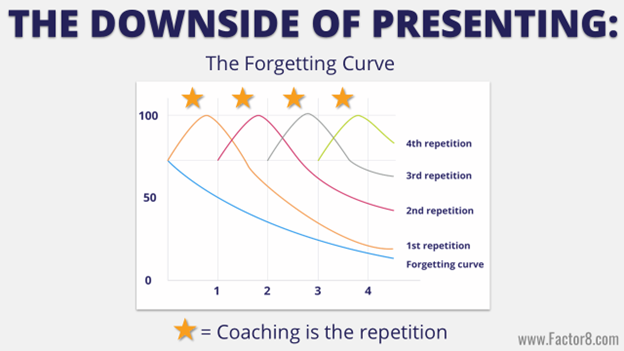
Folks the name of the game to get people to do what you need them to do, to get results, to get commission checks is: RECALL. They can’t do it if they can’t remember it.
In order to obtain recall, you need to have good facilitation or training. Unfortunately, most facilitation is broken. You can’t just tell someone to do something and expect them to do it perfectly, they need to practice.
Grab a sheet of paper and draw a picture of the Statue of Liberty based on memory. Assuming your side hustle isn’t as an artist, it’s probably going to look like something a child drew. Why? Well, when was the last time you drew something? Drawing is something we did a lot as a kid until other things became more exciting or interesting. We quit practicing, and when we quit practicing, our skills freeze.
For many of us, teaching is also a skill frozen in time. We think of teaching and we see ourselves sitting in a lecture hall with someone talking at us, telling us what to do. And we know that’s not how people learn.
That’s why we’ve got to redefine teaching and facilitate instead.
We define facilitation using the acronym CUP. It stands for…
By using the CUP method for facilitation, that’s how we beat The Forgetting Curve. Expect 70-80% recall. Get some buy-in along the way, a little practice and roleplay, synthesis with what they do on the job, and you’re looking at 80-90% recall. Plus, you’ll create new habits.
Everyone does it a little differently, but a lot of people confuse sales coaching with leading, but with a few questions sprinkled in.
We define sales coaching as… Ongoing development method used by leaders using questions to inspire and deliver personal feedback on skills.
Pay attention to the bolded words. If you’re just giving people advice or there are 25 people in the room, that’s not coaching. When you’ve got a team of reps in the room, what you’re really doing is presenting.
ACTION: Go and CUP check your virtual sales training. If you’ve got a lot of videos and little practice, people aren’t doing what you tell them to do. Leaders, if you do a lot of announcing without any coaching, follow-up, or roleplays, they’re not doing what you tell them to do. And when it’s something critical like learning how to sell and be successful in new hire onboarding, you’ve got to do all 3.
READ: Why You Need a Sales Training and Enablement Budget
If behavior change is critical, start with the 1-2-3 punch. Begin with the presentation, then facilitate, and then coach. Now, coaching alone CAN be powerful (but not how you think…)
Great coaches have 1 thing in common: they motivate people. Motivation is the key to everything. It affects recall (information + caring = recall).
READ: Tips for Enablement Leaders to Increase Sales Coaching Focus
Our job as managers and coaches is to ensure our reps leave our coaching sessions feeling like superheroes. That’s why we teach the 5:1 method – share 5 positives and 1 area for improvement. It’s also the #1 mistake new managers make. Why? We hear the laundry list of things that went wrong on a sales call and can’t help but tell them every single one of them.
The power of sales coaching is in the questions you ask. Said in another way:
“Leaders who ask more, get more.”
That’s why we coach in questions. It’s called “Instinctive Elaboration”. It’s the secret behind the Factor 8 SWIIFT℠ intro where we’re literally hijacking the brain of the prospect to answer our questions even if they didn’t mean to and it’s why it works to get them talking.
It works like this: how old are you?
Did a number pop in your head? Now it’s halfway out of your mouth.
The brain stops what it’s doing and starts answering questions whether it wants to or not.
Here’s more proof: how much do you weigh?
I know you didn’t want to share it, but you thought it, didn’t you? 🙂
DOWNLOAD: 20 Ways to Increase the Sales Coaching Focus at Work
We’ve spent years mastering the art of coaching and have compiled the best sales coaching questions ever (and they’re backed by science).
1. “Tell me about a time you had to do something similar?”
This helps them connect. Unfortunately, not all of us have the time or tech to do the CUP theory. We use a lot of video, but do videos actually teach? We don’t think so (read more about that here.)
2. “Why are you so good at this?”
You can ask this to anybody in any coaching session and something happens in the brain called “Confirmation Bias”. If you ask them a ‘why’ question, they’ll look for the reason that it’s true. This instantly boosts motivation.
3. “What happens when you knock this out of the park?”
This question builds confidence by creating mental imagery, scientifically known as “Functional Equivalence.” You’ve probably heard it with Olympic athletes where they picture themselves doing their gymnastics routine perfectly in their head and it fires the neurons as if they’re doing it. If you can get your reps to picture success, they’re more likely to achieve it.
There’s also something called the “Pygmalion Effect” which says that if your manager believes in you, you’ll believe in yourself more. Read differently:
“Leaders who expect more, get more.”
4. “What are you most proud of on that call?”
If anybody has reps that beat themselves up a little bit, this question is for you. The brain will search for an answer and find it – guaranteed.
5. “What should we do next?”
This is all about active recall; going in and finding the information in the brain. The other question we ask is “what was the customer thinking?” This is out of our head and our noise and puts ourselves into the shoes of the customer which is what we’re trying to do. It shortens ramp time, folks. Ramp time isn’t about me not knowing it, it’s about me not knowing when to use it. And if we can burn the pathways in the brain to recall the information we need at the right time, that’s how we get people to learn and apply skills faster.
6. “What one thing is most important to work on?”
You can use this in any coaching interaction anywhere and the science behind it is called “Implementation Intention.” Studies show that if you work on one thing and put a plan in place, it’s 2-3x more effective.
Coaching your team is more than just sharing information with them—it’s about really changing the way they think and act. By incorporating presenting, facilitating, and coaching, you’ll move from just talking at your team to actually sparking real behavior change.


