

100+ Sales Statistics Straight From Sales Teams
Where this data comes from
Every number on this page comes straight from sales reps, managers, and leaders. No recycled roundups, no stats borrowed from stats posts.
Most sales statistics articles pull the same third-party numbers from the same handful of reports, and half of them are hard to trace back to a real source. We wanted to know what sales teams actually think, so we asked them.
This page pulls from Factor 8’s State of Sales research: surveys of thousands of sales reps, managers, and leaders, with separate question tracks for each role. That lets us show where the three levels agree, and where they see the same team completely differently.
We also pulled in findings from two earlier Factor 8 studies on sales team retention and virtual selling. Those stats are labeled so you always know which study they came from.
Who we asked in our latest survey
How to read these numbers
Percentages are rounded to the nearest whole number, so a few totals land at 99% or 101%. Some questions let people pick more than one answer, so those don’t add up to 100%. When a stat comes from one role’s survey, we say so: “reps,” “managers,” or “leaders.”
Feel free to borrow any stat on this page. Just credit Factor 8’s State of Sales research and link back here. (How to cite it is at the bottom.)
Jump to a section
- →Key sales statistics at a glance
- →Sales outlook and trends (Stats 1 to 14)
- →Remote and hybrid sales (Stats 15 to 25)
- →Prospecting and cold calling (Stats 26 to 38)
- →Sales skill gaps (Stats 39 to 53)
- →Sales managers and coaching (Stats 54 to 71)
- →Sales training (Stats 72 to 85)
- →Sales retention and careers (Stats 86 to 99)
- →AI in sales (Stats 100 to 125)
- →What it means for your team
- →How to cite these stats
Key sales statistics at a glance
Short on time? These are the 10 numbers that surprised us most.

Sales outlook and trends statistics
The higher you sit in the org chart, the better the market looks. Leaders are optimistic. The reps talking to buyers every day are much less sure.
How sales teams feel about the market
- 56% of sales leaders say the selling market is better than last year, compared with 45% of managers and only 40% of reps.
- 29% of sales reps say the market is worse than last year, nearly double the share of sales leaders (15%).

The top sales trends leaders are seeing
- 54% of sales leaders say sales cycles are taking longer, and 51% say budgets are shrinking.
- 41% of sales leaders say more decision-makers are involved in each deal.
- 41% of sales leaders say buyers do more research on their own and enter the funnel later.
- 38% of sales leaders say buyers are ghosting more often.
- 33% of sales leaders say outreach needs to be more personalized to get a response.
- 31% of sales leaders say deals are getting stuck in internal reviews and approvals.
- 26% of sales leaders say “doing nothing” is a growing reason they lose deals.
- 25% of sales leaders say customers want more proof and fewer demos.

Where leaders are putting their budget
- 54% of sales leaders plan to put more of their budget into marketing and lead generation, their top priority.
- 41% of sales leaders plan to spend more on AI in, and 39% plan to spend more on people development and training.
- 38% of sales leaders plan to invest more in customer retention, and 34% plan to build better sales processes.
- Only 11% of sales leaders plan to spend more on travel, like in-person meetings, SKOs, and offsites.
What this means: Deals are slower, more crowded, and harder to win, and reps feel it first. When leaders and reps read the market this differently, forecasts and quotas drift away from reality.
Try this: Share these trend numbers with your team, then ask reps which ones they see in their own deals. With more decision-makers per deal, coach reps to multithread early instead of betting everything on one champion.
See the full report: The Current State of Sales →
Remote and hybrid sales statistics
Reps are happiest at home and say they sell more there. They also work fewer hours, which raises a fair question about what “productive” really means.
Where sales teams work
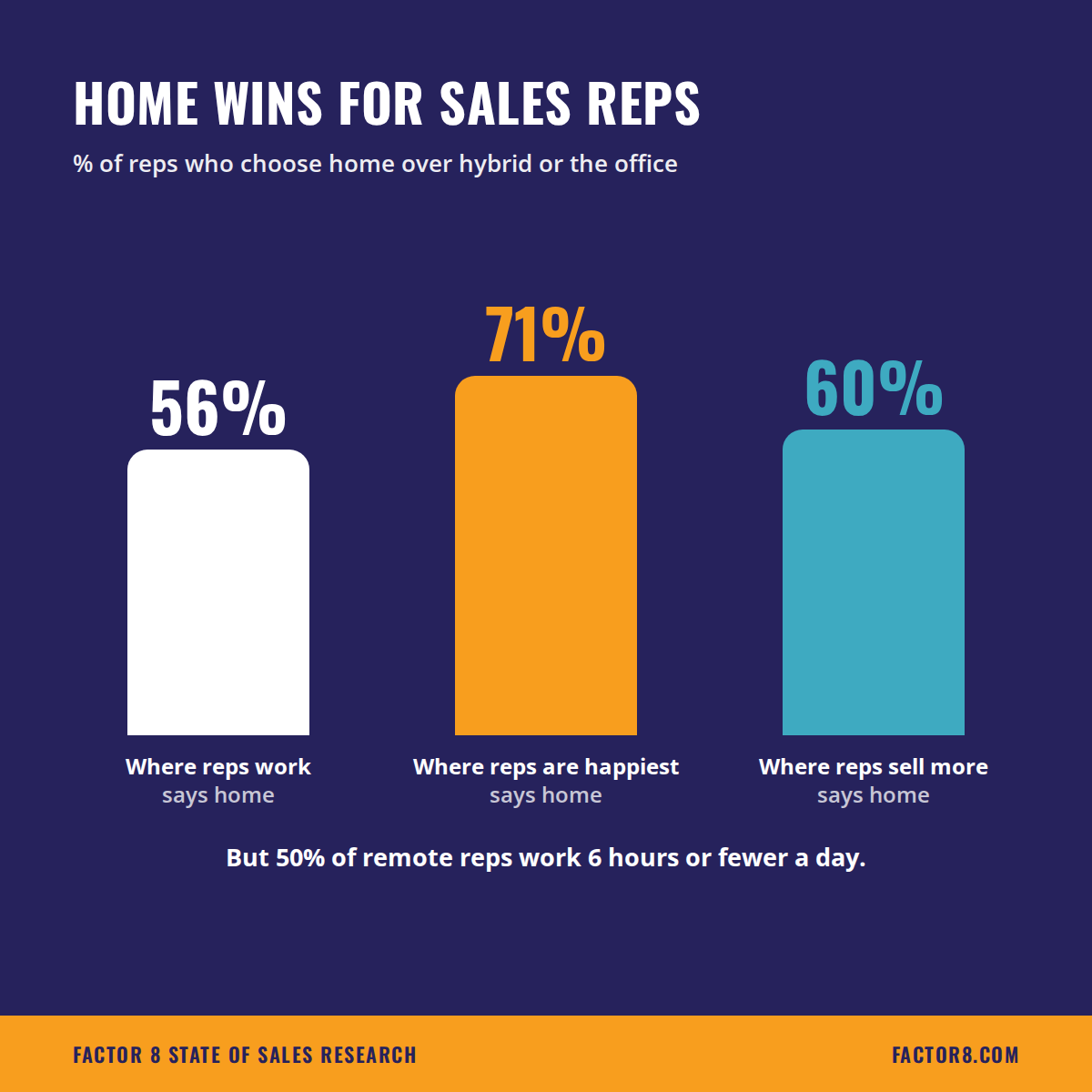
- 56% of sales reps work primarily from home, 25% work hybrid, and 18% work mostly in an office.
- 60% of sales managers say their teams work hybrid, 25% work mostly in an office, and only 15% run fully remote teams.
- 56% of sales leaders would prefer their teams work hybrid, 35% would prefer them 100% remote, and only 10% want them fully in the office.
Where reps are happiest and most productive
- 71% of sales reps say they’re happiest working from home, 18% say hybrid, and only 11% say the office.
- 60% of sales reps say they feel most accomplished and sell more at home, 24% say hybrid, and only 16% say the office.
How many hours reps actually work
- 45% of sales reps say they actively work 6 hours or fewer a day.
- 50% of remote sales reps work 6 hours or fewer a day.
Why reps like selling virtually
- 69% of sales reps say the biggest benefit of virtual selling is getting more done in less time or reaching more customers in a day.
- 13% of sales reps say the biggest benefit of virtual selling is better work-life balance.
- 15% of sales reps still prefer selling face-to-face over selling virtually.
- Only 4% of sales reps say virtual selling helps them close more deals.
What this means: Home wins on happiness and how productive reps feel. Fewer hours isn’t automatically a problem, as long as output holds up. The risk is managing to time on the clock instead of results.
Try this: Manage remote reps to outcomes, not hours: conversations held, meetings booked, pipeline created. Then protect their best hours for selling by cutting the internal meetings they already want less of (more on that below).
See the full report: The Current State of Sales →
Prospecting and cold calling statistics
Prospecting is the hardest part of the job. Reps put most of their effort into email, while the phone is what they say actually wins.
Where reps struggle
- 60% of sales reps say prospecting is the part of the sales cycle they struggle with most, four times more than closing (15%).
- 49% of sales leaders say prospecting is the top sales skill gap on their teams.
- 51% of sales managers say prospecting and outbound lead generation is their team’s top training need.
Effort vs. results by channel
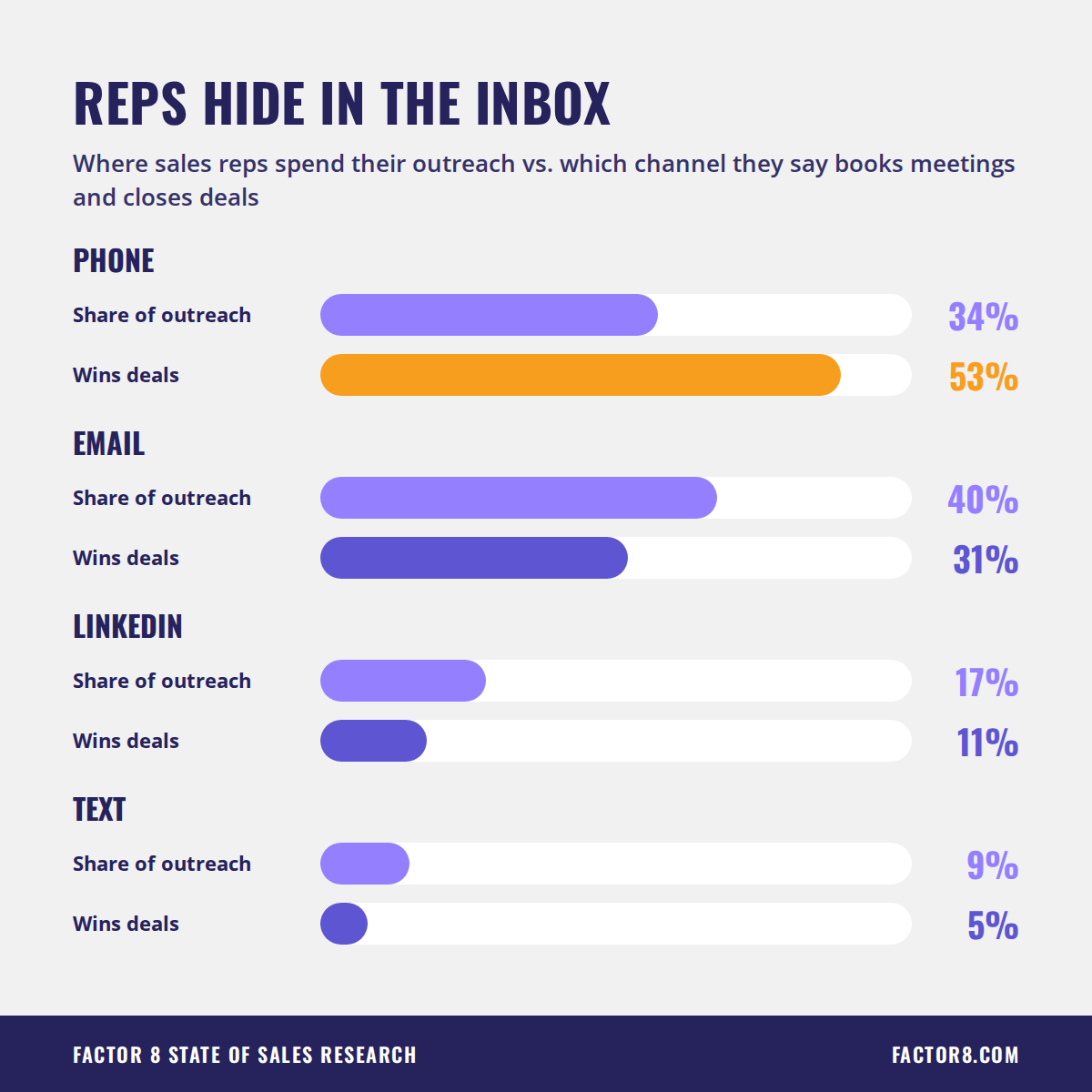
- Sales reps put only 34% of their outreach into phone calls, yet 53% say the phone books the most meetings and closes the most deals.
- Email gets 40% of sales reps’ outreach, but only 31% of reps say it’s the channel that books the most meetings and closes the most deals.
- LinkedIn gets 17% of sales reps’ outreach, but only 11% of reps say it’s the channel that books the most meetings and closes the most deals.
What leaders and managers see
- 40% of sales leaders wish their reps would pick up the phone more.
- 38% of sales leaders say call confidence, like fear of the phone and low talk time, is a skill gap on their team.
- 32% of sales leaders say poor outbound call skills are a skill gap on their team.
- 41% of sales leaders most want to improve outbound prospecting effectiveness, from connect to meeting.
- 22% of sales managers say weak messaging is their team’s biggest challenge to hitting goal, and 16% say it’s a lack of outbound calls.
What reps are experiencing
- 40% of sales professionals say prospecting research and calls are their biggest virtual selling challenge.
- 45% of sales professionals say getting prospects to engage is the hardest part of a prospecting call.
What this means: Reps hide in the inbox. Email feels productive, but the phone is what reps themselves say wins. Leaders see it too, and call confidence shows up as a real skill gap, not just a motivation problem.
Try this: Audit your cadence against the table above. If email outweighs phone, rebalance. Block daily call time, and build call confidence with short, regular role-plays on openers and the first 30 seconds.
See the full report: Sales Team Challenges and Skill Gaps →
Sales skill gap statistics
Leaders rarely blame talent or tools. Their top challenges are execution and process, and the skill gaps they see are fundamentals.
What’s stopping teams from hitting goal
- Inconsistent adoption and execution is sales leaders’ #1 challenge to hitting goal (24%), followed by the lack of a consistent sales process (21%).
- 12% of sales leaders say finding sales talent is their #1 challenge to hitting goal, and another 12% blame the economy.
Rep skill gaps, according to leaders
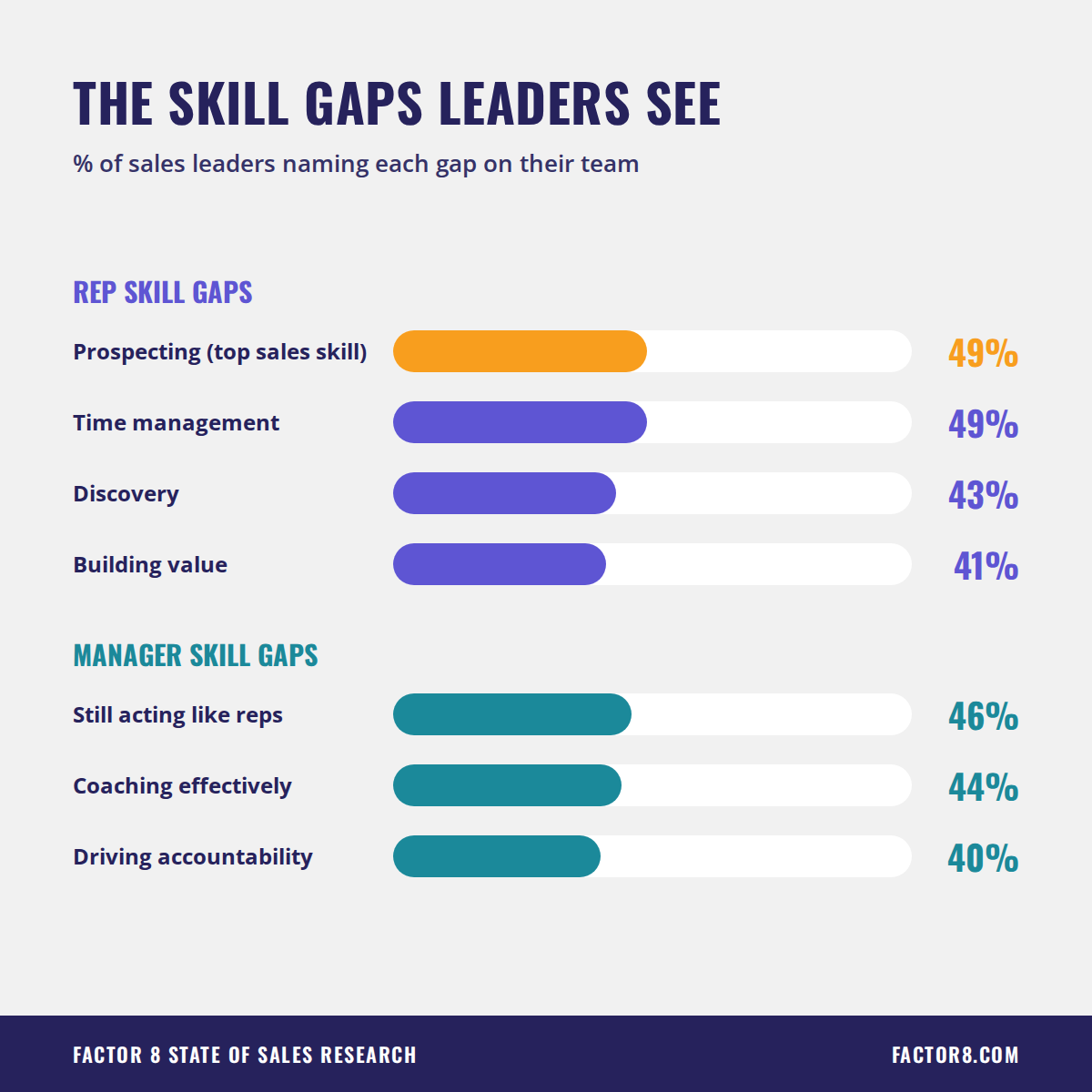
- 49% of sales leaders say time management and prioritization is a skill gap on their team, tied with prospecting as the most-cited gap.
- 43% of sales leaders say their reps struggle to uncover bigger opportunities in discovery, and 41% say reps can’t build and present value.
- 30% of sales leaders say their reps’ deals are stalling out.
Manager skill gaps, according to leaders
- 46% of sales leaders say their managers haven’t learned to stop being reps and lead the team.
- 44% of sales leaders say their managers don’t coach reps effectively, and 40% say managers struggle to drive accountability.
- 37% of sales leaders say their managers struggle with time management and delegation.
What leaders wish reps did more of
- 51% of sales leaders wish their reps would really listen and connect with the customer.
- 41% of sales leaders wish their reps would work on their sales skills, and 41% wish they’d follow through on what they say they’ll do.
- 32% of sales leaders wish their reps would follow the playbook, and 32% wish they’d update the CRM consistently.
- 11% of sales leaders wish their reps would “actually work 8 hours a day.”
The metrics leaders most want to move
- 41% of sales leaders most want to improve account expansion, like upsell and cross-sell.
- 35% of sales leaders most want to improve final close conversion, and 33% want shorter sales cycles.
- 27% of sales leaders most want new reps to ramp to quota faster.
What this means: The biggest gaps aren’t exotic. Time management, discovery, value, and follow-through are fundamentals, and on the manager side the gap is the jump from top rep to real leader.
Try this: Don’t try to fix everything at once. Pick one rep skill and one manager skill per quarter, train it, and have managers coach to it every week until it sticks.
See the full report: Sales Team Challenges and Skill Gaps →
Sales manager and coaching statistics
Sales managers are stretched thin. They’re burned out by admin and meetings, and the thing everyone wants more of, coaching, is what gets squeezed.
Manager burnout
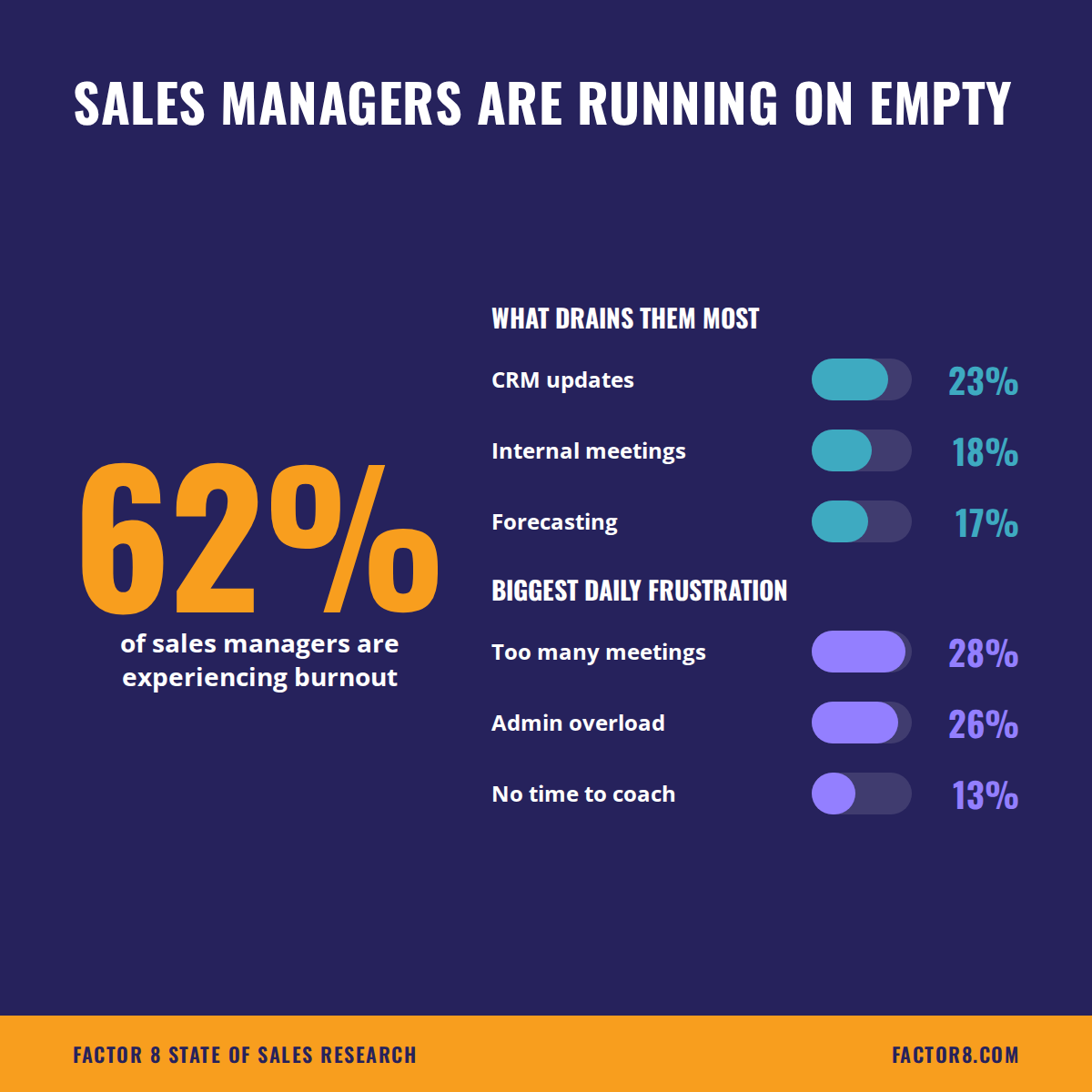
- 62% of sales managers are experiencing burnout.
- CRM updates drain the most energy from sales managers’ days (23%), followed by internal meetings (18%) and forecasting (17%).
- Too many meetings is sales managers’ biggest daily frustration (28%), followed by admin overload (26%).
- 13% of sales managers say not having enough time to coach is their biggest daily frustration.
How much managers actually coach
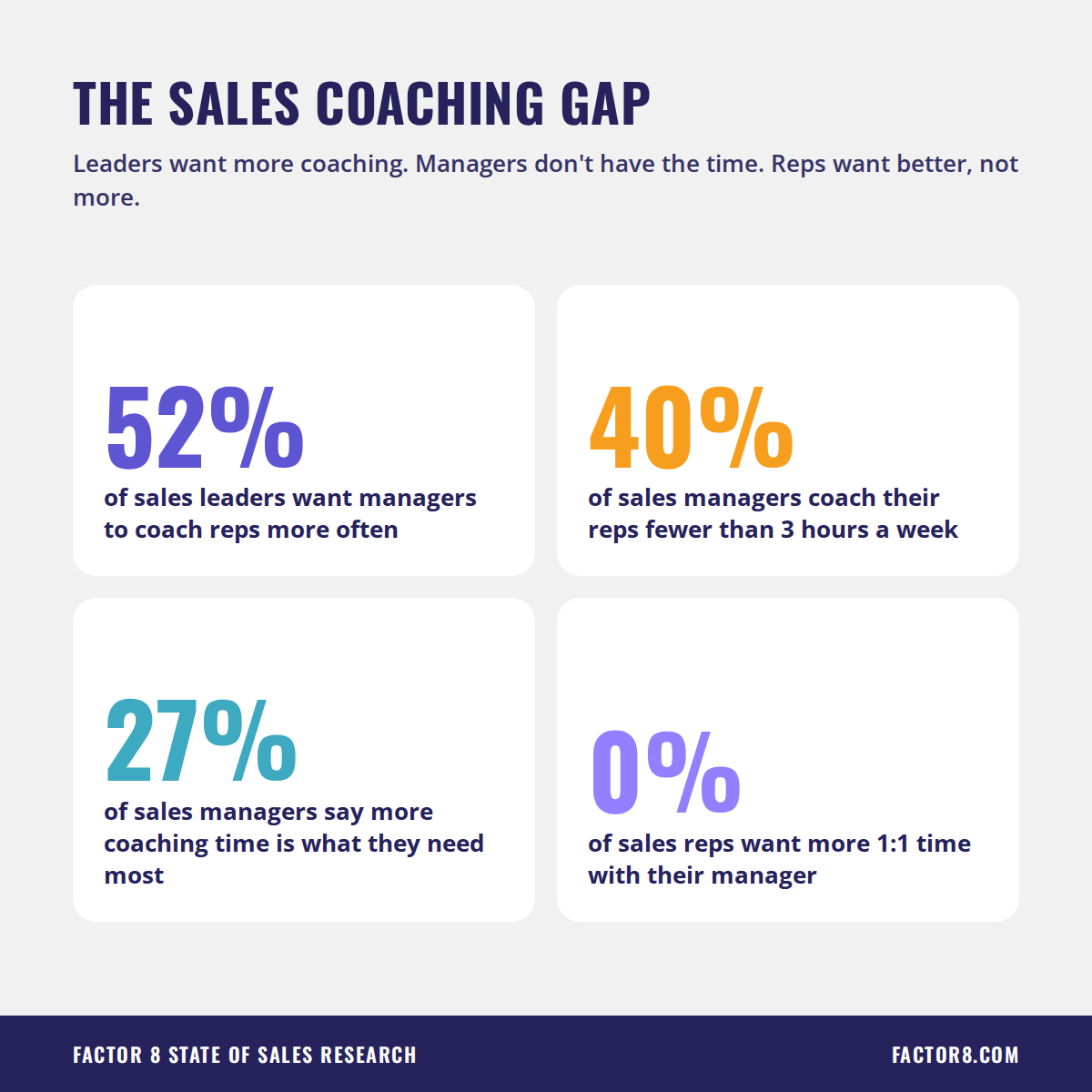
- 40% of sales managers coach their reps fewer than 3 hours a week.
- 27% of sales managers say more coaching time is what they need most to fix their team’s biggest challenge, and 26% say better rep training.
What managers want from leadership and enablement
- 51% of sales managers want a clear sales process and methodology from leadership or enablement.
- 49% of sales managers want ongoing skills training for their team, and 44% want coaching frameworks for themselves.
- 42% of sales managers want shared accountability for their reps.
- 34% of sales managers want clear definitions of “what good looks like,” like playbooks and call scoring forms.
- 27% of sales managers want training for their own move into sales management.
What leaders want from managers
- 52% of sales leaders want their managers to coach reps more often, and 52% want them to hold reps more accountable.
- 41% of sales leaders want their managers to drive consistent execution of the sales process.
What reps want from their managers
- 0% of sales reps want more 1:1 time with their manager.
- 27% of sales reps say the #1 thing they want is a manager who fights for them, with better territories, tools, and training.
- 16% of sales reps wish their manager gave them better call and skills coaching.
- 65% of sales reps rate their manager “better than most” or better, 16% call them “totally average,” and 19% rate them a 1 or 2 out of 5.
- Sales managers say the elevated status and responsibility is what they love most about the job (19%), followed by coaching their people (16%).
What this means: Reps don’t want more 1:1s, they want better ones. Leaders want more coaching, managers want more time and a framework to do it, and reps want a manager who has their back. Everyone is asking for the same thing from different seats.
Try this: coach by rep category, not on autopilot. In Factor 8’s Call Coaching 201 course, managers sort reps into categories and set coaching frequency by need:
A few more rules from the course: aim for 50% of a manager’s time spent coaching, book 45-minute sessions so there’s a 15-minute buffer between them, and keep at least an hour of “floor time” with the team daily. Great call coaching means a live or recorded call is present, the conversation is two-way, there are 3 people or fewer, and every rep walks out with personal feedback.
See the full report: Sales Training, Coaching, and Development →
Sales training statistics
Reps want more training, but most of what they get isn’t working. Reps don’t rate it, leaders don’t trust their own plans, and too much of it doesn’t stick.
How reps rate their sales training
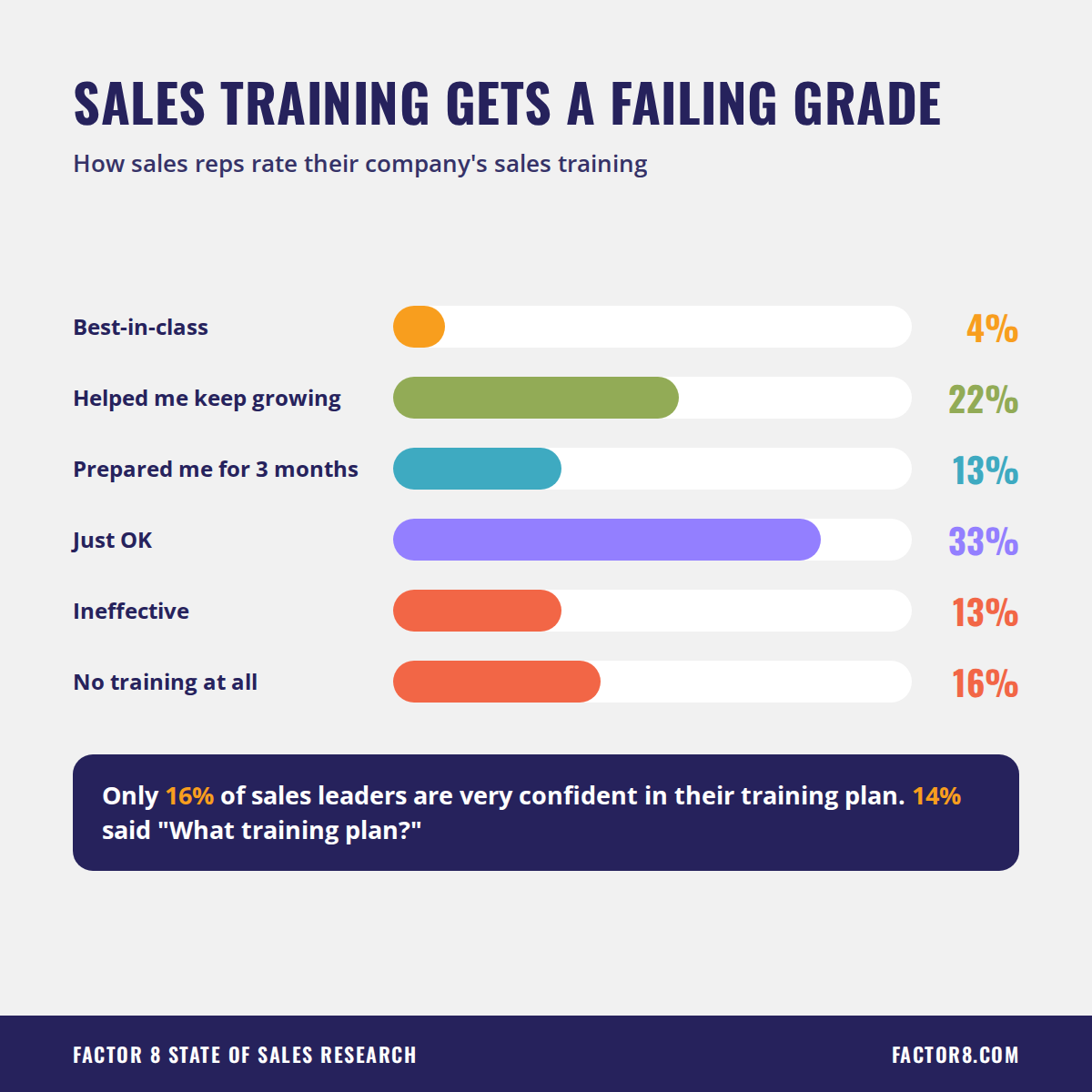
- Only 4% of sales reps say their company’s sales training is best-in-class.
- 22% of sales reps say their company’s sales training helped them get started and keep growing, and 13% say it only prepared them for their first 3 months.
- 46% of sales reps say their company’s sales training wasn’t good, including 13% who rated it “about as effective as an ejector seat in a helicopter.”
- 16% of sales reps got no sales training at all.
How confident leaders are in their training plan
- Only 16% of sales leaders are very confident in their rep and manager training plan.
- 84% of sales leaders aren’t fully confident in their training plan, and 14% answered “What training plan?”
- 8% of sales leaders would “rather hire my teenager to train the team.”
What frustrates leaders about training and enablement
- Low tool adoption is sales leaders’ biggest frustration with training and enablement (48%), followed by low buy-in for training (35%).
- 21% of sales leaders say “nothing sticks” when it comes to sales training, and 21% say it’s hard to prove ROI.
- 21% of sales leaders say their sales training doesn’t feel customized to their team.
- 10% of sales leaders say they have no idea what their enablement team does.
What reps want more (and less) of
- 79% of sales reps want more training and coaching.
- Asked to pick the one thing they want more of day to day, 29% of sales reps chose sales training, tied with better tools, while only 7% want less training.
- 49% of sales reps want fewer internal meetings, and 25% want fewer internal emails.
What this means: Reps aren’t asking to be left alone. They want training that actually helps them sell, and fewer meetings that don’t. Leaders know their plans have gaps, and “nothing sticks” is what happens when training is a one-time event.
Try this: Treat training as a habit, not an event. Tie every session to a skill reps use this week, have managers reinforce it in coaching, and measure the behavior, not just completion.
See the full report: Sales Training, Coaching, and Development →
Sales retention and career statistics
Salespeople love sales. Whether they stay at your company comes down to growth, burnout, and leadership, and rarely pay.
Do salespeople still love sales?
- 75% of sales reps are proud to tell people they work in sales, 25% say “not really,” and 0% would rather say they clean portable toilets. (It was an option.)
- 75% of sales reps want to build their career in sales, 25% aren’t sure, and not one said no.
- 61% of sales managers want to stay in sales leadership long-term, 39% aren’t sure, and not one said no.
Will they stay at your company?
- Only 55% of sales reps want to build their career at their current company, 40% aren’t sure, and 6% say “no way.”
- 78% of sales managers want to stay and grow at their current company, 19% aren’t sure, and 3% say “hard pass.”
Why reps would leave
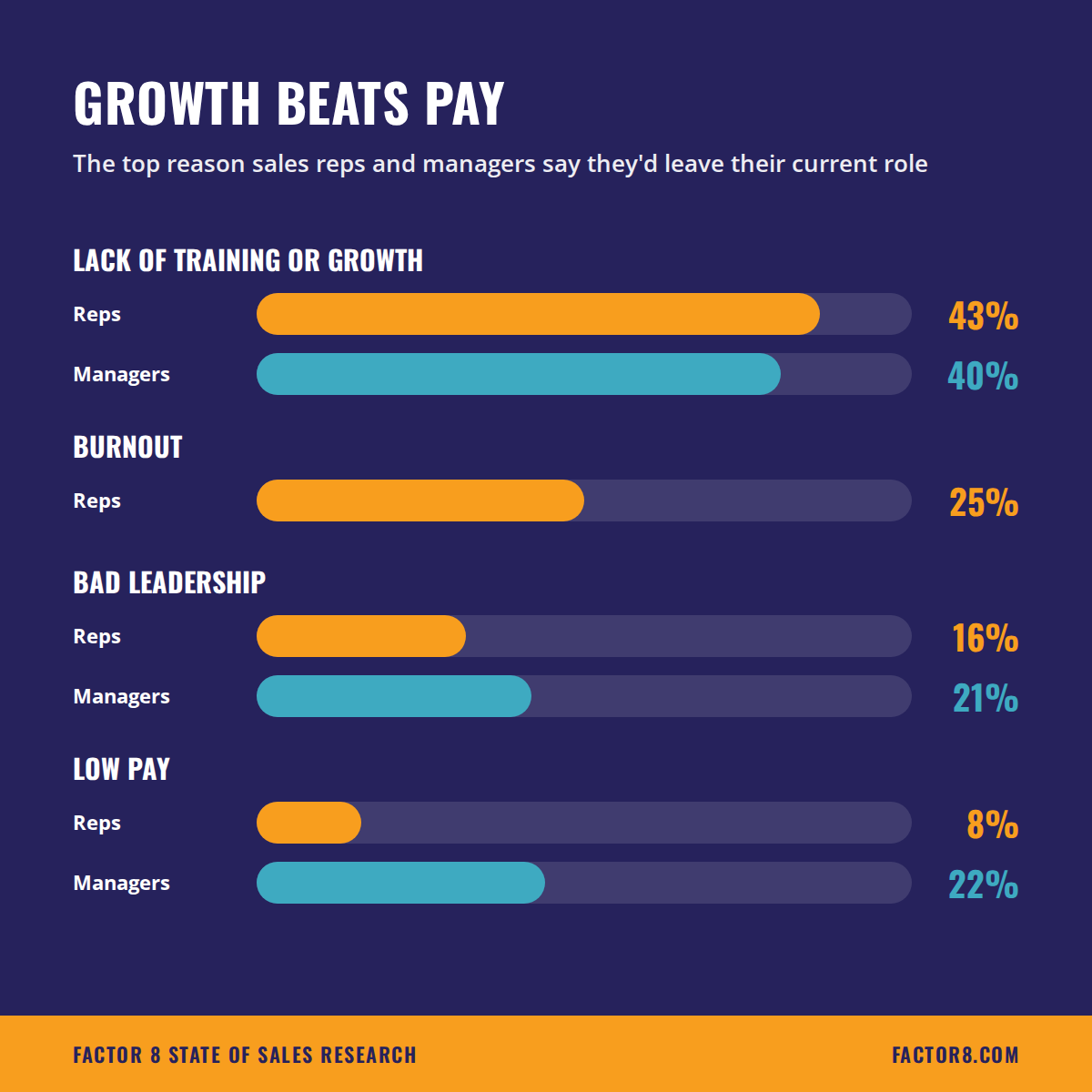
- 43% of sales reps say a lack of training or a clear growth path is the top reason they’d leave their current role.
- 25% of sales reps say burnout would make them leave their current role, and 16% say bad leadership.
- Only 8% of sales reps say low pay would make them leave their current role.
Why managers would leave
- 40% of sales managers say a lack of training or career growth is the top reason they’d leave, nearly double low pay (22%).
- 21% of sales managers say bad leadership would make them leave their current role.
What leaders get wrong about retention
- Sales reps and managers both rank training and skill development as the #1 thing that keeps them at a company.
- Sales reps rank compensation #5 on their list of reasons to stay, while sales leaders rank it #1.
- 39% of sales reps who left their last job cited poor culture or bad leadership, but only 14% of sales leaders think that’s a top reason people quit.
- In an earlier Factor 8 study, 48% of sales reps say a lack of training, coaching, and career growth would be the #1 reason they’d leave their current company.
What this means: For reps, growth beats pay. The same goes for managers. Either way, the 40% of reps who “aren’t sure” about staying are the ones a clear development path can keep.
Try this: Map a visible career path for every role, then show reps the skills that get them to the next level. Ask your “not sure” reps directly what would make them stay. Most leaders guess wrong.
See the full report: Sales Team Retention →
AI in sales statistics
AI is already part of the daily sales job at every level. Reps lean on it most to write, and almost never to practice or build their skills.
How many salespeople use AI at work
- 49% of sales reps use their company’s AI tools every day, along with 46% of sales leaders and 44% of sales managers.
- 22% of sales reps use their own AI tools because their company hasn’t provided any, and 21% of sales leaders do too.
- Only 4% of sales reps don’t use AI at all, and 0% said they don’t want to.
The AI tools sales teams use most
- ChatGPT is the most-used AI tool in sales at every level: 80% of reps, 79% of managers, and 69% of leaders who use AI use it.
- 38% of sales reps who use AI use Microsoft Copilot, and 35% use Gemini.
- 21% of sales leaders say their teams use Gong, twice the share of sales reps (10%), and 19% say their teams use Claude.
- 25% of sales managers who use AI use Agent.ai, 25% use Allego, and 19% use Ambition.
What salespeople use AI for
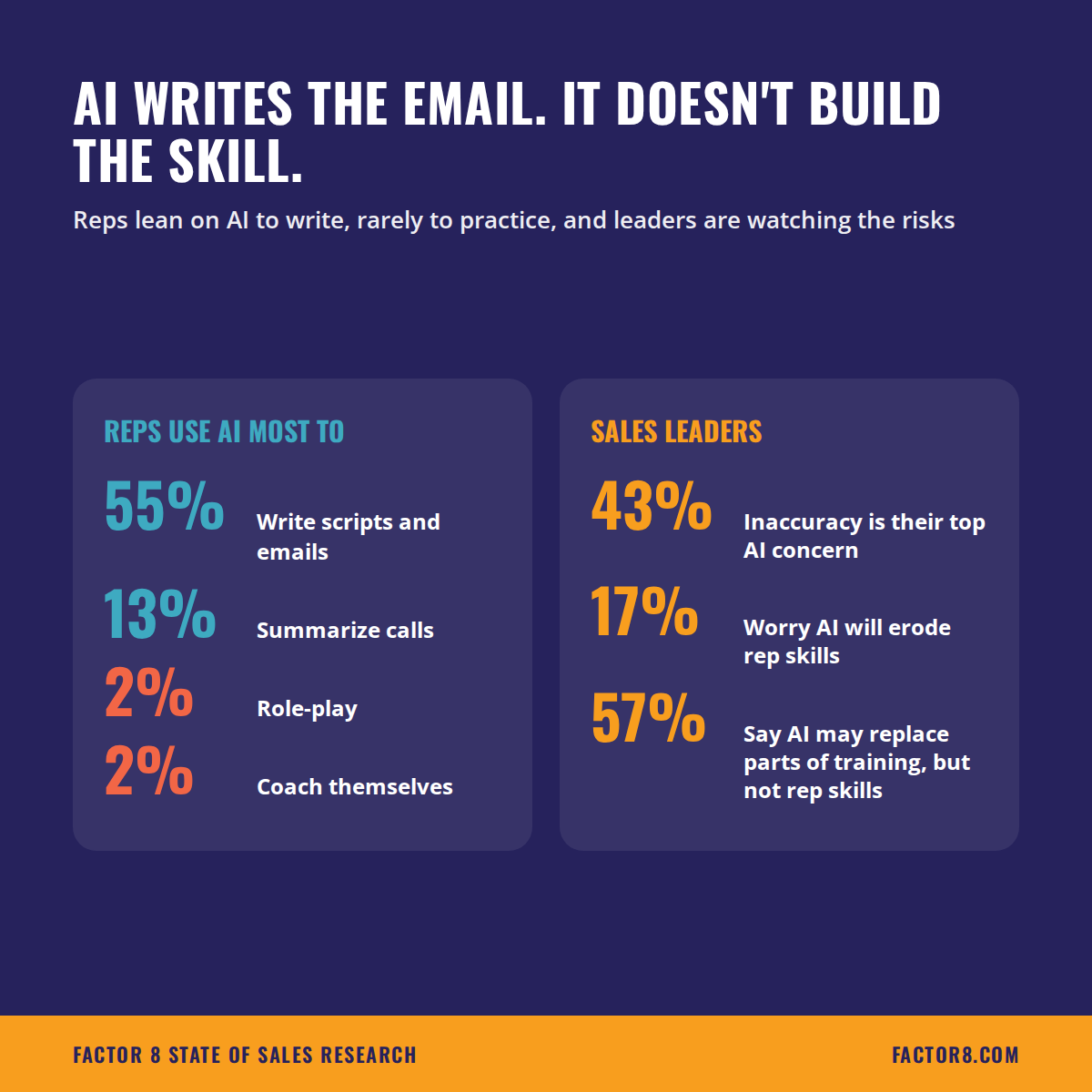
- 55% of sales reps use AI most for writing scripts and emails, and 13% use it most to summarize calls.
- Just 5% of sales reps use AI most for prospecting, 2% for role-playing, and 2% for coaching.
- Sales managers use AI most to write scripts for their reps (25%) and their own emails and messages (19%).
- 63% of sales leaders say their team uses AI to write messaging, and 62% use it to summarize sales calls and take notes.
- 51% of sales leaders say their team uses AI to support prospecting.
- Only 19% of sales leaders say their team uses AI to improve rep coaching, and 11% use it to coach managers.
What leaders want AI to do
- 60% of sales leaders want AI to help their reps find leads, and 57% want help with prospect research.
- 56% of sales leaders want AI to improve their reps’ email and social outreach, and 52% want help qualifying leads.
- 51% of sales leaders simply want AI to save their reps time.
- Only 24% of sales leaders want AI to coach their reps.
Concerns about AI in sales
- Inaccuracy is sales leaders’ top concern about AI in sales (43%), far ahead of skill erosion (17%) and compliance (13%).
- Only 8% of sales leaders worry most about AI replacing humans, and 19% have no AI concerns at all.
Will AI replace salespeople?
- Only 18% of sales reps are worried about AI taking their sales job.
- 37% of sales leaders think AI will replace some of their reps: 24% within 3 years and 13% in 5 to 10 years.
- 56% of sales leaders hope AI won’t replace their reps, saying human interaction is better, and 8% say flat out it won’t.
Will AI replace training and coaching?
- 78% of sales reps don’t want AI to replace their sales training.
- 44% of sales managers hope AI replaces sales training and coaching, double the share of reps (22%).
- 35% of sales leaders think AI will replace manager coaching, 44% say it will help but not replace it, and 21% hope it never does.
- 57% of sales leaders say AI may replace parts of sales training, but not rep skills.

What this means: AI is great at drafting. It can’t teach a rep how to open a call, run discovery, or handle an objection. Reps use AI mostly to write and almost never to practice, and leaders’ top worries are inaccuracy and skill erosion. That’s why most leaders (57%) say AI may replace parts of training, but not rep skills. If a rep doesn’t know what good looks like, AI just helps them send more of the wrong thing, faster.
Try this: Use AI to speed up the work and training to build the skill. Teach reps what a great email, opener, and discovery call sound like, so they can judge, edit, and customize what AI writes instead of sending it as-is. Then use AI for the practice reps rarely do today, like role-play, and keep managers coaching.
See the full report: All State of Sales research →
What these sales statistics mean for your team
Across 125 stats, the same six stories keep showing up.
- Prospecting is the hardest part of the job, and reps are underusing the channel that works. 60% of reps struggle most with prospecting, and 53% say the phone wins the most deals, yet it gets only 34% of their outreach. Rebalance the cadence and build call confidence.
- Leaders and reps see different markets. Leaders are optimistic, reps are worried, and leaders misread why people leave. Ask your reps directly, then compare their answers to your assumptions.
- Managers are the bottleneck, and they’re burned out. 62% of managers are burned out, meetings and admin top their frustrations, and leaders still want them coaching more. Cut the noise, give them a framework, and protect coaching time on the calendar.
- Reps want more training, but most of what they get isn’t working. Only 4% of reps call theirs best-in-class, and only 16% of leaders are very confident in their plan. Make training continuous, specific, and reinforced by managers.
- Growth keeps reps, and pay is rarely the reason they go. A lack of training or growth is the top reason both reps and managers would leave. Show every rep where they can go next and what skills get them there.
- AI speeds up the work, but it doesn’t build the skill. 55% of reps use AI most to write scripts and emails, only 2% use it most to role-play, and leaders’ top concerns are inaccuracy and skill erosion. Pair AI with training so reps know what good looks like.
Seeing your team in these numbers? We can help. Contact us today.
How to cite these sales statistics
Please use them! Attribute findings to Factor 8’s State of Sales research and link to this page or the specific report.
Example: According to Factor 8’s State of Sales research, 60% of sales reps say prospecting is the part of the sales cycle they struggle with most.