

Voicemails
How Real People are Winning the Sales Prospecting Game Using AI [Webinar]
How Real People are Winning the Sales Prospecting Game Using AI
[Video Recording]
Meet the Speakers

Lauren Bailey
Founder
Factor 8 & #GirlsClub
Lauren Bailey, known to many as “LB”, is a sales leader, enablement leader, and entrepreneur and founder of 3 successful brands: Factor 8, providing front-line job training for inside sellers and managers, The Sales Bar, a subscription-based virtual sales training platform, and #GirlsClub, a community and development program helping more women earn leadership positions in sales.

My mission is to walk alongside sales professionals as they develop the skills and best practices needed to find sales success. Our purpose is to show salespeople their true worth as the tip of the spear. I have the pleasure of hosting the best minds in sales every day and creating content that elevates the sales profession.
Connect with me @saywhatsales on Instagram, TikTok, and Twitter. Join us live daily to learn and grow into a top-performing sales professional.

Jax Gill
Training Manager
Inspira Financial
Jacqueline Gill is a Senior Manager in Sales Enablement who’s been at TTEC for 12 years—which in BPO years is basically a lifetime. While her official job is enabling sales, she’s also been known to jump into learning services sales conversations once the executive sellers work their magic. Think of her as the closer with a curriculum. Outside of work, she’s a proud mom of four and a firm believer that AI can help with just about anything—except maybe laundry.

Doug Gibbs
Sr. Inside Sales Manager, Tools & Technology
Waste Management
Forty-seven years’ experience managing teams and processes across two primary industries, Retail Department stores and Environmental Solutions/Logistics. The last eleven years have been invested with the Inside Sales Teams at WM, including managing retention and acquisition teams, then progressing to exploring, sourcing, procuring and implementing 3rd party tools and solutions to significantly improve both our customer’s and Sales Team’s experiences.

David Kreiger
President
Sales Roads
David Kreiger is the founder of SalesRoads, a leading sales outsourcing firm with over 17 years of experience helping businesses drive revenue growth by building winning sales teams. A seasoned entrepreneur and host of the “Sell Like A Leader” podcast, David champions a philosophy that sales success hinges on talent development and a people-first mindset.
Fall in Love With Prospecting: 5 Tips to Make Filling the Pipeline Suck Less [Webinar Recording]
Fall in Love With Prospecting:
5 Tips to Make Filling the Pipeline Suck Less
[Video Recording]
7 Phone & Video Prospecting Tips for Sales Reps to Crush It
Plenty of sales reps love the convenience of email and LinkedIn prospecting. But poorly crafted, AI-generated messages do little to build rapport and trust with your prospects.
That’s why, as much as some people despise it, you have to pick up the phone.
As young reps continue to phase into the sales force, there is a growing challenge for them to get beyond the keyboard. And while the pandemic certainly didn’t help matters, fostering those face-to-face (or voice-to-voice) connections has become more critical than ever.
Suffice it to say that salespeople can’t afford to rest on their laurels. We have to fight harder to build pipeline, persuade prospects, and win deals.
That means moving from behind the keyboard, picking up the phone, and utilizing videos in prospecting.
If you’re ready to crush it, here are seven tips that can help our reps make the most of phone and video in their prospecting efforts.
1. Don’t rely on email alone
It’s important to connect with people on social and email, certainly. But think about it: when’s the last time you bought something over email?
Never mind that people are wary of scammers and phishing attempts. No one buys from text on a screen.
People buy from other people. More importantly, they buy from people they trust.
That doesn’t mean you shouldn’t use email. But there are ways to make email more engaging and personal.
For example, emails that use video get a 96% higher click-through rate than those that don’t. It makes sense: video shows off your face, which helps to foster that personal connection.
So if you’re relying on a “spray and pray” approach to email where you’re sending as many as you can hoping for something to stick, just stop. You’ve got way more tools at your disposal.
2. Make your videos watchable
Just getting started using video in your prospecting efforts is a great first step. But if you really want to maximize your chance of success, then you need to make your videos as watchable as possible.
Most people drop off of videos 70-80% of the way through. So it’s important to structure your video so you get their attention and deliver necessary value as quickly and efficiently as possible—before they click away.
Here are some tips to make your videos more watchable:
- Start with empathy. Show the prospect that you truly understand the problem they’re facing.
-
- Lead with value. Catch the prospect’s attention by offering something to help with that problem as early in the video as possible.
- Use a list to structure your video. “3 things before our call tomorrow,” or “4 things I noticed on your website.” That will help make the video more scannable and increase the prospect’s likelihood of retaining that information
- Caption your video. Adding captions to videos can increase the watch rate by up to 80 percent. Captions also help with scannability.
- Put your call-to-action in the middle. It logically makes sense to throw the CTA at the end. But by that point, most people have dropped off. Put it in the middle to increase the likelihood that people will actually see it.
3. Use the prospect’s name off the bat
The first few seconds of a video are key to getting your relationship with the prospect off on the right foot. One great way to do this: use the prospect’s name.
This goes back as far as Dale Carnegie: people perk up when they hear their own name. When you use their name, you set the tone of the relationship as a familiar one, which increases their likelihood to trust you.
What’s more, when you use a prospect’s name in a video, it’s proof that you aren’t batch-sending messages. You’re taking the time to record a personalized message, which shows that you’re putting effort into building that connection.
WATCH: 10 Tips for Building Human-to-Human Connections on Sales Calls
4. Don’t just call prospects once
It’s no surprise that phone calls used in tandem with email help to increase the likelihood of a response.
The problem, however, is that only 10% of sales reps make more than three attempts to reach a prospect. Calling more than three times may seem like a lot, when you consider that it takes anywhere from seven to fourteen touches to get a conversation with a prospect, then frequent follow-up is key to making that conversion.
Also remember that while email and social media are powerful tools, they have one purpose: to get you on a call with the prospect. That’s the only way you’ll be able to sell them.
5. Don’t waste time following up if your data is incorrect
Spray and pray is popular because it’s quick and easy. Even if half the data is incorrect, you’re spending so little time on each prospect that it nets out positive.
But when you’re taking the time to follow up multiple times, record videos, and build relationships with prospects, investing in the wrong people can be a significant time sink.
That’s why it’s important to do your homework. One tip we recommend at Factor 8 is if you get a voicemail, hit the 0 button to find the directory or talk to someone else in the company.
What I tell people is: try to be James Bond for about 10 dials. You’re going to learn something critical that will help you find the right person or provide you with important information that you can then use to land the deal:
- Who reports to who?
- What system do they have?
- How long has your decision maker worked there?
- Are there any current projects that are a priority?
- How many employers/locations are there?
- Other key influencers that you should include in the process?
Use your personality, talk to people, and get some critical account information that can help you become more successful as you build your relationship with them over time.
READ MORE: How to Use Sales Intelligence to Boost Profits
6. Qualify, qualify, qualify
First of all: sales qualification is not the same as lead qualification. The latter is a marketing indication that a prospect may be ready to buy due to their engagement. Sales qualification is about how much money you can make with a particular account—what’s the potential that they’ll buy from you?
There are a number of factors that go into play here:
- Size of sales team—more reps means more revenue
- Is the company B2B or B2C?
- What tools or platforms does the company already have (especially important if you sell SaaS)?
- Do salespeople have to acquire their own tools or does the company provide them?
One great tip for this: don’t blow past the gatekeepers! In your haste to get to the decision maker, you may end up missing the opportunity to gain some vital information on the company that can help you tailor your video and phone communications.
READ MORE: How to Build an Account and Lead Qualification Strategy
7. You were hired for your personality—use it
If marketing could source leads and close deals on their own, we wouldn’t need sales.
The reason you have a job is because salespeople can do something marketers just can’t. You weren’t hired to send canned messages. Marketing can do that more efficiently than you.
Salespeople are there because personality makes a huge difference in how prospects feel about potential vendors. For many businesses, it’s the people that are the differentiator between themselves and their closest competitors.
So let people get to know you. You’ve been hired to be a personality. Use it!
If your sales team struggles to use phone and video effectively, Factor 8 can provide the training and resources needed to get everyone up to speed. Learn more about our training and coaching services here.
Subscribe to our email list to receive new content, webinar invites, and training offers.

4 Quick and Effective Sales Voicemail Scripts
Are you thinking, “Should I leave a voicemail? Nobody ever calls back! Am I doing something wrong? Why aren’t people calling me back? Can I leave a better voicemail?”
Don’t worry, you’re not alone… and you aren’t wrong.
A good 90% of our outbound calls end in voicemails and less than 3% are actually returned. Oh boy, math time. That means up to 225 voicemails left every week if I’m making 50 calls a day. And only 7-8 potential clients calling me back. More bad news: That’s because your voicemails are probably bad (sorry).
Frankly, most voicemails aren’t great. In fact, voicemails are the one time I advocate for a script. Actually, 4 scripts. After 15 years of teaching phone sales, we’ve found 4 voicemails that consistently get more calls back. We’re talking, double to triple more. Ready for the math? That means 14-23 calls back in a week instead of 8. Dude, 14 more conversations every week! That’s like getting a bonus day of selling time every week, for only the cost of changing up a voicemail. Yup, it’s literally that easy.
WATCH: How To Leave A Sales Voicemail That Gets Returned
You want to know the four types now, don’t you? You’re in luck. They’re all below with voicemail scripts.
Awesome Voicemail Script #1 – Value
Honestly, most voicemails are either all about the sales rep, why THEY are calling, and what THEY want. Or, they are vaguely veiled sales pitches. If you want to stand out, focus all of your attention on the customer instead. We call that So, What’s In It for Them or SWIIFT℠. Each potential customer wants to know if a call back is worth their time, so answer their unasked question immediately by pushing the value. Warning: if you push too hard, these can run the risk of sounding like a sales pitch. So, we find they work best for existing accounts or existing relationships. To use them with a new account, we suggest using it in combo with some mystery. Did you say mystery?
Value Voicemail Script:
John!? LB at Factor 8. (480) 555-2424. I’ve got three things that will save you time this quarter. Call me back for a five-minute run down. I’m at (480) 555-2424. Thanks!
Awesome Voicemail Script #2 – Mystery
Folks, FOMO is real. So let’s use it. Just a little mystery can have your potential clients saying to themselves, “Do I know them?”, “Why did they call me?” When you leave them wanting to know more it can translate into real-life callbacks. It may take guts, but when you use this strategy with the right customers, it will pay off!
Mystery Voicemail Script:
John!? It’s Lauren at (480) 555-2424. Call me back. Again, I’m at (480) 555-2424.
Awesome Voicemail Script #3 – Levers
A lever is information that proves your credibility, convinces them this isn’t a cold call, AND that you know your stuff! A lever can be account information, history, company knowledge, or a person – from either your company or theirs. The BEST lever is their boss.
Lever Voicemail Script #1: the Boss Lever
Hi John. Lauren with Factor 8. I’ve been talking with your boss, Amy, and she asked me to call you so I promised her that I would. Please reach me at (480) 555-2424. Again, Lauren with Factor 8 at (480) 555-2424. Thanks!
See the subtle implication that his boss wants him to talk to me? This voicemail script works if I call Amy and she says, “I don’t handle that, that’s John.” I say, “OK, I’ll call John,” and then we’re off to the races. I know, this is a special scenario, but use it as often as you can. For a regular lever, try something like:
Lever Voicemail Script #2: the Standard Lever
Hey John, LB here over at Factor 8. I’ve been working with your CXS team there for a few years. Will you please call me back? I’m at (480) 555-2424. Again, Lauren with Factor 8 at (480) 555-2424. Thanks!
Awesome Voicemail Script #4 – Urgency
If you’ve ever told someone that you’ll send an email anyway or that you’d call them back anyway, you’ve crushed the urgency in the situation. Reverse it instead! Ratchet up the intensity by adding a timeline and some energy (and even a little mystery). Try to get them to call back immediately after listening!
Urgency Voicemail Script:
Hey John. Lauren calling with Factor 8. I’m trying like crazy to reach you by end of day. Please call me at (480) 555-2424. Again, Lauren trying to get to you urgently. Call me back quickly please at (480) 555-2424.
Of course, we love the good combination message. Bringing a few different voicemail scripts together can create some real voicemail magic!
Combination Voicemail Script:
John? Lauren with Factor 8. Sue gave me your name. We need to talk today about your account so I can help save you some money. Please return my call at (480) 555-2424. That’s (480) 555-2424. Talk soon.
This script has urgency, mystery, a lever, AND value! (And you can still say it in under 10 seconds.) Now, that’s a powerful voicemail. I’d call back… wouldn’t you? I hope you found one that speaks to you – so more of your prospects will too.
Subscribe to our email list to receive new content, webinar invites, and training offers.
Sales Outreach: How to Incorporate Emails and Phone Calls Into Your Sequences
You’ve heard of sequences, right? They are an integral part of your sales outreach and a magical combination of touchpoints to your prospects that, if all goes well, will result in a REALLY good sales call. Recently, the AMAZING Brooke Bachesta of Outreach, aka the gurus of outreach and sequences, and I got together to talk about how to build the perfect sequence! Brooke (who also happens to be a #GirlsClub Gen 1 graduate) is a wealth of knowledge and we were so lucky to grab a little time with her. Okay, it’s time to get into the good stuff!
Let’s start with the basics…
What is a sequence?
A sequence is a repeatable set of steps used to connect with potential customers. These could be a manual list of emails that you send or reminders you set for yourself to connect on LinkedIn (Tip: it’s a heck of a lot easier if you use software like Outreach or additional tools that allow you to automate nearly everything!) Think of it as you setting your future self up for success.
When do we use sequences?
The idea behind a sequence is to connect with people who are not totally familiar with you or your company. So, you can (and should) be using a sequence in any of these situations:
- Top of funnel
- Prioritized prospecting
- Refining your ‘hit list’
- Cold Leads
- Warm Leads
- Account penetration
- Account revitalization
- Anyone else you’re not talking to on the regular
What is in a sequence?
The most successful sequences include a multi-channel campaign. When we say multi-channel, we mean a combination of email, phone calls, LinkedIn, direct mail, etc. Essentially, you want to use every available form of communication to try and find the one that will get you some virtual or live face time with your prospect.
What makes a GREAT sequence?
All of the following:
- A multi-channel campaign
- Phone, Email, LinkedIn, Text, Direct Mail, Carrier Pigeon (just kidding!), etc.
- About 2 weeks of effort before changing strategies
- 15+ touchpoints per contact
- 3 days or less between touchpoints
We get it, 15+ touchpoints in 2 weeks sounds like a lot, but we promise there is research to back us up. Skip Miller released a really great book called Outbounding. One of the things he found was that if you wait for more than 3 days between touchpoints the prospect is going to forget who you are. Think of it this way, even if your prospects are not responding to you, shortening the time between your reachouts helps them to at least have familiarity with your name. While they might not pick up on the first call, they may answer on the 5th call. With this under 3 3-day window, they are more likely to, at the very least, recognize your name and be more inclined to talk.
How can I write a really great sales email?
Spoiler alert! People don’t really care who you are or what you sell. So, we have to bring them in and smoothly transition right to the point. Great emails typically hit all of the following marks:
- 4-5 word subject line
- Creative & relevant content
- 150(ish) words total. We want it to be short enough to read on your phone
- Use the SWIIFT℠ Method (So What’s In It For Them) – learn more about SWIIFT℠ HERE
- Cleanly and uniformly formatted
- Stick to a structure:
- Make it personalized to them, their company, their industry
- Highlight the areas for potential pain
- Seamlessly transition to how you can help
- Provide relevant social proof
- Include a call to action
READ: How to Write Better Sales Emails: 12 Actionable Tips
How about voicemails, should you leave one?
YES! I beg you, please, leave voicemails EVERY. SINGLE. TIME. We’ve already mentioned that there are 15 touches in a good sequence. About half of those touches should be voicemails. You are already putting in the time, doing the research, and making the calls… but if you are not leaving a voicemail, then it’s like that phone call never happened.
Hot Tip: before picking up that phone for your first call of the day, make sure your voice is warmed up. Whether that first call results in a living, breathing human on the other end or a voicemail, if your voice cracks it’s not a good look (err, sound).
DOWNLOAD: 4 Voicemail Script Samples
What makes a great voicemail?
Here are some tips for leaving a great voicemail:
- Make it 10 seconds or less
- Put some personality in your message and don’t read directly from a script. Pretend you’re talking to your best friend
- Be clear in your messaging
In a great sequence, there will be about 7 phone calls. For most contacts that could equate to as many as 7 voicemails. So, switch up the message styles. My 4 favorite types of voicemails are:
- Urgency
- Mystery
- Value
- Lever
Insider Tip: in your sequence notes, keep track of the type of voicemail you leave. This will help you know what to say when they call you back and can help you find patterns in the styles of voicemail that are most successful for you. You can read more about my 4 favorite voicemails HERE.
Here are two examples of great sequences from our friends at Outreach:
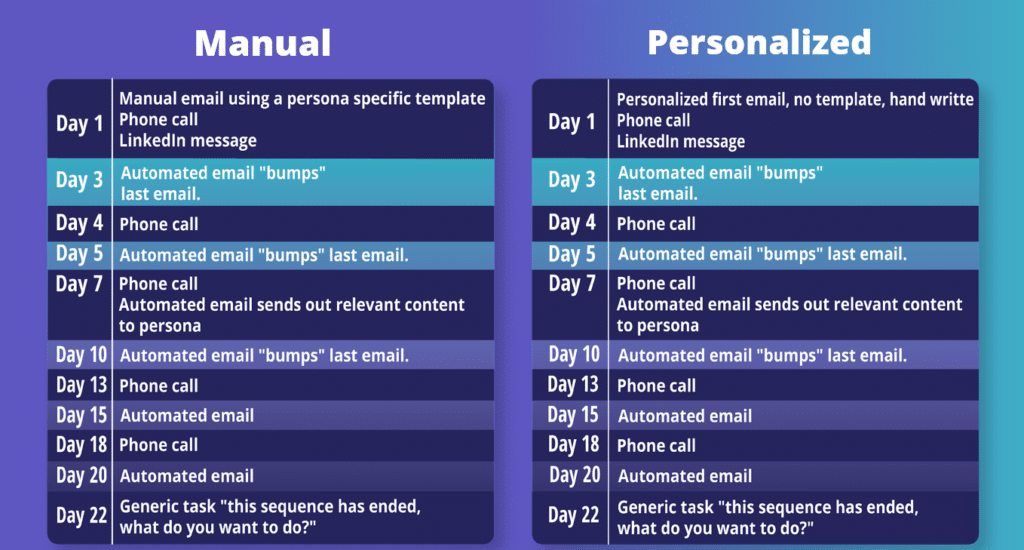
What’s the difference between these two?
If you read through, you would think these two sequences are exactly the same. And they almost are, with one BIG difference: the 1st email. The “manual” sequence includes a templated email (that may have a tiny bit of personalization). While the “personalized” sequence, on the other hand, includes a truly personalized email, like one written from scratch.
When do you use each type?
You will likely find yourself using the manual sequence for the majority of your top-of-funnel, prioritized prospecting, when refining your ‘hit list’, and cold leads. The return rate on automated emails is roughly 1%. So, we don’t want to spend too much time writing a truly personalized email for an unqualified account.
Now, when we’re talking about account penetration and account revitalization, we would recommend a personalized sequence instead. For these types of prospects, you will likely have solid background information or have had prior contact with the recipient. Warm leads will likely fall under this category as well, especially if you have spent time speaking with them at say a conference or networking event.
*Gasp* your sequence worked and they answered the phone! Now what?
Before starting your call series you should craft a couple of standard (but still great) intros for when your prospect actually answers. The key is to remember not to sell in the intro, instead focus on helping. The goal of your intro is to get your foot in the door and to get your prospect talking. Selling comes later.
Here’s what a great standard intro is going to include:
- It should be short and focused on what’s in it for them (think SWIIFT℠)
- Includes the goal of the call
- Should end with a question
- The entire goal of your intro is to GET THEM TALKING
The questions you ask in your intro should be short and shouldn’t require too much thinking. We want to aim for yes or no questions, or questions that involve an auto-answer. Think things like “How many reps are on your team?”, “Are you outbound or inbound?”, “Looking to add a couple of new team members?” Get them talking and THEN we transition to the sales call.
WATCH: Quick Tips For Better Cold Call Openings
Wondering what NOT to include in your intro?
If you play your cards right, there will be plenty of time for selling either later in this first call, or during your follow-up (more tips on bridging to the follow-up call here). The first time your prospect answers the phone, your job is to get them talking and engaged. We’ve talked about what to do… now let’s touch on what NOT to do:
- No social proof
- No introducing yourself
- No value props
- No features or benefits
- Remember: Don’t sell – do help!
Shoving research in their ear as soon as they answer isn’t appealing. The prospect doesn’t care if you’re the regional vice president for the mid-coast Atlantic region of your company’s XYZ division. In the first 2 minutes of the call, they don’t care what your amazing features are. What they care about is getting their job done better, faster, and easier. So, let’s start out by showing them how we can help!
Remember, the whole purpose of a sequence is to amplify your already amazing sales skills and get you to the finish line faster. So when working on your sales outreach, take time crafting your initial sequence cadence and your templated emails (if you’re going the manual sequence route). Future you will say “Thank you!”
If you’d like even more information on crafting the perfect prospecting message or sequence, you can watch our whole session with Brooke HERE!
Subscribe to our email list to receive new content, webinar invites, and training offers.

6 Logistics Sales Tips to Master Phone Selling
Freight and logistics sales has undergone a massive change in the past few years. As companies embrace digital transformation, in-person sales meetings are falling in frequency. So you’re probably spending a lot more time on the phone than before.
This can be…how should I put it…intimidating? 😱 Or at the very least, uncomfortable?
So here are six logistics sales tips to help you crush cold calls and reach those tough-to-crack prospects.
(Psst! Interested in logistics sales training? We can help! Contact us today.)
1. Don’t stop calling
For sales calls, the third time isn’t the charm. You have to call someone at least six times before you get a response. Not just for cold leads, but warm leads too.
People are shocked when I say this. But think about it: when was the last time you called someone once and immediately got a response? (I’m gonna guess it doesn’t happen that often.)
Over 36% of purchased leads receive no sales contact. And it’s not because reps are lazy. It’s because we’d rather go after the low-hanging fruit for immediate results. But there just isn’t enough low-hanging fruit to go around. If you want consistent results, you’ve got to climb a little higher. That’s why I recommend 10 touches for A leads, 8 for B leads, and 6 for C leads…as a bare minimum.
READ: How to Build an Account and Lead Qualification Strategy
2. Leave a voicemail and send an email—every time
Yes, you read that right. Every time. It’s easy to ignore a missed call. It’s harder to ignore several missed calls, multiple voicemails, emails—you get the picture. If you’re going to invest the time in making several hundred calls a week, make it hard for them to forget it.
Think of the voicemail as a resume. It’s there to show who you are, what differentiates you, and what value you offer. If you put it in front of them enough times, the prospect is more likely to pick up. Once that happens, then you can start selling.
WATCH: How to Leave Voicemails that Get Returned
3. Be patient.
In a virtual environment, sales cycles can be longer than traditional, F2F approaches. So when you make 100 calls in a day and don’t hear anything, don’t worry! Eventually, you’ll call someone enough times and they’ll pick up (even if it’s because they feel guilty 😉). At that point, you can make them feel like they’re the one doing you a favor by taking the call.
READ: Quick and Effective Voicemail Scripts
4. Keep your intro and pitch SWIIFT℠
Salespeople often talk about “engaging prospects.” But what does “engage” actually mean? It’s simple: An engaged prospect is a talking prospect. And what’s the best way to get someone talking? Ask them a question.
So instead of going through your usual dog-and-pony show, use the SWIIFT℠ methodology (So, What’s in it for Them?) to flip the conversation around. SWIIFT℠ gets the prospect to answer 2-5 short, closed questions to get the conversation going. This helps you build the necessary rapport and understand the prospect enough to demonstrate your value.
READ: The SWIIFT℠ Selling Methodology
5. Don’t “check in” with prospects.
Be real: how many times have you jumped at the chance to “check in” with a sales rep? Yeah, me neither.
If you’re going to ask for your prospect’s time, you better give them a good reason to get on the line with you. So start brainstorming how you can add value to them:
- Address a specific issue they raised last time you talked
- Update them on new and improved features
- Talk about something in the news and how you can respond to that
- Share something you learned from another client—a kind of cross-pollination
Don’t just call to sell something. Call to add value…real value.
DOWNLOAD: 20 Value-Add Reasons to Call Your Customers
6. Make the most of short calls
In virtual sales, the average first call is three-and-a-half minutes. If you last that long, you’re doing great.
You may wonder: what could I possibly get done in such a short amount of time? In reality, you only have to do three things:
- Differentiate yourself
- Get a commitment for the next step
- Book the next call
Commitments change depending on where the buyer is in the journey: set up a demo, loop in other stakeholders and decision-makers, read over a contract, or even sign and onboard. But every call you make needs to involve getting some kind of commitment. Then, you use that commitment to bridge to the next call.
So there you go. Follow these six tips, and I promise you’ll be crushing those sales calls. Happy selling!
Watch The Video Below For More Logistics Sales Tips.
Subscribe to our email list to receive new content, webinar invites, and training offers.

Top Cold Call Tips and Techniques
People love to ask, “Is Cold Calling Dead?” It’s probably for the controversy effect more than anything, right? My answer (like all great consultants) is, “It depends.” Marketing has come a long way indeed to ensure our brand is recognized before the call. Maybe content has been consumed, landing pages visited, social posts engaged. But if they’ve never talked to us before, is it still cold? Nah, let’s call that warm.
Not all companies are as fortunate. Start-up sellers may not have marketing support and the customer’s first impression is the first call. Even if they may recognize a little something from LinkedIn, it’s not enough to call it warm. Marketing tells us it takes at least 4 touches to actually leave an impression, and 6-8 to get to the point of purchasing (some companies even require 20+ touches!)
But can we be honest for a second? Sellers don’t give a darn. An outbound call to someone who isn’t expecting the call feels cold. Frigid below-zero kind of cold to today’s sellers. Why? Most of them haven’t grown up using the phone. My kid was shocked to learn his phone dialed out. “What!? It’s not just for texting!?”
Your millennial sales force wants to email and send LinkedIn messages. I know this because I get 30 a day. Want to differentiate? Immediately…
Ban the spam and get on the phone!
New to phone sales? Here are some cold call tips to help the water feel a bit warmer:
- You’re immediately differentiating yourself by calling vs. emailing. This is a very good thing. I get 30 messages a day and about one voicemail per week.
- It will take about six calls for you to get a hold of most of your prospects and most sellers give up after two. This is the game, my friends, do NOT give up. Do NOT take it personally. Cheerfully make your tally mark and know you are one call closer to a sale. Remember from above that it takes 6-8 touches to buy? Each time you leave a message it’s a touch. Sales is math.
- Yes, leave a voicemail! About every two days is great. No voicemail = no touch. You’ve made the dial but forgotten the return. Read more about voicemails that actually get returned here.
- Intersperse written messages. Use your outreach tool to help you send a series of voicemails, emails, and social messages over a period of 2-6 weeks. Close enough to be recognized from the last touch but not so close to being considered a stalker. You and your sales leaders can determine this.
- Design your outreach cadence based on client potential. If you’re doing account-based marketing and this is a top prospect, you’re going to touch more often and for longer. We recommend A, B, C, D lead qualifications. Read more on that here.
OK, now let’s move from strategy to psychology.
How do I beat cold call rejection? Rejection sucks. Be very clear that cold call dodging is not rejection! Imagine a stranger calling you just to tell you that they don’t want to talk with you anymore. Um, OK. I’m cool with that. Feels different if it’s your best friend or your brother, right? Now THAT is rejection. They know you. They don’t like you. Ouch.
A stranger saying they have no time, they’re not interested, or simply launching a call is not rejection. It’s a busy life. They don’t know your name, your company, your face, or your annoying habits yet. 🙂 It’s called call dodging, not YOU dodging.
Let’s also focus on sales as a helping profession. I recommend you spend a good four hours immersed in customer testimonials and case studies before picking up the phone for the first time. Learn why people love your product and your company. Learn about the problems you’ve solved and the situations you’ve bailed them out of at work! Your job is to find people struggling with these situations and save them. Your job is to educate them on a solution. What would they do without you? What if they don’t even know a solution exists!? What if they’re searching for a solution right now and are about to make a big mistake!? I want you to really dig in and picture this scenario and then picture this stranger thanking you for helping them. See it clearly and then see it every time before you pick up the phone.
In a cold call rut? Try picturing your best friend next time you hit “send.” Get a smile on your face and really imagine it. Your entire energy will change and you’ll be shocked how you’ll come off better.
Need more cold call inspiration? I want you to imagine that this outbound calling job is actually your business degree. Hell, your MBA program. Your job on every single call is to learn something about their business, their industry, their company, and their job role. It’s called genuine curiosity my friends, and nobody displays it in sales anymore. Be fascinated. Be inspired. Seek to truly learn and grow. Your prospect will be so flattered and surprised, you’ll learn everything you need to know to qualify or uncover a need. You may even find your future perfect job situation!
Finally, a few skills to help. The most important skills to turn dials into actual leads or opportunities are:
- Voicemails. Yeah, we covered this before. If you leave 10-15 voicemails a day using our techniques, you’ll get at least 2 returned. That’s 10 conversations a week. Folks, that’s like a bonus day of the week. You get 6 days to hit your goal while everyone else gets five.
- Call Introductions. 90% of them suck. Yeah, sorry about that. If you’ve not spent a few hours training and perfecting your intro, it probably sounds like your value prop and is about 10 seconds too long. Learn the SWIIFT℠ Intro that perks their ear and gets them talking. You’ll be shocked at how many conversations happen instead of rejections.
- Overcoming the Brush-Off. Even with a better intro, you’ll get some brush-offs. Remember, this isn’t rejection – they don’t even know you! Most of us either hang up or answer it like an objection, and that’s wrong. How do you overcome “I don’t have time” or overcome “I’m not interested?” By moving around it.
- A Better Value Prop. If marketing wrote it for you, it won’t work in phone sales. Sorry marketing. Value props need to answer who you are and why they care in a way that your grandmother could understand. The best ones use “The rule of three” to get their brain accidentally picturing your services.
In summary, no matter the temperature of your outbound calls, when you make them a game, adjust your mindset, and layer in some skills, then you and your team can harness the incredible power that most of your competition has left behind. Sure, it’s easier to pop an email but remember:
“Nobody ever bought anything over email.”
Choose to be in sales instead of marketing. Pick up the phone and have some fun!
Subscribe to our email list to receive new content, webinar invites, and training offers.

4 Time-Saving Sales Prospecting Strategies
Can you guess what percent of sellers HATE prospecting?
(Hint: it’s not 100% – that was my first guess) But it is the majority of sellers…
64%!
Yet 100% of managers DO say that sellers need to prospect more (and be better at it – if you’re one of those managers, contact us. We can help 😉)
So what can you do?
It all starts with planning.
In order to get better results without feeling like you’re wasting hours, you’ve got to put some work in ahead of time. But have no fear, there is a way for you to plan for prospecting without being part of that 64% hating it along the way (and if you already are, maybe this article will change your mind!)
Check out these top 4 sales prospecting strategies to help speed things up.
WATCH: Sales Shot – Power Prospecting
Drastically Underprepare
Yep, read it again. Think about it this way: what’s your main goal when you pick up the phone? The obvious answer is to entice them to set up meeting 1. But that’s probably a pretty unlikely accomplishment with just one phone call.
What’s the most likely case? You’re going to get their voicemail!
READ: 4 Quick and Effective Voicemail Scripts
With speed in mind, think about the key elements you need to craft and leave your voicemail during your prospecting. Here’s a list of the usual suspects with a breakdown of why you do or don’t need them.
- Name – This one is pretty obvious. Know their name when you call! (But guess what? Sometimes you don’t even need this when they’ll repeat it in their voicemail!)
- Solution Match – If they aren’t even on the phone, you’ve got nothing to diagnose for them, so you don’t need it yet.
- Value Prop – YES! (SWIIFT℠ everyone!) What value are you bringing them? An absolute must. A whopping 74% of buyers will choose to work with sellers who are the FIRST to add value according to Corporate Visions.
- Case Study – Sure, a ready case study is helpful, but do you really want to bog down your call OR voicemail by spitting out stats? They don’t care yet! Skip it.
- Pricing – Again, hard to know what they need yet, and that doesn’t lend itself well to providing pricing.
- Job History -Spoiler: it’s not needed! Focus instead on one quick rapport builder.
- Call Intro – Make sure you have this down pat.
- Voicemail – ALWAYS leave a voicemail! Otherwise, the effort you put into making this call goes right down the drain. You’re not buying a billboard to leave it blank, are you? (Shameless plug: your voicemail is 3x more likely to get returned when you take our class, Messages That Get Returned, which we offer in our eLearning platform, The Sales Bar)
READ: Best Sales Scripts To Get A Buyer’s Attention
So to summarize – when you pick up that phone, know their name, have your value prop handy, your call intro, and a voicemail if all else fails. Save the image below to help you remember.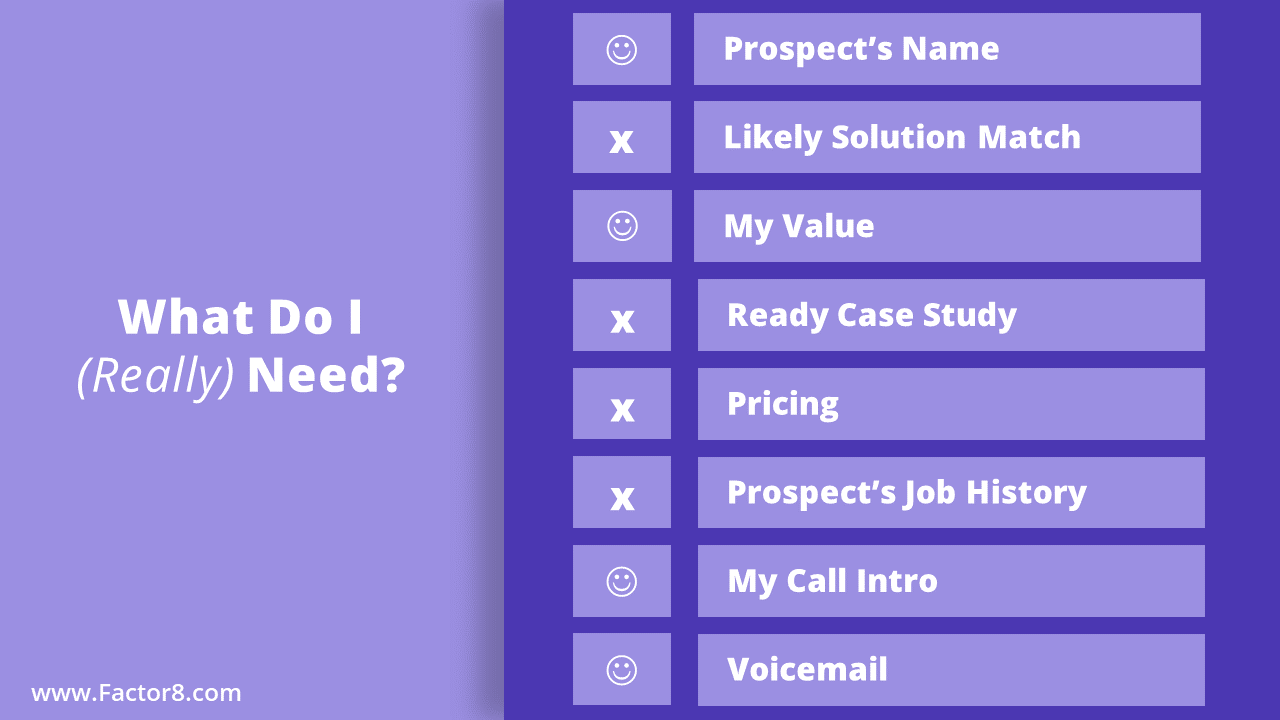
Group Your Leads
Make it easier on yourself by grouping your leads together. Here are some quick categories to organize them by:
- CRM History
- Trigger Event (did they all attend a conference? Fill out an inbound lead form?)
- Profile/Demographics
- Offer (do you have an incentive to offer when you reach out to them?)
- Location (do you have a rep going to that location soon? Perfect time to reach out!)
- Social Connection (mutual friend, past acquaintance, school history, etc.!)
READ: Build A Lead Qualification Strategy
Group Your Research
When you do your research, your first instinct might make you feel like you HAVE to give individual attention to every single person and potential lead. Guess what? You don’t!
Easily group call goals, qualify & explore questions, voicemail scripts, and your SWIIFT intros.
What should you individualize? The rapport builder – it’ll be unique for each person.
Boom, you just saved yourself a whole lot of time!
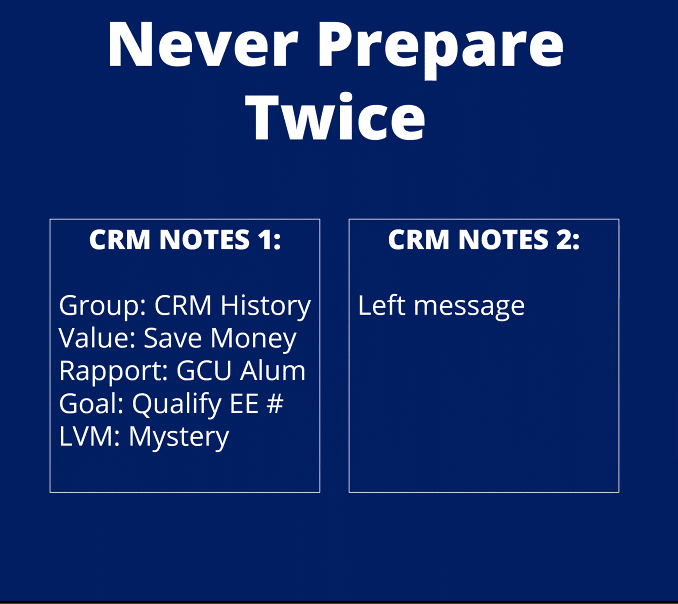
Never Prepare Twice
Be nice to future you! By taking better notes and including specific details about the voicemail you’ve previously left, you’ll never be left scratching your head wondering what you’ve already done and having to double back.
Here’s what to include:
- What group is your lead in
- What value prop did you use
- What was your rapport builder
- What was your call goal
- What type of voicemail did you leave
BONUS: Always Add Value
Seems like a no-brainer, right? You always want to call to add value to your prospects. Try the following:
- Interact with them on social media – comment and share their posts
- Recognize something – give a compliment!
- Customize your request
- Be brief
- Always GIVE something first
- Ask short and closed questions to get them talking
Bottom Line
Prospecting is always going to be a numbers game. Remember: it takes 6-9 times to get to 90% of the people on your list! Put in the work – but don’t worry about putting in extra.
Subscribe to our email list to receive new content, webinar invites, and training offers.
Why You Need To Stop Pitching & Lead With Value Instead [Webinar Recording]
Why You Need To Stop Pitching & Lead With Value Instead
[Video Recording]