At Dun & Bradstreet, some of the most tenured sales managers, leaders with over 20 years of experience, had a breakthrough they didn’t see coming.
John Healy, one of our Sales Advisors, spent a full day with the team, leading a session on Driving Performance with Goals (a longtime manager favorite). But this wasn’t another pep talk about why goals matter. It was hands-on. Practical. Focused on building real connections between daily activities, KPIs, and long-term outcomes.
For many in the room, it was the first time the dots fully connected.
The real shift didn’t come from slides or lectures. It happened inside The Sales Bar by doing the work.
The managers rolled up their sleeves and practiced how to:
Map goals to rep behaviors
Build coaching cadences that actually stick
Practice conversations before trying them live
Lead like strategic managers, not just task supervisors
By the end of the day, those same leaders were mapping out new team strategies, role-playing coaching conversations, and sharing real-life examples of how they would start applying new approaches immediately.
They weren’t just talking about change. They were leading it.
Why did it work?
Because they didn’t just learn about managing performance. They experienced it.
The Sales Bar isn’t just another resource. It is where even the most experienced sales leaders go to sharpen their edge and lead with purpose.
Subscribe to our email list to receive new content, webinar invites, and training offers.
If your reps are still using AI like it’s 2023 (or not using it at all), they’re already behind. In our Sales Shot, I sat down with four sales pros and AI enthusiasts whose teams are actually using AI for sales prospecting, not just talking about it. We’re talking AI-enhanced targeting and prospect research, coaching bots, live conversation sentiment tracking, even inbound AI voice agents that are outperforming humans (yes, really – so, will AI take over sales jobs? That’s a topic for another blog!)
Here’s what went down, and the best AI tools, tips, and prompts you’ll want to steal.
Smarter Targeting and Prospect Research
We kicked off with a game-changer: using AI to make sure you’re calling the right people. David Kreiger, SalesRoads, shared how his team usesClay to qualify leads before reps ever pick up the phone. It pulls company data and uses AI to tell you if a prospect actually fits your ICP, saves hours of manual research, and gets your team focused on the right accounts.
John Buckley (from Sell Better’s Daily Sales Show) showed usAgent.ai, a no-code agent that scores a company for outbound fit with a single URL. He’s trained it on his ICP so it gives a quick thumbs-up or “hard pass.” No prompt writing needed.
Jax Gill (from Inspira Financial) took it even further. She trains ChatGPT to review a company’s website and her prospect’s LinkedIn profile, then find common ground to help her build rapport fast. She even gives it a list of her solutions and asks for possible pain points to reference in the convo. It’s like AI-powered pre-call prep, minus the rabbit holes.
Prompt ideas to steal:
“Here’s my ICP. Here’s this company’s website. Is this a fit or not? Why?”
“Compare my LinkedIn profile to [prospect’s name]’s. What do we have in common?”
“Given this company and our services, what pain points can I lead with?”
Better AI Sales Prospecting Emails and Messaging
Let’s talk outbound emails. Doug Gibb’steam at Waste ManagementusesConquer with GenAI email, which drafts emails based on past conversations and makes sure they don’t miss a promised follow-up. It pulls call and email history straight into Salesforce, so everything’s in one place.
David dropped this gem: if you write more than three emails a week, build a custom GPT. He’s trained his to match his tone and voice. Upload 50 of your best emails, and now your GPT can write in your style. It’s faster, but more importantly, it’s better.
James added Oliv to the mix. This tool sends him a cheat sheet before every call with company background, team bios, and even icebreakers. “Ask Chloe about her transition from radio hosting to content marketing” is way better than “Hope you’re well.”
One big reminder from everyone: AI-generated emails shouldn’t sound AI-generated. If your message is filled with fluff, jargon, or emojis in every line, it’s going straight to trash. Your prospects can smell it. Use AI to help, but still bring your brain.
Prompt ideas to steal:
“Use my tone. Write a prospecting email for this company using the info from our last call.”
“Summarize this LinkedIn profile in one sentence I can use as a cold email opener.”
“Rewrite this message to sound more human, less like it came from a bot.”
Coaching, Confidence, and Call Reviews
AI isn’t just helping reps do the work. It’s helping them get better at it. David recommends using AI to coach yourself after calls. His reps drop their call transcripts into ChatGPT and ask for feedback. What could I have done better? What questions did I miss? It gives them a score and action steps to improve.
Jax uses AI before the call. She practices objections with ChatGPT in persona-mode. “Be a tough IT Director. Push back on cost.” It gives her reps a safe space to screw up and get better.
Doug’s team uses Conquer to transcribe and summarize every call. It flags sentiment dips, highlights next steps, and scores reps on their delivery. That all feeds into Ambition, where managers get a full coaching report before every one-on-one. And yes, even new managers can coach like pros because the system shows them exactly what to focus on.
We also shouted out Grw AI, a tool for roleplay call coaching. Reps can practice calls and get feedback based on real frameworks. It’s like flight simulator training for sellers.
I also shared how much I love using Fathomfor call notes. I just click a button and boom, it gives me a clean sales summary with top pain points, current situation, and next steps. It’s fast, easy, and way more useful than generic transcripts. Use it for internal calls too to help you take notes and create to-dos.
Prompt ideas to steal:
“You’re a skeptical IT Director. Let’s roleplay a cold call. Push back on price and security.”
“Here’s my call transcript. What could I have done better? Give me a grade.”
“Give me 3 coaching questions to reflect on after this call.”
Real-Time Insights and In-the-Moment Support
Sales moves fast. Reps don’t have time to dig through notes or scroll LinkedIn for the latest news. That’s where real-time insights come in.
James’s tip: Use LinkedIn Sales Navigator alerts. Ring the bell on your top prospects and accounts. You’ll get notified when they change jobs, get promoted, or post. Instant reason to reach out. That’s prospecting fuel your team is probably ignoring.
Doug’s team uses Ambition’s pre-read feature to prep for coaching. It pulls 90 days of call scores, KPIs, pipeline data, and even sentiment analysis so managers walk into meetings ready. Their AI-based pipeline insights show if deals are stuck, what changed, and where to focus.
David shared Trellus, a power dialer that lets reps pause mid-call to get AI-powered coaching suggestions. It’s like having a manager in your ear without the pressure.
Prompt ideas to steal:
“Give me coaching advice based on this sales call recording.”
“Summarize this opportunity pipeline for my one-on-one. What’s stuck and why?”
“If my rep is below target on discovery, what should I review with them this week?”
AI for Inbound, Enablement, and Emotional Intelligence
You didn’t think AI was just for outbound, did you? David’s team is usingSelafor inbound calls, and it’s outperforming human reps in tier-one qualification. The AI calls the lead, asks 2–3 qualifying questions, and routes the hot ones straight to an SDR. It’s efficient, repeatable, and for simple calls, often better than a live person.
James brought up Sybill, which reads facial expressions and body language during video calls. It sends post-call insights like, “Your buyer leaned back and widened their eyes when you said pricing.” That’s gold for follow-up and helps reps refine their messaging and emotional timing.
And of course, Doug’s team uses Microsoft Copilot, a company-approved, closed AI system integrated into their workflows. Their AI governance committee ensures compliance, which matters when your team is 50,000 strong.
Bonus tip from Jax: Use ChatGPT as your personal hype woman. “Give me a pre-call pep talk.” Or ask it to roast you. Either way, you’re showing up more confident.
Prompt ideas to steal:
“Pretend you’re my mentor. Give me a 30-second pep talk before this big sales call.”
“Roast me. What could I do better in my outbound pitch?”
“Act like a buyer. Ask me 3 tough qualifying questions based on this service.”
This session wasn’t fluff. These are real leaders, using real tools, getting real results. If your team is still scared of AI or waiting for some “perfect system,” you’re already behind.
The final takeaway?
“Use the time AI saves you to do the task better. Not faster. Better.” – David Kreiger
TL;DR – Here are the best AI sales tools and how our panelists are using them:
Agent.ai– James built an agent that scores companies instantly based on ICP fit, eliminating the need for prompt engineering
Ambition– Doug uses it to prep managers for coaching with pre-read insights that include sentiment, pipeline data, and call scores
ChatGPT – Jax shared how her team uses ChatGPT to simulate prospect objections and refine messaging before high-stakes calls; it’s like having a role-play coach on standby
Clay– David uses Clay to pre-qualify leads and filter out non-ICP accounts, saving reps hours of manual research
Conquer– Doug’s team uses it to auto-draft follow-ups based on call history and transcribe every conversation for coaching
Fathom – We use Fathom here at Factor 8 to summarize sales calls and uncover real buyer pain points. Tip: Use it for both internal and external meetings to quickly extract key details, create to-do lists, and skip manual note-taking
Grw AI– Lauren and Jax called it a flight simulator for sales; perfect for reps to practice and build confidence before high-stakes calls
Microsoft Copilot – James noted that Copilot helps his team save time by summarizing long email threads and prepping for meetings straight from Outlook and Teams
Oliv– James loves Oliv for the call prep emails, especially the personalized icebreakers like asking about career transitions
Sybill – Doug mentioned using Sybill to flag buyer reactions mid-call, helping reps spot hesitation or interest and follow up more strategically
Sela – David says Sela outperforms humans for tier-1 inbound lead qualification and is being used successfully in production
Trellus– David mentioned reps can pause a call and get live coaching advice based on the persona or objection they’re handling
Subscribe to our email list to receive new content, webinar invites, and training offers.
Sales Management is the busiest, most overwhelming job in the world (right?!) And that was before most of us went remote.
It’s no wonder so many new managers hit a wall and ask themselves, “Did I make a mistake getting into management?” Trust me, you’re not alone.
But it doesn’t have to be this hard. One of the biggest game-changers for managers is building a cadence, or a system, for how and when you engage your team. Like sellers need a sales process, managers need a management process. This is how you take back control of your day, stop fighting fires, and get back to why you took this job in the first place: to develop and lead people.
Here are 5 things to help you take back control of your day (and learn to love being in management!) Let’s dig in.
No More Whack-A-Mole
If your day feels like playing whack-a-mole with Slack pings, rep questions, and customer escalations, you’re not alone. These are what I call “jello days”, days that feel messy, unstructured, and impossible to control.
Picture trying to nail jello to a wall. That’s how sales managers often describe their days. No matter how hard you try to stick to your plan, something always slips, shifts, or melts away. It’s reactive chaos. You’re busy all day, but not moving anything forward. You’re putting out fires, answering questions, jumping into calls, but not doing the proactive work that actually drives results.
It’s exhausting. And it’s not why you got into leadership.
Most of us became managers because we love seeing others win. But when you’re stuck in jello days, that purpose gets buried under a pile of “got a sec?” interruptions and endless meetings.
So what’s the fix? A structured cadence. Organizing your week around proactive touchpoints like coaching, huddles, and strategy sessions helps you take back your time and lead with intention.
Here’s the difference between reactive and proactive tasks:
I literally pull out a Post-it each day and write down the one thing I must do. I don’t leave until that’s done. It’s simple but powerful.
The magic formula:
Identify your top priorities
Build them into your calendar
Do your one thing first before opening your inbox
This discipline is what separates high-performing managers from the rest. The best don’t just exceed team goals. They get more of their team to quota, reduce attrition, and consistently coach. That doesn’t happen by accident.
Let’s break the myth. You don’t need to cover everything in one meeting. It doesn’t work. Instead, you need a sales manager cadence, a system of regular, focused meetings that make everything more efficient and effective.
Here’s the cadence I teach:
1:1 Meetings (Monthly) – Focus on performance. What happened last month? What’s the plan this month? How are we tracking? Then shift gears. This is also your chance to connect and coach.
Call Coaching (2x/month) – Small groups (no more than 3). This is real coaching. Feedback on call execution, not just listening together.
Sales Huddles (2x/week) – Stand-ups with energy. Talk goals, wins, contests, and questions. Keep it short.
Pipeline Meetings (2x/month) – Stop doing these 1:1. Make them group sessions. It builds accountability and saves you hours.
Sales Strategy Sessions (Ad hoc) – When someone’s behind, this is your chance to step in and help with deal, territory, or lead strategy.
Team Meetings (1x/month) – Focus on culture, recognition, and updates. Make them worth showing up for.
Quarterly Career Reviews (1x/quarter) – Go deep on development. Celebrate progress, talk about career goals, and lay the foundation for retention.
Calendar It or Forget It
Now, make it real. Start with a blank calendar and schedule your cadence:
Block quarterly reviews
Add monthly 1:1s and team meetings
Layer in weekly huddles and coaching
Leave half your day open for the inevitable reactive stuff
Don’t over-schedule. Try to keep your total meetings under four hours a day. The other half of your day will get eaten by the unexpected, so plan for it.
Once it’s on your calendar, protect it. This is your new system. If you move meetings around, your team will too. When your reps know when they’ll get your attention, the “drive-bys” stop, and they’ll start saving their questions for the right time.
Send out the invites. Include prep expectations and agendas so everyone shows up ready. And if they don’t? Don’t let it slide. Your calendar only works if your team respects it — and they’ll follow your lead.
You don’t have to answer every rep question in the moment. In fact, doing that all day is exactly what’s keeping you in firefighting mode. Start redirecting those interruptions into your existing cadence.
Try phrases like:
“I did hear your call. Nice job. Let’s break it down during coaching.” “Can we talk about that in tomorrow’s huddle?” “I’d love to help, but I only have three minutes right now. Can you bring this to our 1:1?”
Reps will always take the path of least resistance. If you make yourself available 24/7, they’ll keep coming. But if you push conversations into the right meetings, they’ll start to respect your time—and even come more prepared.
Lauren calls this “guarding your time.” The requests won’t stop, so you have to stop them.
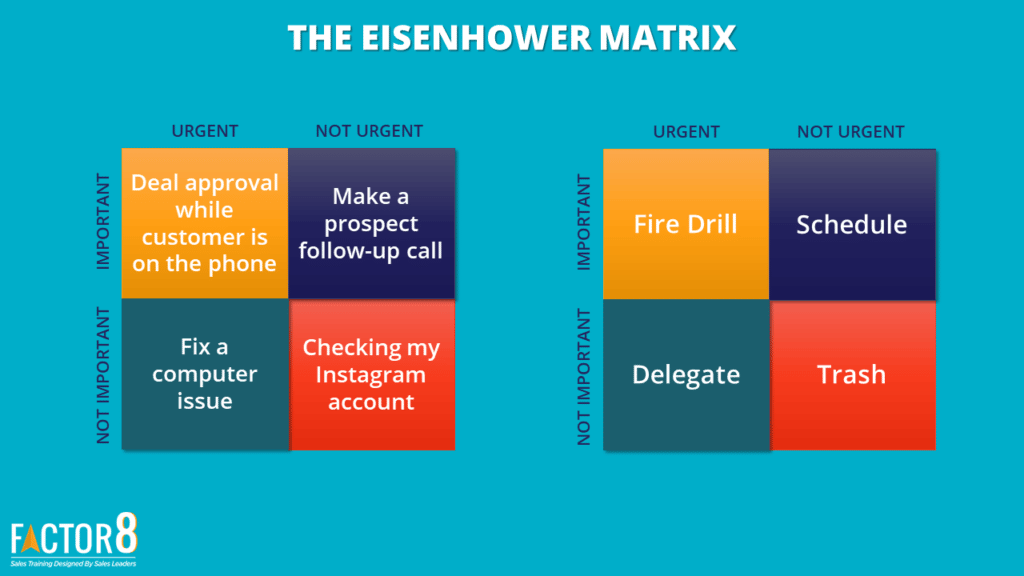
This is where the Eisenhower Matrix comes in. It helps you quickly sort out what’s:
Urgent and important (you handle it)
Important but not urgent (you schedule it)
Urgent but not important (you delegate it)
Neither (you trash it)
Urgent usually means there’s a time-sensitive deadline. Important means it impacts results or revenue. Just because something feels urgent to someone else doesn’t mean it is.
Building the muscle to decide what gets your time is one of the most critical skills a manager can learn.
Building your sales manager cadence will give you back your day and maybe even your life. It creates structure, accountability, and clarity for your team. And it lets you do the thing you wanted to do when you took this job: lead.
Try the cadence. Try it for one month. I’ve gotten hugs around the world for this structure, and I hope it helps you too.
And if you’re not sure where to start? We’ve got cheat sheets, templates, and a full class in The Sales Bar to help you Own Your Day and run every meeting like a pro.
Subscribe to our email list to receive new content, webinar invites, and training offers.
Call coaching is literally THE hardest new skill for sales managers. Yes, it’s a new skill even if you’re not a new manager. Why? Because as a seller – hell, as a HUMAN – our job is to take action to get results. We are “me” focused and “results” focused. Coaching flips this on its head as we’re told to be “rep” focused and skill improvement vs. deal focused. Let’s be clear, you guys…
THAT.
ISN’T.
NATURAL.
And the better you were as a seller, the harder it was as a manager. Great sellers are competitive, a little selfish and needy (c’mon, own that), and ruthlessly devoted to the “W.”
In fact, the very best skill coaching (aka call coaching aka just coaching) is NOT focused on the deal. It’s about the rep’s development first and foremost. Focusing on the deal over the rep is where we get in trouble and make common coaching mistakes like, “The Laundry List” and “Be Like Me.” Why? Because we’re impatient to get the win, to save the deal, to bank the commission. Let me summarize in caps, as that makes me feel like I’m really driving the point:
GOOD CALL COACHING IS NOT DEAL COACHING.
If you can enter into the meeting 100% not caring if they win or lose the revenue and only if they feel better about themselves and are excited to improve, then you get it.
You’re also some sort of superhero because that’s basically impossible.
OF COURSE, you care about the “W”. You’re in sales!!
Over my years in sales leadership and training leadership, I’ve developed a lot of hacks to fix this situation. For example, I only use call recordings of past deals. This prevents my natural sales animal from emerging and ripping the headset off a sweet, well-meaning newbie and taking over the deal (and thereby completely deflating if not scaring my employee).
I also have a GREAT way to take notes during the call to help me vent my frustrations, but still appear supportive and encouraging to an underperformer (admit it, that’s hard).
There’s also a rule of thumb to NEVER break on what to coach, plus:
How many things to coach at once
How often to coach each rep
How to track it so improvement happens
How to make time to do more coaching
It’s a complex challenge we face in doing more and better coaching on the job. And going virtual didn’t help. Alas, it’s a worthy pursuit. Frankly, I feel a bit like the Captain Ahab of sales call coaching. I’ve evolved, improved, and added to my training solution pretty much every year for the past ten years. I keep searching for new and improved silver bullets to make the transition easier and faster. And we’re getting there, folks. We’ve created a comprehensive and effective program that changes behaviors and results (contact us if you’re interested in our sales call coaching training).
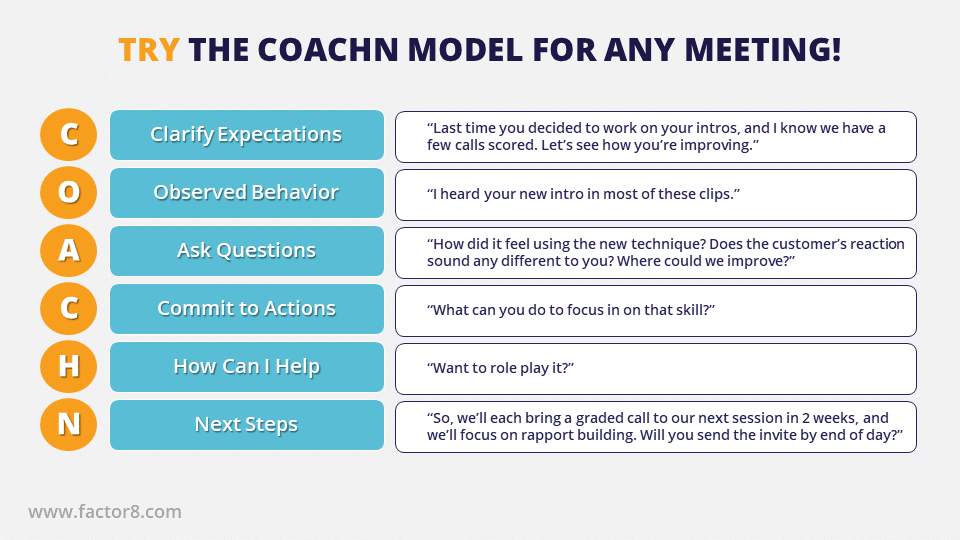
I would be remiss if I did not mention the call coaching framework we created here at Factor 8: The COACHN℠ Model. It ensures reps and managers have the most efficient and effective coaching sessions possible. Check out the image below (and save it to your desktop!).
Subscribe to our email list to receive new content, webinar invites, and training offers.
Sales Management is a tough gig. Virtual sales management is tougher. Like our sales teams struggle to sell “with an arm and leg tied behind their back” with the exclusion of visual cues, difficulty reaching customers/prospects, and having drastically limited selling time, these same challenges (and more) affect managers. Especially newer leaders.
In my first few years of sales management, I relied heavily on the visual cues of how my colleagues managed their teams. I saw huddles happening (“Oh, I should do that.”) I overheard team meetings and coaching sessions (“Wow, I need to give that kind of advice”) and I picked up deal strategy and day management skills.
Until we’re tenured leaders of sales teams, we don’t have our management cadence locked in. The cadence is our management process – the series of meetings, touchpoints, and actions we take in a day, month, and quarter to keep our business on track. In fact, I dare say most sales managers spend their first year or two bouncing between requests, fires, and demands.
It’s natural to be reactive in our high-demand, fast-paced environment. There’s a line at our desk, in our email inbox, and in our assignments from above. Without these, we’d wander a bit aimlessly trying to figure out our jobs as we transition from individual contributor/seller to leader. It’s why so many leaders struggle to give up the deal, the customer base, the live sales calls – we know this world! We RULE this world!
And herein lies the rub. Now that we’re managing virtually, we need a proactive approach. We need to shortcut the learning curve and have a plan – one that includes the challenge of not seeing who’s in their seat, overhearing the calls, and picking up on the team dynamic. Rough.
To speed this process, and alleviate some stress along the way, let me share a few key tips:
1. Establish (and edit) your proactive management cadence immediately. We teach this in “Essential Manager Meetings” (a course in The Sales Bar) and it’s one of our first courses for all new managers. At a minimum, your cadence needs to include:
Multiple weekly sales huddles to provide focus, inspiration, energy, and insight
Monthly private 1:1 performance meetings with each team member
Multiple 1:1 to 3:1 call/skill coaching sessions with each team member monthly
Multiple team forecast meetings (frequency depending on sales cycle)
Monthly team meetings for updates, development, communication, connection
Where do you find the time for all these meetings? By pushing the daily incoming demand to one of these meetings. Rep Slacking you with a “great call update?” Push it to your morning huddle or your next call coaching. Rep forecasting below goal? Schedule an ad-hoc sales strategy meeting to review deals. Getting lots of emails with company questions? Move forward the team meeting and address them together.
We set the process and then we daily teach our reps to operate within it by delegating, pushing, and scheduling “official” meeting time vs. reacting all day. That makes time management a critical management skill…
2. Own Your Day (another course in The Sales Bar). Especially now that we’re at home, it’s way too easy to work 12 hour days (or the opposite for some). The line at your desk is now your chat. Email is center screen all day. It’s harder than ever to stay proactive and protect our rep-focused parts of the day. We have to schedule it, and then protect it. Our top priorities also get calendar time and we protect them like our most important meetings of the day.
We love the Eisenhower Matrix (everyone’s favorite part of this course) to help managers decide when to fire drill, when to delegate, when to schedule, and when to trash a request. When you’re in charge of your own day, you can help reps be in charge of theirs – so critical for virtual selling.
3. Call Coaching. When we’re virtual, the tendency is to count heavily on the numbers. If we can’t hear the calls and watch the behavior, we watch what we can – the metrics. This is a mistake. Especially now that your reps are selling a new way, focus on quality over quantity. That means it’s time to get visibility. If you don’t have call recording capabilities, start lobbying for it now. ExecVision, Chorus, and Gong make it easy to be legal and to get the insight you need into rep conversations + the tools to coach them.
Scheduled call coaching using recordings or ride-along meetings are critical. It’s going to be tougher than ever to make it happen (hence the first two points), so give this to your reps. When your calendar is up to date, they know when you are free and it’s on them to invite you to 1-2 calls/week.
Sales skill feedback also has some new priorities right now. Field sellers gone virtual will need some help and focus on phone detective skills – working phone systems, making multiple attempts, capturing new contacts, qualifying accounts – honestly some of the basic skills covered for new BDRs. They may not LOVE the idea of getting entry-level phone skills training, but these are tools they need in their belt today – and tomorrow.
Phone sellers now struggle with video. They need your feedback on the basics like backgrounds, lighting, proper attire, and etiquette. We’ve all seen the fails – those are on us as their managers. Check out our course Running a Virtual Sales Meeting in The Sales Bar for basics on virtual meeting agendas, engagement, and online tools use.
The key is that they get the coaching and support regularly and you build it into a regularly scheduled meeting as part of your cadence.
My entire team – including the sales team – has been virtual since inception. Our BDR is new and gets call coaching every Tuesday and Thursday for 45 minutes at 9 a.m. She brings the call recording to support what we coached last time and before it’s over there’s a commitment to what we’re coaching next time. The coaching is done over video so we can see faces and reactions and expressions – this is a personal development moment, and it helps us connect.
Remember, a connection to the boss is critical for every employee. Call coaching is about helping develop reps skills (not close deals) as much as it is about increasing our team’s engagement with us and with the company – and there is nothing more important for retention. Coaching is bonding 1:1 time and your team needs this attention from you, even more, when we’re virtual.
Subscribe to our email list to receive new content, webinar invites, and training offers.
I’m writing this blog at 9 am tucked into bed with the flu. I started to write it at 7:15 am, but decided on OJ and an episode of American Housewife instead.
In the 45 minutes I procrastinated, I received 74 emails. WHAT?!
Please be clear that I counted the new emails, scanned briefly, and then shut Outlook. Why? Because if I didn’t this article wouldn’t get written this morning – probably not even by end of day. And because if someone really needed me there are at least 3 faster ways they can get a hold of me.
Email is the new snail mail. It’s where un-urgent requests, FYIs, and sales pitches belong, and if you aren’t treating it that way you and your organization could be wasting precious time. Yes, you get enough emails to keep you busy 4-6 hours/day, and if you ignore them all the time they will pile up (you make good points my dear sweet email lover). Alternatively, answering other people’s requests is probably not the most important part of your job, is it?
Our completely normal instinct to deal with something simple that’s in our line of sight is prioritizing other people’s to-do lists over our own.
Here are a few best practices and time-saving tips to take back your day:
Get rid of email alerts. Immediately. If we can agree that email is NOT where urgent items live (read: it has an imminent deadline), then quit interrupting your current screen with them. Every time the pop-up happens, a part of your brain goes down the rabbit hole until it finally just can’t resist a quick alt-tab to email to take care of it. It only takes a minute, right? Sure! Until you see the next one and the next one…it’s like trying to eat just one handful of popcorn at the movies. Impossible. If we could resist we wouldn’t be in our inbox right now. Kill the alerts. Be present in your current task instead.
Designate a time for email. There, that may feel better to my GMail addicted friends. 🙂 I do email once a day at the end of the day. True, my assistant cleans it out for me in the morning, so I’m cheating just a little bit. Carve out two hours/day, put it on your calendar, and be strong. It only hurts for a couple of days. You’re not ignoring. You’re prioritizing. You were hired to coach, strategize, lead…not to type.
Set communication expectations with your team. Have a conversation about what you consider urgent and important tasks and requests. Agree on what task/topic requires an instant message, text, phone, call, drop by, or email. Help team members know when you want to be CC’ed and when you don’t (there’s 50 less per day for you) and help them understand that if they email, they can expect a reply in 2-3 business days. If you choose to reprimand them for “bumping their email to the top” and sending you emails about their emails, that one is up to you. It may also be a great time to let them know when you’ll be doing meetings, coaching, and other activities that may not be interrupted with a minor customer issue or system question.
Assess in a week. Getting more done? Finding times where you wonder what you should be doing? Getting more rep coaching done? These are good signs. If you find you’ve chewed off your nails and you’re staying at work late to do all the email, your addiction is more serious and I’m sorry for recommending this cold turkey. Try some of these gentler adjustments instead:
Start the day by cleaning out emails – just book your first meeting within an hour so it doesn’t go long
Try an email cleaner like Unroll.me that will aggregate your junk mail
Consider delegating – if you’re on email alerts, groups, etc. for leads or training, perhaps someone on your team could monitor these and bring hot topics to a team meeting
Eat lunch at your desk once or twice a week and take the extra hour to respond during that time
Find one email/day your can unsubscribe or junk
I cordially invite you to try several of these time-saving tips and join me in the sweet, sweet freedom of being released from email jail. Looking for more ways to get sales management tasks done in less time? This was one of over twenty hacks in our top-rated sales manager course “Own Your Day”, which is now available on-demand at The Sales Bar.
Subscribe to our email list to receive new content, webinar invites, and training offers.
Learning to be a great sales coach is hard – really hard. It’s the hardest thing we teach new managers who were formally reps. Now, it’s not as hard as climbing Mt. Everest or teaching your grandma how to order presents online, but it’s rough.
It’s the #1 skill that most new managers struggle with. If you’re a naturally phenomenal coach, congrats (seriously!), but the rest of us are struggling. Why? We don’t often know what defines great sales coaching. So let’s break it down…
The Difference Between Presenting vs. Facilitation vs. Coaching
The lines are often blurred between presenting, training, and sales coaching, especially when we don’t have staff and resources dedicated to each. Why does it matter?
Well, does this sound familiar?
“I’VE TOLD THEM 100 TIMES!!”
We’ve heard it from managers and VPs (and parents 😉 ). It’s rough, folks. If people aren’t retaining what you’re telling them to do, they obviously aren’t going to do it. So we have to back up a few steps and make sure it gets in their brain and sticks.
What is presenting?
We define presenting as…Introducing new information through speech often using slides/visual aids.
Watching a webinar? You’re listening to someone presenting. Sitting in a lecture hall in college? That’s presenting.
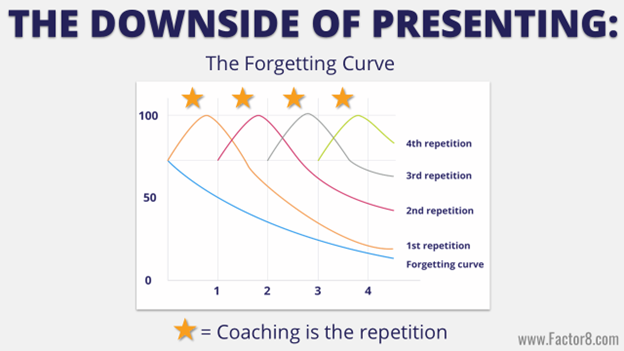
Now the downside to presenting is something called The Forgetting Curve. If you’re in sales enablement or training, you’ve likely heard of it. It shows us that by the end of the day, reps have lost 50% of what you taught them. In a week, they’ve lost 90%. So it’s pretty obvious why they aren’t doing what you told them to do – they can’t even remember it!
There are two ways you can beat The Forgetting Curve.
By utilizing great facilitation or training. The better (and more interactive) the training, the more likely the skills will stick. The more often reps actually do something, the more likely they’ll remember it and the more likely you’ll get results.
Through coaching. All you have to do is tell people what to do and then 1:1, 4x throughout the week, go and coach them on the same skill. You’ve got time to do that, right? 😐 Nope! That’s why good facilitation is the better option.
What is facilitation?
Folks the name of the game to get people to do what you need them to do, to get results, to get commission checks is: RECALL. They can’t do it if they can’t remember it.
In order to obtain recall, you need to have good facilitation or training. Unfortunately, most facilitation is broken. You can’t just tell someone to do something and expect them to do it perfectly, they need to practice.
Grab a sheet of paper and draw a picture of the Statue of Liberty based on memory. Assuming your side hustle isn’t as an artist, it’s probably going to look like something a child drew. Why? Well, when was the last time you drew something? Drawing is something we did a lot as a kid until other things became more exciting or interesting. We quit practicing, and when we quit practicing, our skills freeze.
For many of us, teaching is also a skill frozen in time. We think of teaching and we see ourselves sitting in a lecture hall with someone talking at us, telling us what to do. And we know that’s not how people learn.
That’s why we’ve got to redefine teaching and facilitate instead.
We define facilitation using the acronym CUP. It stands for…
C = Connect. If you want people to remember things, apply them, and do what you tell them to do, you have to help them connect with the information (it’s called Adult Learning Theory). It basically says that adults have filing cabinets in their heads. If you tell a kid something new, they’ll accept it as fact. Adults won’t even log it until you help them find the file folder. That means you’re helping them connect with it.
U = Use. Great training takes longer because we’re facilitating them actually getting their hands on it. I’ve watched people do systems training where their team is just sitting and watching. Totally hands-off, and totally a waste of time. If we want people to understand, we have to get them to use it.
P = Practice. We absolutely, positively have to practice. End of story.
By using the CUP method for facilitation, that’s how we beat The Forgetting Curve. Expect 70-80% recall. Get some buy-in along the way, a little practice and roleplay, synthesis with what they do on the job, and you’re looking at 80-90% recall. Plus, you’ll create new habits.
What is sales coaching?
Everyone does it a little differently, but a lot of people confuse sales coaching with leading, but with a few questions sprinkled in.
We define sales coaching as… Ongoing development method used by leaders using questions to inspire and deliver personal feedback on skills.
Pay attention to the bolded words. If you’re just giving people advice or there are 25 people in the room, that’s not coaching. When you’ve got a team of reps in the room, what you’re really doing is presenting.
ACTION: Go and CUP check your virtual sales training. If you’ve got a lot of videos and little practice, people aren’t doing what you tell them to do. Leaders, if you do a lot of announcing without any coaching, follow-up, or roleplays, they’re not doing what you tell them to do. And when it’s something critical like learning how to sell and be successful in new hire onboarding, you’ve got to do all 3.
If behavior change is critical, start with the 1-2-3 punch. Begin with the presentation, then facilitate, and then coach. Now, coaching alone CAN be powerful (but not how you think…)
Great coaches have 1 thing in common: they motivate people. Motivation is the key to everything. It affects recall (information + caring = recall).
Our job as managers and coaches is to ensure our reps leave our coaching sessions feeling like superheroes. That’s why we teach the 5:1 method – share 5 positives and 1 area for improvement. It’s also the #1 mistake new managers make. Why? We hear the laundry list of things that went wrong on a sales call and can’t help but tell them every single one of them.
The power of sales coaching is in the questions you ask. Said in another way:
“Leaders who ask more, get more.”
That’s why we coach in questions. It’s called “Instinctive Elaboration”. It’s the secret behind the Factor 8 SWIIFT℠ intro where we’re literally hijacking the brain of the prospect to answer our questions even if they didn’t mean to and it’s why it works to get them talking.
It works like this: how old are you?
Did a number pop in your head? Now it’s halfway out of your mouth.
The brain stops what it’s doing and starts answering questions whether it wants to or not.
Here’s more proof: how much do you weigh?
I know you didn’t want to share it, but you thought it, didn’t you? 🙂
We’ve spent years mastering the art of coaching and have compiled the best sales coaching questions ever (and they’re backed by science).
1. “Tell me about a time you had to do something similar?”
This helps them connect. Unfortunately, not all of us have the time or tech to do the CUP theory. We use a lot of video, but do videos actually teach? We don’t think so (read more about that here.)
2. “Why are you so good at this?”
You can ask this to anybody in any coaching session and something happens in the brain called “Confirmation Bias”. If you ask them a ‘why’ question, they’ll look for the reason that it’s true. This instantly boosts motivation.
3. “What happens when you knock this out of the park?”
This question builds confidence by creating mental imagery, scientifically known as “Functional Equivalence.” You’ve probably heard it with Olympic athletes where they picture themselves doing their gymnastics routine perfectly in their head and it fires the neurons as if they’re doing it. If you can get your reps to picture success, they’re more likely to achieve it.
There’s also something called the “Pygmalion Effect” which says that if your manager believes in you, you’ll believe in yourself more. Read differently:
“Leaders who expect more, get more.”
4. “What are you most proud of on that call?”
If anybody has reps that beat themselves up a little bit, this question is for you. The brain will search for an answer and find it – guaranteed.
5. “What should we do next?”
This is all about active recall; going in and finding the information in the brain. The other question we ask is “what was the customer thinking?” This is out of our head and our noise and puts ourselves into the shoes of the customer which is what we’re trying to do. It shortens ramp time, folks. Ramp time isn’t about me not knowing it, it’s about me not knowing when to use it. And if we can burn the pathways in the brain to recall the information we need at the right time, that’s how we get people to learn and apply skills faster.
6. “What one thing is most important to work on?”
You can use this in any coaching interaction anywhere and the science behind it is called “Implementation Intention.” Studies show that if you work on one thing and put a plan in place, it’s 2-3x more effective.
Coaching your team is more than just sharing information with them—it’s about really changing the way they think and act. By incorporating presenting, facilitating, and coaching, you’ll move from just talking at your team to actually sparking real behavior change.
Subscribe to our email list to receive new content, webinar invites, and training offers.
Great news. You’ve got proof of concept, found your ICP, and gotten some funding. Now it’s time to build out your BDR team.
Bad news. Once you win the war for talent, the real work of sales training begins. Since most SaaS startups aren’t hiring classes of 15 reps and a trainer, you get the task of onboarding one or two at a time. And then again. And again. And again.
Here are some sales manager tips to save your sanity when onboarding new BDRs:
Start a Google Doc now with everything they’ll need to know. Brainstorm in the following categories:
Industry acumen
Product knowledge – feature, function, benefit
Customer knowledge
Ideal customer situations
Business acumen
Competitor acumen
System logins and skills
Company info – who’s who, relevant background, etc.
Questions to uncover ideal customer situations and challenges
Call recordings to hear good, bad, and ugly calls
Phone sales skills like leaving good voicemails, intros, uncovering contacts, and delivering value props on the phone
Wherever possible, start hyperlinking to internal and external sites, videos, and resources so reps can self-serve for the info. Why go back and re-find that email 20 times?
Now identify what you can outsource. Trust me, if you try to hire, train, coach, and lead the team you will either explode or mess a few of these up in a serious way.
Buy the system training if your vendor offers it or go find free forums and videos to link to.
Sales skills are another area. Your job is to coach them, not teach them from scratch. Outsource the heavy lifting and stick to leading the team and coaching the delivery. The Sales Bar has hundreds of phone sales resources for new BDRs and Managers. They’ll also want some basic LinkedIn skills. I like Vengreso or Frontline.
Find internal experts. Use your CEO, product geeks, and past customers and get them to do a video or recorded webinar to teach key points. Keep them short and on track with some guidelines during your request; these folks typically aren’t natural trainers! And if they do it live, get it recorded, I promise they won’t be available every time. Where you can’t record, set up a lunch or coffee chat vs. a formal presentation. Get your new rep to record it, plus their notes!
Start a schedule and get your document in chronological order with about 6 hours of learning work/day to start. Make the schedule about 2 weeks long and ramp the training time down while call time goes up. So by the end of the second week, they may be doing 1-2 hours of training/day and 6 hours of work. Show that training doesn’t stop and they have some assignments every month! Bonus: show a path to the next level in their career, even if it’s just a footnote. In addition to the learning, your schedule should include:
Call shadowing with you or other reps. Bonus: have them score it using your coaching form. Side note: get a coaching form
Calls to past customers to hear their stories and happy outcomes
Research on their own – e.g. top features of competitors
Outbound calling – even if it’s just to capture contacts, qualify accounts, data cleanse, etc.
LOTS of time with you where they bring their questions, you talk shop, build a relationship, and make your newbie feel important
Hook them up with a buddy/mentor. Reps who build strong friendships at work are happier and stay longer according to Gallup. With the average lifespan of a BDR under 18 months, it’s worth the effort. Pay for their first lunch and ask them to get together weekly for the rep’s first month. If it doesn’t stick after that, you’ve at least planted some seeds. Bonus: they’ll come to you less often for their questions when they have a buddy.
This approach will help your reps be more independent while saving you at least twenty hours per rep. Each hire can help make the document better and old hires can support the new.
Make updating the document and improving it part of their work assignment so it stays current and off your to-do list.
May this also help you resist the temptation to hand your new rep a script and wish them good luck on the phone. Millennials are searching for career development and time with their boss at work, and they make their employment decisions based on this. Spend a few bucks, give them some structure, buy them some training, and you’ll see the payoff in their faster success and tenure!
Want some help onboarding new BDRs?
We’ve got your back! Contact us today to learn how you can incorporate sales training into your new BDR onboarding process to speed ramp time and improve retention.
I’ve got a quick time management tip for all of you super-busy frontline sales managers.
At 23, in my first sales management job, I was buried by everything my team needed and all the things I didn’t know how to help with. Sound familiar?
Here’s the best time management tip that you can learn that we teach in our quick and easy time management course for sales managers (it’s called Own Your Day)
It’s all about getting out of the reactive mode and into the proactive mode.
One of the most important skills that we teach new managers (who literally hug me afterward) is what to focus on first, second, third, and fourth, what to get rid of, what to delegate, what to do immediately, what to schedule for later, etc.
But here’s the crux of the skill: it’s saying NO to the rep request that’s coming at you right now.
You know the ones—people telling you about the call they just had, the deal they closed, or asking a product question. And all of that hits you before 9 am.
But here’s how to say no without being a jerk:
Scheduled meetings. When you build a sales management cadence, you’re not saying no, you’re saying, “This is so important, let’s talk about it in our scheduled call coaching,” or, “Bring that story to the huddle.” That way, you’re acknowledging their need but pushing it into the cadence.
This is probably the #1 best time management skill you’ll learn to take back your day and stop working before it’s dark (winter excluded 😉). You’re welcome.
Don’t have a cadence yet? Or a way to manage the requests? We’ve got you covered. Join our Sales Management Certification.
Subscribe to our email list to receive new content, webinar invites, and training offers.
This one is for the enablement folks. Truth: I’m an enablement leader in my heart and soul.
I was just talking to an enablement leader friend who was really frustrated that they spent so many months building a robust training program – rolled it out beautifully – and had to hand their baby over to the sales manager to keep those skills alive. Which did not work…
I’ve been both an enablement leader and sales manager and can tell you that sales management is the busiest job in the world. We spend the bulk of our day fighting fires and there’s never been a learning emergency.
So if you’re an enablement or training leader and you’d like some tips to get sales managers to coach more often and keep rep skills alive, keep reading.
I’ve got 20 tips to help you increase the sales coaching focus at work. Below are my top 3 (get the rest at the bottom of this article).
#1 – Don’t expect them to do more work
As I said previously, sales management is the busiest job in the world. If you want them to coach, you’ve got to fit coaching into their jam-packed schedule. What meetings do sales managers have often? Rep performance 1:1s, pipeline meetings, team meetings, and sales huddles. You’ve got to find ways for your managers to keep rep skills alive during their existing meetings.
At Factor 8, we’ve built manager toolkits that have activities a sales manager can run during a sales huddle to keep skills alive after training.
#2 – Make it easy
If they need to build a deck, it’s not going to happen. If they need to create a process, it’s not going to happen. If they need to go on a scavenger hunt to find different information for the coaching session, it’s not going to happen. You’ve got to make it fast and easy for managers.
At Factor 8, we’ve created coaching guides for various rep skills that managers can easily use for skill reinforcement. They combine a cheat sheet of what “good” looks like, which questions to ask during coaching, and a ready-to-use worksheet that coaches both the will and the skill with an easy grading form.
#3 – Most managers don’t know what “coaching” means
Sure, they understand the definition, but they don’t know what it means to actually coach a rep and they definitely don’t know what “good” coaching looks like. That means you get a lot of things like this…
“Hey rep, let’s work on this deal.” You’ve been coached. ✔
“Hey team, what’s the forecast?” You’ve been coached. ✔
“Let me get on this call and help you close it.” You’ve been coached. ✔
Folks, this isn’t coaching. As enablement leaders, we know that.
So, in training hundreds of sales managers over the last few years, I’ve learned that it’s a tough skill, it’s not natural for sales managers, and they’re too nervous to do it (though they’ll never admit that last one out loud).
Just put yourself in their shoes. Imagine going to a top player and saying “Let me listen to your call and give you feedback on how to do it better.” Sounds terribly nerve-wracking, right?
That’s why we’ve got to address it and build confidence in their sales coaching, call coaching, and rep skill coaching skills.
If you haven’t taught your managers how to coach to build up their own confidence, it’s probably no surprise that you think they can be doing more coaching.
If you’d like to talk about more specific strategies or a particular issue you’re dealing with in making that connection with sales leadership so they really get behind enablement, I’m here to talk. Email me at LB@factor8.com.